
Last Updated: May 11, 2026
Key takeaways
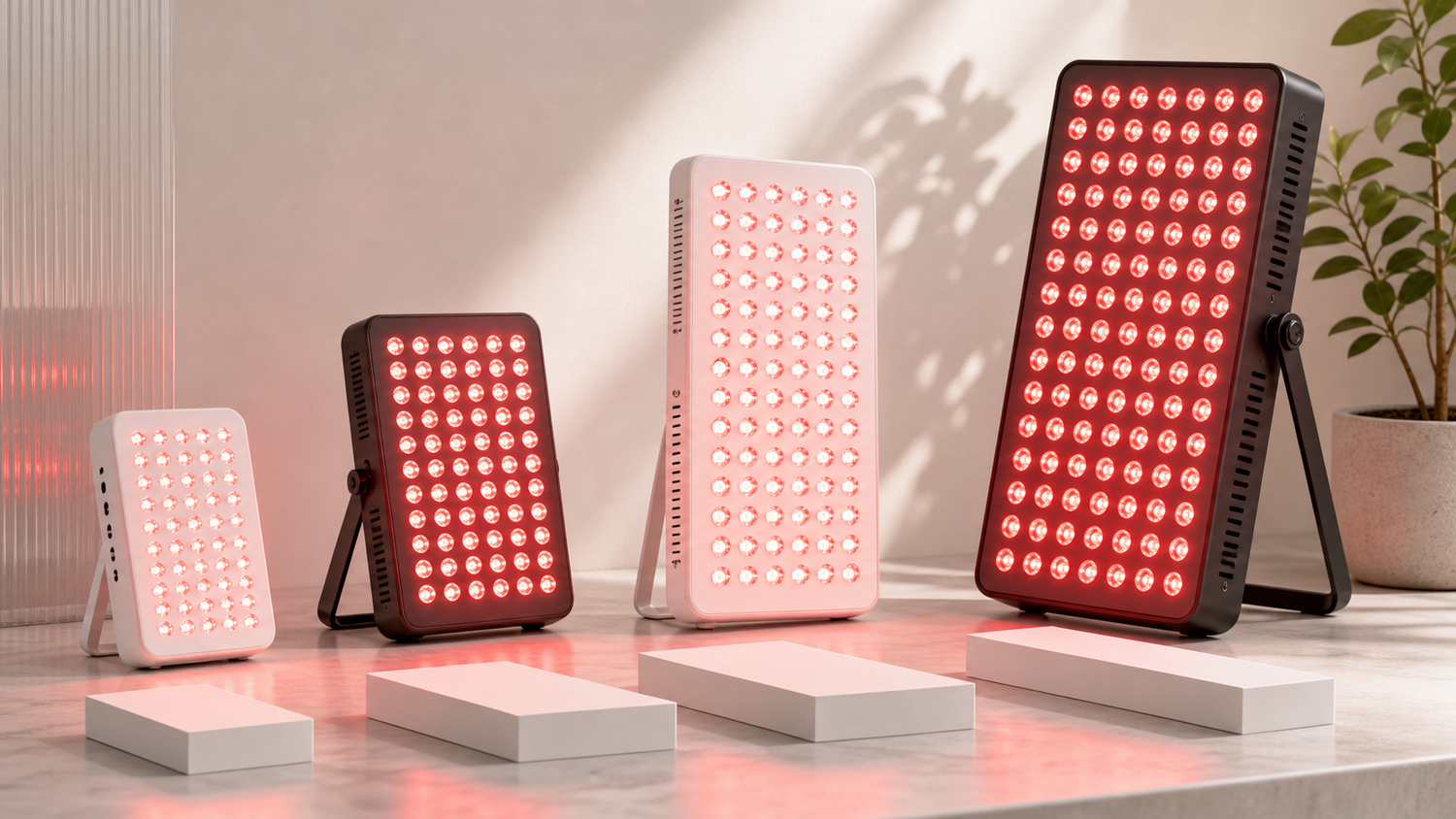
- For roughly 80 percent of home users, the article recommends a mid-size panel of 12–20 inches wide with 40–100 LEDs for the best balance of coverage, time, price, and storage.
- Panel size mainly affects how long each session takes, not whether you get results, since larger panels cover more area in a single position.
- Mini panels (6–10 inches) suit face or single-spot use, while large and XL panels suit athletes, couples, or whole-body coverage.
- Panel size does not determine irradiance – LED density, LED quality, and driver design do, so bigger is not automatically stronger.
- The mid-size SOLRA Red Light Panel covers face plus upper body in 10–15 minute sessions, from $159.
You've decided to buy a red light therapy panel. Now comes the second-hardest question after "which brand": what size? The market ranges from 6-inch mini panels to 6-foot whole-body towers, with prices spanning $80 to $5,000+. Most buyers either over-buy (paying $1,200 for whole-body coverage they'll use once) or under-buy (a tiny panel that takes 45 minutes to cover a face).
Panel size is more important than wavelength specs once you've crossed the dual-wavelength threshold. The wrong size makes daily use impractical; the right size becomes invisible in your routine.
This guide walks through every panel size category, who each one is for, and how to match panel size to your actual life — not the marketing.
What size red light therapy panel should you buy?
For most home users, a mid-size panel of 12 to 20 inches in width with 40-100 LEDs delivers the best balance of session area, session time, price, and storage practicality. Smaller panels work for face-only or targeted use; larger panels make sense for couples, athletes, or whole-body recovery goals.
Quick decision framework:
| Size Category | Width | LED Count | Best For | Typical Price |
|---|---|---|---|---|
| Mini / Travel | 6-10 inches | 10-30 | Face, single-spot sessions | $80-180 |
| Mid-size (recommended) | 12-20 inches | 40-100 | Face + upper body / couples | $150-450 |
| Large | 24-36 inches | 120-250 | Full upper body, athletes | $500-1,200 |
| XL / Whole-body | 36-72 inches tall | 250-1,000+ | Standing whole-body, multiple users | $1,200-3,500 |
| Modular / Multi-panel | Custom | 500-2,000+ | Dedicated wellness rooms, clinics | $3,000-10,000+ |
Mini red light therapy panels (under 12 inches)
Mini panels are 6-10 inches wide with 10-30 LEDs, designed for face, single body areas, or travel use. They cost $80-180 and work well as starter devices or supplementary sessions for specific zones.
Pros
- Lowest price point of any quality panel
- Compact and easy to store / travel with
- Quick face sessions (5-10 min)
- Good for testing the concept before committing to larger investment
- Easy to position close to specific areas (knee, shoulder, single facial zone)
Cons
- Session zone limited to about 8-10 inch diameter
- Body sessions require frequent repositioning (face, then reposition for chest, then reposition for shoulders)
- Total session time for whole-face or whole-body grows long (30-60 min)
- Lower total power means less coverage for muscle recovery or large-area sessions
- Some mini panels skip 850nm wavelength to keep cost down
Best for
- Skin-focused users who only want face sessions
- Travel use as a supplement to a larger home panel
- Tight budget buyers ($100-150 range)
- Spot sessions for specific areas (single knee, targeted spots)
Skip if
- You want muscle recovery or athletic use
- You have hair-related goals (need wider scalp coverage)
- You're targeting whole-body wellness
- You want sessions under 15 minutes total
Mid-size red light therapy panels (12-20 inches wide)
Mid-size panels of 12-20 inches with 40-100 LEDs are the sweet spot for most home users — covering face plus upper body in 10-15 minute sessions, at prices ranging from $150 to $450.
This is the category most home users should look at first. SOLRA's Red Light Panel sits in this category at $159 (panel only) to $229 (with floor stand).
Pros
- Session zone of 16-24 inch diameter at typical distance
- Covers face plus chest, or face plus shoulders, in single position
- Short enough sessions for daily routine (10-15 min)
- Practical to mount on wall, hang on door, or use with stand
- Right size for couples to share without scheduling conflicts
- Best value per square inch of session area
Cons
- Whole-body session still requires repositioning (front, then back, then targeted limbs)
- Total session time for back + front + arms can hit 30+ minutes
- Not large enough for full-length standing exposure
Best for
- Most home users (~80% of buyers fit here)
- Couples or households where 2-3 people use it
- People with both skin and recovery goals
- Limited space — fits on a desk or hangs in any door
Skip if
- You want to lie down and have entire front of body covered in single position
- You have multiple high-intensity training sessions per day
- You have space + budget for a larger panel and prefer one-shot full coverage
Large red light therapy panels (24-36 inches)
Large panels (24-36 inches wide, 120-250 LEDs) cover full upper body or partial whole-body in a single position, priced $500-1,200. Best for athletes, serious wellness users, or households where multiple people will use it daily.
Pros
- Session zone covers torso + arms in single position
- Higher total power for faster sessions
- Better for muscle recovery and athletic use
- Multiple users can position side-by-side
- Justifies dedicated wall mount or stand setup
Cons
- Requires more space — not casually moved around
- Higher purchase cost ($500-1,200)
- Slightly higher electricity use per session
- Often requires sturdier mounting hardware
- Diminishing returns vs mid-size unless you really use full coverage
Best for
- Serious athletes with daily recovery goals
- Multiple-user households (3+ daily users)
- People with dedicated wellness rooms or gym areas
- Users with broader recovery or large-area session needs
Skip if
- You're a single user with face/skin focus
- You don't have wall space or floor area for full setup
- Your budget is under $500 — mid-size delivers most of the same benefit
XL / whole-body red light therapy panels (36+ inches tall)
XL panels of 36 to 72+ inches in height deliver full standing-position whole-body coverage with 250-1,000+ LEDs, priced $1,200-3,500. Justifiable for dedicated home wellness setups but overkill for most individual users.
Pros
- Whole-body sessions in one position
- Standing exposure covers chest, abdomen, legs simultaneously
- Single 15-20 min session covers what would take 60 min on mid-size panels
- Premium feel and clinic-grade specifications
- Suitable for households with multiple high-intensity users
Cons
- Significant space requirement (3x3 ft floor footprint minimum)
- Higher price ($1,200-3,500)
- More expensive to ship and harder to return
- Often requires assembly
- Higher electricity use
- Limited justification for solo users with mid-size already adequate
Best for
- Dedicated home wellness rooms
- Households where 4+ people use it daily
- Replacement for clinic memberships (heavy clinic users moving to home)
- Wellness-focused content creators or coaches who demo for others
Skip if
- You're a solo user without serious athletic or recovery needs
- You haven't established daily consistency with a smaller panel first
- Your budget is under $1,000
- Space is limited (small apartment, shared rooms)
How does panel size affect session time?
Panel size primarily affects how long each session takes, not whether you get results. A larger panel covers more area at once, so single-position sessions are shorter; a smaller panel needs more repositioning time but delivers the same per-spot dose.
Typical session time by panel size and goal:
| Panel Size | Face Only | Face + Upper Body | Whole Body Front + Back |
|---|---|---|---|
| Mini (8 inches) | 10-15 min | 25-40 min (reposition) | 60-90 min |
| Mid-size (16 inches) | 10-15 min | 15-20 min | 30-45 min (reposition) |
| Large (30 inches) | 10-15 min | 10-15 min | 20-30 min |
| XL whole-body (60+ inches) | 10-15 min | 10-15 min | 15-20 min (both sides at once or quick flip) |
The practical reality: session length is the #1 predictor of whether you'll stick with red light therapy long-term. A 15-minute daily session lasts; a 45-minute daily session quietly disappears from your routine within 3 weeks. Buy a panel that fits a session length you'll actually maintain.
How does panel size affect price per square inch of coverage?
Mid-size panels typically offer the best value per square inch of coverage, with mini panels overpaying for their tiny session zones and XL panels charging a premium for whole-body convenience that most home users don't actually need daily.
Approximate value per square inch (session zone area / price):
- Mini panel: ~$2-3 per square inch of session zone
- Mid-size panel: ~$0.50-1.50 per square inch
- Large panel: ~$1-2 per square inch
- XL whole-body: ~$2-4 per square inch (premium for convenience)
The mid-size category wins on raw efficiency because you're getting LED density at scale without paying for the structural overhead of full-body towers.
For full cost breakdown across categories, see our how much does red light therapy cost guide.
Does panel size affect irradiance?
Panel size doesn't determine irradiance — LED density, LED quality, and driver design do. A small panel with quality components can deliver the same per-spot intensity as a large panel; the difference is just coverage area.
What this means when comparing panels:
- Don't assume bigger = stronger
- Check the manufacturer's irradiance spec at recommended distance (mW/cm2 at 6 inches)
- A 12-inch panel rated at 100 mW/cm2 beats a 24-inch panel rated at 40 mW/cm2 for per-spot intensity
- Larger panels usually have higher total power but similar per-square-inch intensity
What size do you need for specific use cases?
Face / anti-aging / skincare focus
Recommendation: Mini to mid-size (8-16 inches). A mini works fine if face is your only goal. Mid-size adds enough coverage to include neck, decolletage, and hands at the same session.
Skin clarity (face + back / chest)
Recommendation: Mid-size (12-20 inches). Body skin requires more coverage than face-only. Mid-size handles face one day, back next day without endless repositioning.
Scalp / hair wellness
Recommendation: Mid-size (12-20 inches). Scalp needs broader coverage than face. Mid-size lets you tilt head down and treat full top + sides in single position.
Muscle recovery (athletes)
Recommendation: Mid-size to large (16-30 inches). Targeted muscle groups work with mid-size; whole-body athletes benefit from large or XL.
Joint comfort (specific area)
Recommendation: Mini to mid-size (8-16 inches). Focused on one area at a time. Mini works; mid-size also works and is more versatile if other goals emerge.
General wellness / sleep / mood
Recommendation: Mid-size (12-20 inches). Broad exposure to multiple body areas across sessions. Don't need whole-body intensity.
Whole-body recovery (multiple users)
Recommendation: Large to XL (24-72 inches). Justify the size and price with usage volume.
Common panel size mistakes to avoid
Buying too big "to grow into"
Most buyers convince themselves they'll graduate to whole-body sessions and buy an XL panel that gets used at 15% capacity. Start with mid-size; upgrade only if you genuinely outgrow it.
Buying too small "to save money"
A $90 mini panel that turns 15-minute sessions into 45-minute sessions gets abandoned. The "savings" become a hidden cost when daily use stops. Mid-size at $150-200 is rarely a regret.
Ignoring storage space
If a panel doesn't have an easy home (wall, door, stand in corner), it ends up in a closet within weeks. Match panel size to where it will actually live.
Confusing panel size with quality
A premium 24-inch panel can be worse than a budget 36-inch panel if the smaller one has better LEDs, better drivers, and proper dual wavelengths. Size is one factor of many.
Buying without checking session math
Estimate your total weekly session time before buying. If a small panel turns 7 sessions per week into 5 hours per week of session time, the math doesn't work for most schedules.
Frequently asked questions
Is a bigger panel always better?
No. Bigger covers more area faster but adds price, space, and electricity costs. Most home users do better with mid-size than oversized.
Can I combine two mid-size panels instead of one large?
Yes — some users buy two mid-size panels for parallel use (one on face, one on legs at the same time). Total cost can be similar to one large panel with more flexibility.
Does the SOLRA panel size work for whole-body sessions?
Yes, with repositioning. The SOLRA Red Light Panel is mid-size, optimized for face + upper body in single position. Full whole-body requires moving the panel between sessions or treating in 2-3 zones.
What's the smallest panel that still works for muscle recovery?
For targeted muscle recovery (single muscle group), 12 inches is fine. For broader recovery (multiple muscle groups, post-workout), 16+ inches is more practical.
Should I wait and save for a larger panel?
Generally no. Starting with mid-size now beats waiting 6 months to afford XL. The compounding benefit of consistent daily use over 6 months on a mid-size panel exceeds 3 months on a larger panel later.
What if I outgrow my mid-size panel?
Most users don't. The ones who do can either sell the panel and upgrade, or add a second panel for parallel coverage. Mid-size panels hold resale value well in the wellness equipment market.
The bottom line
Panel size is the most overlooked spec when buying red light therapy. Pick too small and sessions become tedious and get abandoned; pick too large and you pay for capacity you don't use. For roughly 80% of home buyers, a mid-size panel in the 12-20 inch range delivers the right balance of coverage, session time, price, and practicality.
The SOLRA Red Light Panel hits the mid-size sweet spot — 40 dual-chip LEDs covering face plus upper body in 10-15 minute sessions, with prices starting at $159. Backed by free US shipping and a 60-day money-back guarantee, you can dial in whether mid-size works for your routine before committing long-term.
Shop the SOLRA Red Light Panel — From $159 with Free US Shipping →
Frequently asked questions
What size red light therapy panel should most home users buy?
For most home users, a mid-size panel of 12 to 20 inches wide with 40 to 100 LEDs delivers the best balance of session area, session time, price, and storage practicality, fitting roughly 80 percent of buyers.
How does panel size affect session time?
Panel size primarily affects how long each session takes, not whether you get results; a larger panel covers more area at once for shorter single-position sessions, while a smaller panel needs more repositioning time but delivers the same per-spot dose.
Does a bigger panel mean stronger or higher irradiance?
No. Irradiance is determined by LED density, LED quality, and driver design rather than size, so a small panel with quality components can deliver the same per-spot intensity as a large one, with the difference being coverage area.
Does the SOLRA panel work for whole-body sessions?
Yes, with repositioning; the SOLRA Red Light Panel is mid-size and optimized for face plus upper body in a single position, so full whole-body coverage requires moving the panel or treating in 2 to 3 zones.
Wellness Disclaimer: The information in this article is for general wellness and educational purposes only and is not intended to diagnose, treat, cure, or prevent any disease. SOLRA products are general wellness devices and have not been evaluated by the FDA. Individual results may vary. Consult a qualified healthcare professional before starting any new wellness practice, especially if you have a medical condition or are taking medications.
If you are comparing an at-home option, explore the SOLRA red light panel: a 40-LED system with 660nm red and 850nm near-infrared light, an included floor stand, and a 2-year warranty.
About this guide. Written and maintained by the SOLRA Team, who design and support the SOLRA Red Light Panel (660nm red + 850nm near-infrared light). Our guides focus on practical, comfort-first routines and use general wellness language rather than medical claims. Always follow your device instructions and consult a qualified professional about any medical condition. Editorial review: SOLRA Team · Updated June 2026.

Leave a comment
This site is protected by hCaptcha and the hCaptcha Privacy Policy and Terms of Service apply.