
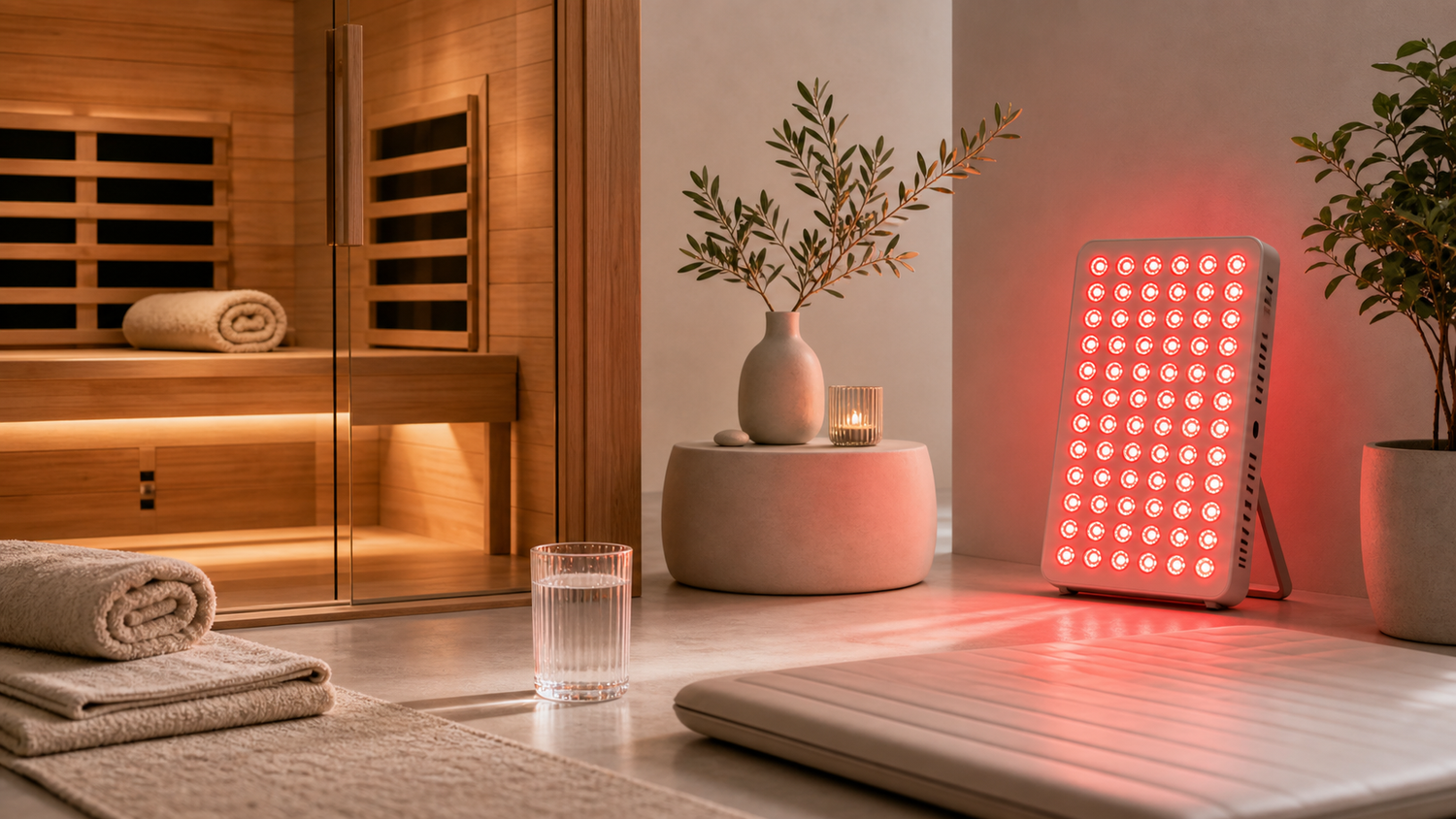
Last Updated: May 13, 2026
Key takeaways
- The article frames red light therapy as a non-thermal cellular approach and infrared sauna as a thermal systemic one, so the right choice depends on your goal.
- Red light uses narrow red (around 630–680 nm) and near-infrared (around 810–880 nm) wavelengths, while infrared saunas use broad far-infrared (around 3,000–100,000 nm) absorbed by water as heat.
- Red light therapy is described as having more direct evidence for skin outcomes and targeted muscle soreness; sauna is associated with more cardiovascular research.
- For home use, panels are presented as more practical – smaller, lower cost, plug into a standard outlet, and minimal electricity versus sauna cabins.
- The two are mechanistically distinct and can be combined, though the article notes no significant research has examined additive benefits.
Red light therapy and infrared sauna get mentioned in the same breath constantly. Both use invisible-to-mostly-invisible light. Both promise recovery, anti-aging, and general wellness benefits. Both have devoted followings. And in casual conversation, people often treat them as essentially the same thing.
They are not the same thing. The wavelengths are different, the mechanisms are different, the research bases are different, and the use cases overlap less than the marketing implies. Understanding what actually distinguishes them makes it much easier to decide which one - or whether either - fits a specific goal.
This article breaks down the real differences, what the research supports for each, and how to think through the choice.
What is red light therapy?
Red light therapy uses specific narrow wavelengths of visible red light (typically around 630-680 nm) and near-infrared light (typically around 810-880 nm) to target cellular processes in skin and underlying tissue, without producing significant heat.
The mechanism, technically called photobiomodulation, centers on absorption of these wavelengths by cytochrome c oxidase in mitochondria. This absorption appears to increase ATP production, modulate reactive oxygen species, and influence inflammatory signaling at the cellular level. The energy delivered is non-thermal at therapeutic doses - users feel mild warmth at most.
Sessions typically last 10 to 20 minutes per body area, with the device positioned 6 to 12 inches from bare skin. The treatment is targeted: a panel placed in front of the knee treats the knee, not the whole body simultaneously.
What is an infrared sauna?
An infrared sauna uses far-infrared (typically 3,000-100,000 nm) or a mix of near, mid, and far-infrared wavelengths to heat the body directly through radiant heat, raising core body temperature and inducing sweating at lower ambient air temperatures than traditional saunas.
The mechanism is fundamentally thermal. Traditional Finnish saunas heat the air to 80-100 degrees Celsius and warm the body indirectly. Infrared saunas operate at lower air temperatures (typically 45-65 degrees Celsius) but deliver heat directly to the body through infrared radiation, producing similar physiological effects (elevated heart rate, sweating, cardiovascular stress response) at a more tolerable ambient temperature for many users.
Sessions typically last 20 to 45 minutes, treating the entire body simultaneously inside an enclosed cabin.
How are the wavelengths actually different?
The wavelength difference is not subtle - red light therapy operates in narrow bands optimized for cellular absorption, while infrared saunas use broad far-infrared wavelengths that are absorbed by water in tissue and produce heat.
A simple way to picture it:
- Red light (around 660 nm): visible to the eye, absorbed primarily by mitochondrial chromophores, penetrates a few millimeters into tissue
- Near-infrared (around 850 nm): invisible, also absorbed by mitochondrial chromophores, penetrates deeper - several centimeters
- Far-infrared (around 3,000-100,000 nm, or 3-100 micrometers): invisible, absorbed primarily by water molecules in tissue, converted to heat, very limited tissue penetration but extensive heating effect
This is why an infrared sauna makes you sweat profusely and a red light therapy panel does not. The energy goes to different places and does different things at the cellular level.
Some infrared saunas advertise near-infrared capabilities alongside far-infrared, and some include actual red light LEDs. These hybrid units exist, but the dosing for red light effects is typically far below what dedicated red light panels deliver, and the primary purpose remains the heat-driven sauna experience.
What does research support for each?
Red light therapy research base
Photobiomodulation has been studied in laboratory and clinical research across a range of biological questions. Research context can be useful when comparing devices, but it should not be translated into a promise that a consumer wellness panel will treat a particular condition or produce a particular health outcome.
- Check whether a brand clearly states the wavelengths, controls, setup, and measurement conditions for its device.
- Keep research discussions separate from a personal medical decision or treatment plan.
- Use a home wellness device according to its current instructions and stop if a routine is uncomfortable.
When comparing a red light panel with an infrared sauna, focus on the type of experience, space requirements, heat, controls, and current product documentation. Consult a qualified healthcare professional for questions about an individual health condition.
Infrared sauna research base
Sauna bathing in general (both traditional and infrared) has been studied for cardiovascular effects, recovery, and broader wellness outcomes. The most rigorous data comes from large prospective cohort studies of Finnish traditional sauna users, which have associated regular sauna bathing with reduced cardiovascular event rates and all-cause mortality.
Infrared sauna research specifically is smaller in scale but has documented:
- Cardiovascular responses similar to moderate aerobic exercise (elevated heart rate, vasodilation)
- Short-term improvements in blood pressure in some studies
- Reductions in chronic pain and fatigue symptoms in some clinical populations
- Recovery effects after exercise
The honest summary: traditional sauna has stronger long-term outcome data, while infrared sauna has plausible short-term physiological data and is sometimes preferred for tolerability.
Which is better for muscle recovery?
Red light therapy has stronger direct evidence for reducing exercise-induced muscle soreness and biomarkers of muscle damage, while infrared sauna supports recovery through general heat-stress adaptation and improved circulation.
The mechanisms differ:
- Red light therapy appears to act at the cellular level on mitochondrial function and inflammatory signaling in the targeted muscle
- Infrared sauna acts systemically through heat-induced cardiovascular and hormonal responses
For targeted recovery (a specific muscle group after a hard workout), red light therapy has the more direct research support. For systemic recovery and general post-training relaxation, sauna - infrared or traditional - has the longer history of use and broader physiological rationale.
These approaches are not mutually exclusive. Some athletes use both, applied to different recovery contexts.
Which is better for skin?
Red light therapy has substantially more direct evidence for skin-specific outcomes including collagen production, fine line reduction, and acne, while infrared sauna primarily benefits skin indirectly through circulation and sweating.
Skin is where the two approaches diverge most clearly. Red light wavelengths are absorbed in skin layers and have been studied in dermatologic trials for decades. Infrared sauna heats the skin but does not deliver wavelengths in the photobiomodulation window at meaningful doses for skin cellular effects.
The sweating involved in sauna use does have some skin benefits - sebum clearance, temporary glow from increased circulation - but these are different in kind from the cellular effects red light therapy targets.
Which is better for cardiovascular health?
Infrared sauna has more direct cardiovascular research, particularly when extended to traditional sauna data, while red light therapy is not primarily studied for cardiovascular outcomes.
This is one area where the two approaches are not really competing - they target different outcomes. Sauna use produces a transient cardiovascular workout-like response (elevated heart rate, vasodilation, blood pressure changes during and after the session). Repeated exposure over years has been associated in observational studies with lower cardiovascular event rates.
Red light therapy, by contrast, is not generally framed as a cardiovascular intervention and lacks comparable outcome data in this domain. Some emerging research explores systemic effects of full-body red light exposure, but this is preliminary.
Which is more practical for home use?
Red light therapy is significantly more practical for typical home setups - panels are smaller, lower cost, require no installation, and use minimal electricity compared to infrared sauna cabins.
Comparison of home-use factors:
- Space: A red light panel mounts on a stand or wall and takes the footprint of a small bookshelf. An infrared sauna cabin requires a dedicated 3-by-3 to 5-by-7 foot footprint with ceiling clearance
- Cost: Quality home red light panels range from a few hundred to a couple thousand dollars. Home infrared saunas range from roughly $1,500 for portable units to $5,000-15,000 for cabin units
- Installation: Red light panels plug into a standard outlet. Most cabin saunas require a dedicated 20-amp circuit or a 240-volt line
- Session friction: A 15-minute red light session can be done while reading or doing other tasks. A 30-45 minute sauna session requires preparation, hydration management, and post-session cooldown
- Maintenance: Red light panels are largely maintenance-free. Sauna cabins need periodic cleaning of the interior wood and ventilation
Can both be used together?
Yes - red light therapy and infrared sauna are mechanistically distinct and can be combined without conflict, though no significant research has examined whether combined use produces additive benefits.
If both are accessible, a practical sequence many users adopt:
- Red light therapy first on bare skin, targeting specific areas (10-20 minutes)
- Sauna session afterward for systemic effects (20-40 minutes)
- Adequate hydration throughout
The reverse order works too. There is no biological reason the sequence matters significantly, and individual preference can guide the choice.
The bottom line
Red light therapy and infrared sauna are often grouped together because they both involve light-spectrum wavelengths and both fall under the "wellness device" umbrella. But mechanistically they are different categories - one is a non-thermal cellular intervention, the other is a thermal systemic intervention.
The right choice depends on the specific goal. The research bases are different. The use cases are different. The practical demands are different. Once that distinction is clear, the decision becomes much easier - and the disappointment of expecting one to do the other's job is avoided.
Quick comparison
| Red light therapy | Infrared sauna | |
|---|---|---|
| Mechanism | Non-thermal, cellular | Thermal, systemic (heat) |
| Wavelengths | Red ~630–680nm + NIR ~810–880nm | Far-infrared ~3,000–100,000nm |
| Often associated with | Skin & targeted muscle soreness | Cardiovascular research |
| Home practicality | Compact, standard outlet, low cost | Large cabin, higher cost |
Frequently asked questions
What is the core difference between red light therapy and an infrared sauna?
Red light therapy uses narrow wavelengths of visible red light around 630 to 680 nm and near-infrared around 810 to 880 nm to target cellular processes without producing significant heat, while an infrared sauna uses far-infrared wavelengths around 3,000 to 100,000 nm to heat the body and induce sweating. One is a non-thermal cellular intervention and the other is a thermal systemic intervention.
Which is better for muscle recovery?
Red light therapy has stronger direct evidence for reducing exercise-induced muscle soreness and biomarkers of muscle damage, while infrared sauna supports recovery through general heat-stress adaptation and improved circulation. For targeted recovery of a specific muscle group, red light therapy has the more direct research support; for systemic recovery, sauna has a longer history of use.
Which is better for skin?
Red light therapy has substantially more direct evidence for skin-specific outcomes including collagen production, fine line reduction, and acne, while infrared sauna primarily benefits skin indirectly through circulation and sweating. Infrared sauna does not deliver wavelengths in the photobiomodulation window at meaningful doses for skin cellular effects.
Which is more practical for home use?
Red light therapy is significantly more practical for typical home setups because panels are smaller, lower cost, require no installation, and use minimal electricity. A panel takes the footprint of a small bookshelf and plugs into a standard outlet, while an infrared sauna cabin needs a dedicated footprint and often a 20-amp or 240-volt circuit.
Wellness Disclaimer: The information in this article is for general wellness and educational purposes only and is not intended to diagnose, treat, cure, or prevent any disease. SOLRA products are general wellness devices and have not been evaluated by the FDA. Individual results may vary. Consult a qualified healthcare professional before starting any new wellness practice, especially if you have a medical condition or are taking medications.
About this guide. Written and maintained by the SOLRA Team, who design and support the SOLRA Red Light Panel (660nm red + 850nm near-infrared light). Our guides focus on practical, comfort-first routines and use general wellness language rather than medical claims. Always follow your device instructions and consult a qualified professional about any medical condition. Editorial review: SOLRA Team · Updated June 2026.


Leave a comment
This site is protected by hCaptcha and the hCaptcha Privacy Policy and Terms of Service apply.