
Last Updated: May 11, 2026
Key takeaways
- The article states the optimal distance for most panels is 6–12 inches from the skin, with 9 inches as a safe starting default.
- Intensity follows the inverse square law, so doubling the distance drops intensity to roughly one-quarter and small distance changes produce large intensity changes.
- Sitting too close mainly causes mild LED warmth rather than light damage, while sitting too far under-doses and requires much longer sessions to compensate.
- Both 660nm red and 850nm near-infrared follow the same law, with 850nm penetrating deeper into tissue; SOLRA recommends 6–12 inches.
- Locking in a consistent, marked distance is discussed as more reliable than constant optimization or mid-session adjustments.
You just unboxed your red light therapy panel. You set it up on a stand or hung it on a wall. Then comes the question every new user asks within the first 60 seconds: how close should I actually be?
Is 3 inches better than 12? Will I burn? Will sitting farther reduce results? The packaging says "6-12 inches" but doesn't explain why — and that's where most people start guessing.
Here's exactly how distance affects red light therapy, the optimal range for each goal, and how to dial in the right distance for your panel and session length.
How close should you be to a red light therapy panel?
The optimal distance for most red light therapy panels is 6 to 12 inches from the skin — close enough to receive therapeutic irradiance, far enough to avoid excessive intensity that wastes energy or causes mild skin warmth.
Quick reference by goal:
| Goal | Distance Range | Session Length |
|---|---|---|
| Facial skin (anti-aging, skin clarity) | 6-12 inches | 10-15 minutes |
| Deep tissue / muscle recovery | 6-12 inches | 15-20 minutes |
| Sensitive skin | 12-18 inches | 5-10 minutes (build up) |
| Joint / back / large area | 6-10 inches | 15-20 minutes |
| Scalp / hair wellness | 6-12 inches | 5-10 minutes |
| Full-body session | 12-24 inches (covers wider area) | 15-20 minutes |
Below 6 inches you'll feel uncomfortable warmth and waste intensity beyond what the cellular response can use. Beyond 18 inches the intensity drops sharply — you can still get benefit but sessions need to be longer to compensate.
How does distance affect red light therapy intensity?
Light intensity follows the inverse square law — doubling the distance from the source reduces intensity to roughly one-quarter, not one-half. Small distance changes produce large intensity changes.
What this means in practice:
| Distance from Panel | Relative Intensity | Practical Effect |
|---|---|---|
| 3 inches | ~400% (4x baseline) | Too intense — skin warmth, wasted energy |
| 6 inches | 100% (baseline reference) | Optimal for most goals |
| 12 inches | ~25% of 6-inch intensity | Effective but session needs to be longer |
| 24 inches | ~6% of 6-inch intensity | Coverage focused, much longer sessions needed |
| 36 inches | ~3% of 6-inch intensity | Mostly ambient, minimal effect |
Note these are approximations — LED panels don't behave like point sources at very close distances, and most panels deliver more uniform light at 6+ inches than they do at 3 inches.
The takeaway: there's no single "right" distance independent of session length. A 6-inch session for 5 minutes delivers similar total energy to a 12-inch session for 20 minutes. Both work — the choice depends on your schedule and skin tolerance.
What happens if you sit too close to a red light panel?
Sitting closer than 4-6 inches doesn't damage skin from the light itself, but the increased LED heat can cause uncomfortable warmth, mild skin dryness, and "wasted" intensity beyond what cells can absorb in a session.
What actually happens at very close range:
- Skin warmth or mild redness: Not from the light wavelength (red and NIR are non-thermal at therapeutic doses), but from radiated heat off the LEDs themselves. Resolves quickly.
- Biphasic response saturation: Cells reach maximum activation quickly at high intensities. Past that, extra light does nothing — or in rare cases, paradoxically reduces benefit.
- Uneven coverage: Very close = small session area. You're only treating a 6-inch patch instead of the panel's actual coverage zone.
- Eye strain: Bright LEDs at 2-3 inches without proper goggles can stress your retina.
What does NOT happen:
- UV burns (no UV in red light therapy)
- Skin damage (non-ionizing wavelengths)
- Permanent damage at any normal distance
The "more is better" instinct is wrong with red light therapy. Closer + longer doesn't compound results — it just wastes time and electricity.
What happens if you sit too far from a red light panel?
Sitting farther than 18-24 inches doesn't cause harm, but it dramatically reduces intensity — meaning you'd need 4-10x longer sessions to deliver the same total cellular dose.
Practical issues with sitting too far:
- Under-dosing: Cells receive less energy per minute, so the cumulative effect over a typical 15-minute session is lower
- Longer session time: To compensate, you'd sit there for 45-60 minutes, which most people won't sustain
- Plateau without progress: 8 weeks of "did sessions but at 24 inches for 15 min" often produces minimal results — users assume the product doesn't work
- Coverage paradox: Farther covers more area, but the energy delivered to each spot is so low it may not cross the therapeutic threshold
When sitting farther DOES make sense:
- Full-body warming or whole-body coverage where you want broader exposure over multiple zones
- Very sensitive skin building up gradual tolerance
- Combining red light with other activities (sitting at desk, reading) where extending session length isn't a problem
How do you know the right distance for your specific panel?
The manufacturer's recommended distance is calibrated to where their panel delivers optimal irradiance — usually printed in the manual or on the product page. SOLRA recommends 6-12 inches for the Red Light Panel.
How manufacturers determine the recommendation:
- Measure peak irradiance (mW/cm2) at multiple distances using a light meter
- Find the distance where intensity matches established therapeutic ranges (typically 40-150 mW/cm2 for home panels)
- Cross-reference with published research protocols (most use 6-12 inches)
- Recommend the practical range that balances intensity, session area, and user comfort
For SOLRA's panel:
- 6 inches: Higher intensity, smaller session area, shorter sessions (5-10 min for face)
- 9 inches: Balanced — the "sweet spot" for face and upper body
- 12 inches: Wider coverage, longer sessions (15-20 min for body)
If you're not sure where to start: pick 9 inches and 12 minutes. Adjust from there based on how your skin responds and what you're focusing on. For full session protocol, see our how often to use red light therapy guide.
Does distance affect different wavelengths differently?
Both 660nm red light and 850nm near-infrared follow the same inverse square law, but 850nm penetrates deeper into tissue, so distance affects what tissue layer gets the most exposure rather than whether it gets exposed.
The interplay:
- At 6 inches: High intensity of both wavelengths. 660nm saturates skin layers; 850nm reaches deep tissue effectively.
- At 12 inches: Lower intensity, but 850nm still penetrates deeply because depth is governed by wavelength, not distance. Skin still gets the 660nm dose, just over a longer session.
- At 24 inches: Very low intensity. Even 850nm's deep penetration becomes less meaningful because total energy delivered is too low.
The wavelengths don't change behavior with distance — just the total energy delivered changes. If you're using a dual-wavelength panel, distance affects both wavelengths proportionally.
How does distance affect session area?
Closer = smaller session area but higher intensity per square inch. Farther = wider coverage but lower intensity per square inch. The trade-off shapes your session strategy.
Practical impact on session planning:
Close (6 inches) sessions
- Session zone: ~10-12 inch diameter from a standard panel
- Suited for: Face, single body areas, targeted area sessions
- Session length: 5-15 minutes
- Coverage strategy: Reposition between zones (face, then chest, then arms)
Medium (9-12 inches) sessions
- Session zone: ~16-20 inch diameter
- Suited for: Face + upper chest, single shoulder + arm
- Session length: 10-15 minutes
- Coverage strategy: 2-3 zones per session
Far (12-24 inches) sessions
- Session zone: ~24-36+ inch diameter
- Suited for: Whole upper body, back coverage
- Session length: 15-25 minutes
- Coverage strategy: Single position, broader exposure
Many users do split sessions: 5 minutes close on face, then 15 minutes farther for body. This combines targeted skin care with broader recovery in one session.
Should distance change based on goal?
Yes — the optimal distance depends on whether you're targeting surface effects (skin) or deeper tissue (muscle, joint area, scalp).
Goal-specific recommendations:
Skin appearance, skin clarity, anti-aging
- Distance: 6-12 inches
- Why: 660nm acts on skin-level cells; you want focused intensity on the face
- Tip: Closer (6-8 inches) for spot sessions, farther (10-12 inches) for whole-face
Muscle recovery, joint comfort
- Distance: 6-12 inches
- Why: 850nm penetrates deeper; closer helps ensure enough energy reaches deep tissue
- Tip: Stay at 6-8 inches over the target area for 10-15 minutes
Scalp / hair wellness
- Distance: 6-12 inches
- Why: Hair follicles sit in upper millimeters; both wavelengths reach them well at this range
- Tip: Tilt head or reposition panel to ensure direct exposure to target areas
Sleep, mood, general wellness
- Distance: 12-24 inches
- Why: Broader, gentler exposure mirrors natural light environment
- Tip: Longer sessions (15-20 min) at moderate distance work well
Sensitive skin
- Distance: 12-18 inches starting out
- Why: Lower intensity = lower risk of triggering flushing or sensitivity
- Tip: Start with 5-7 min sessions, build up to 10-15 min over 2-3 weeks
How to measure distance accurately
Use a ruler or measuring tape from the panel surface to the closest point of your body (usually face or chest). For consistency, set up a marked position so you can reproduce the distance every session.
Practical tips:
- Mark your floor with tape for standing sessions — same position every time
- Use a stand at fixed height rather than holding the panel
- Measure to skin, not clothes — even thin fabric reduces light penetration
- For face sessions, set a chair distance — same chair, same spot each time
- For body sessions, lay down at consistent position if the panel hangs above
Inconsistent distance is one of the biggest reasons people see inconsistent results. A "rough estimate" of 9 inches that varies between 5 and 15 from day to day produces a 5-9x intensity range across sessions — results will swing wildly.
Should you adjust distance during a session?
Generally no — pick a distance, stay there for the duration, then adjust between sessions if needed. Mid-session adjustments make tracking results harder and don't add meaningful benefit.
Exceptions where mid-session adjustment makes sense:
- Combination sessions: 5 min close for face, then move to chair farther back for body
- Different body parts in same session: Face for 5 min, then turn around for back at same panel distance
- Tolerance building: First week, start farther; second week move closer as skin adjusts
What NOT to do:
- Lean in and out trying to "feel" the right distance
- Move every minute based on perceived warmth
- Change distance daily without tracking what works
Consistency beats optimization. A "good enough" distance used every day for 8 weeks produces better results than a "perfect" distance used inconsistently.
Frequently asked questions
What if my panel doesn't specify a distance?
Use 9 inches as a starting point, with 12-15 minute sessions. Adjust based on response over 1-2 weeks. If you can find the panel's irradiance spec online, look for the distance at which it delivers 40-100 mW/cm2.
Can I use red light therapy through a window or glass?
No — glass blocks most therapeutic wavelengths, particularly the 660nm and 850nm range used in red light therapy. Always use direct exposure without barriers.
Does clothing affect the effective distance?
Yes — thin fabric reduces light penetration by 30-70%. For best results, use on bare skin. If you must wear clothing, choose loose, light-colored cotton over dark synthetics.
Should I be closer for face vs body?
Slightly closer for face (6-9 inches) can target skin effects more precisely. For body, 9-12 inches covers more area while still delivering effective intensity to muscle and joint tissue.
What's the safe minimum distance?
4-6 inches for most quality panels. Below 4 inches you may feel uncomfortable LED heat. There's no light-damage threshold at any normal use distance, but comfort is the practical limit.
Can I lie directly on a red light panel?
Not recommended. Direct contact with the LED surface concentrates heat and pressure. Most panels have a safe minimum standoff distance noted in the manual — usually 2-4 inches for safe contact use.
Does my panel size change the optimal distance?
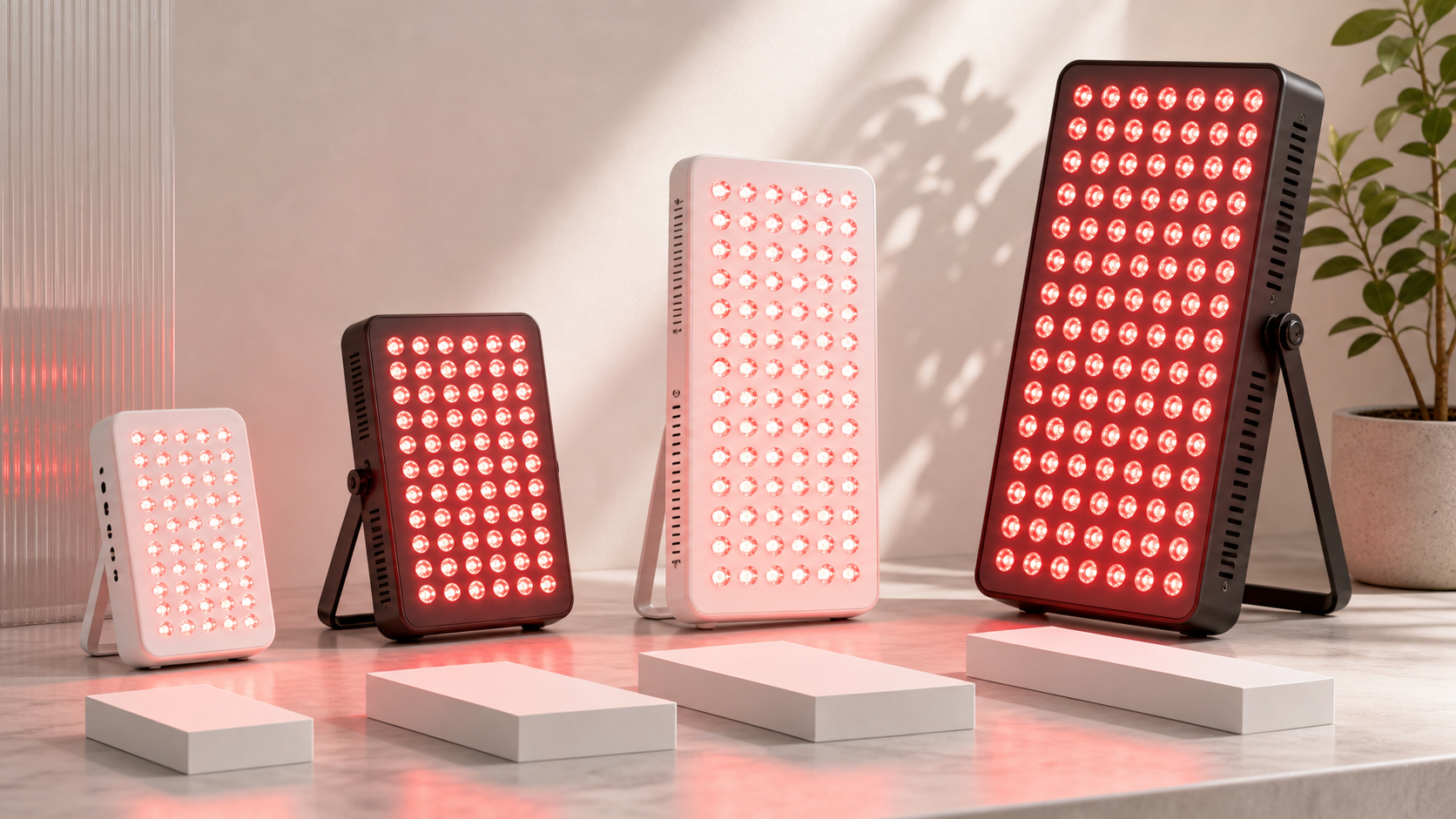
Yes slightly. Larger panels (24+ inches) can be used at 12-18 inches because they spread light over a wider area. Smaller panels (12 inches or under) work best at 6-9 inches because their effective session zone is smaller.
The bottom line
Distance is the single most important variable in your red light therapy session that you control. Too close wastes intensity and may cause warmth; too far under-doses and leads to flat results. The sweet spot for nearly all home use is 6-12 inches, with 9 inches as a safe starting default.
Lock in a consistent distance, mark your spot, and let consistency compound over weeks. That single habit produces more reliable results than any "optimization."
The SOLRA Red Light Panel includes a positioning guide and stand options that make consistent distance easy to maintain. Backed by a 60-day money-back guarantee so you can dial in your optimal setup risk-free.
Shop the SOLRA Red Light Panel — From $159 with Free US Shipping →
Frequently asked questions
How close should I sit to a red light therapy panel?
The optimal distance for most panels is 6 to 12 inches from the skin, with 9 inches as a safe starting default; SOLRA recommends 6 to 12 inches for its Red Light Panel.
How does distance affect intensity?
Light intensity follows the inverse square law, so doubling the distance reduces intensity to roughly one-quarter rather than one-half, meaning small distance changes produce large intensity changes.
What happens if I sit too close?
Closer than about 4 to 6 inches will not damage skin from the light itself, but radiated LED heat can cause uncomfortable warmth, mild skin dryness, and intensity wasted beyond what cells can absorb.
Can I use red light therapy through a window or glass?
No, glass blocks most therapeutic wavelengths, particularly the 660nm and 850nm range, so the article advises always using direct exposure without barriers.
Wellness Disclaimer: The information in this article is for general wellness and educational purposes only and is not intended to diagnose, treat, cure, or prevent any disease. SOLRA products are general wellness devices and have not been evaluated by the FDA. Individual results may vary. Consult a qualified healthcare professional before starting any new wellness practice, especially if you have a medical condition or are taking medications.
About this guide. Written and maintained by the SOLRA Team, who design and support the SOLRA Red Light Panel (660nm red + 850nm near-infrared light). Our guides focus on practical, comfort-first routines and use general wellness language rather than medical claims. Always follow your device instructions and consult a qualified professional about any medical condition. Editorial review: SOLRA Team · Updated June 2026.

Leave a comment
This site is protected by hCaptcha and the hCaptcha Privacy Policy and Terms of Service apply.