
Last Updated: May 20, 2026
Key takeaways
- Red light wellness uses narrow wavelengths of visible red (around 660 nm) and near-infrared (around 850 nm) light to interact with cells without producing significant heat.
- The mechanism, called photobiomodulation, centers on absorption by cytochrome c oxidase in mitochondria, which may support ATP production and modulate cellular signaling.
- 660 nm penetrates a few millimeters into skin while 850 nm reaches several centimeters into muscle and joint areas.
- A typical session framework is 10–20 minutes at 6–12 inches, 3–5 times per week, with eye protection every session.
- It is a general wellness practice, not a treatment for any condition; consult a healthcare professional for medical concerns.
If you've come across red light therapy in your research, you've likely seen a lot of competing descriptions — from cellular biology explanations to marketing language that promises specific outcomes. This guide is for anyone trying to get a clear, honest picture of what red light wellness actually is, what the research suggests, and where it fits into broader wellness routines.
What red light wellness is, in plain terms
Red light wellness uses specific narrow wavelengths of visible red light (typically around 660 nm) and near-infrared light (typically around 850 nm) to interact with cells at the cellular level, without producing significant heat.
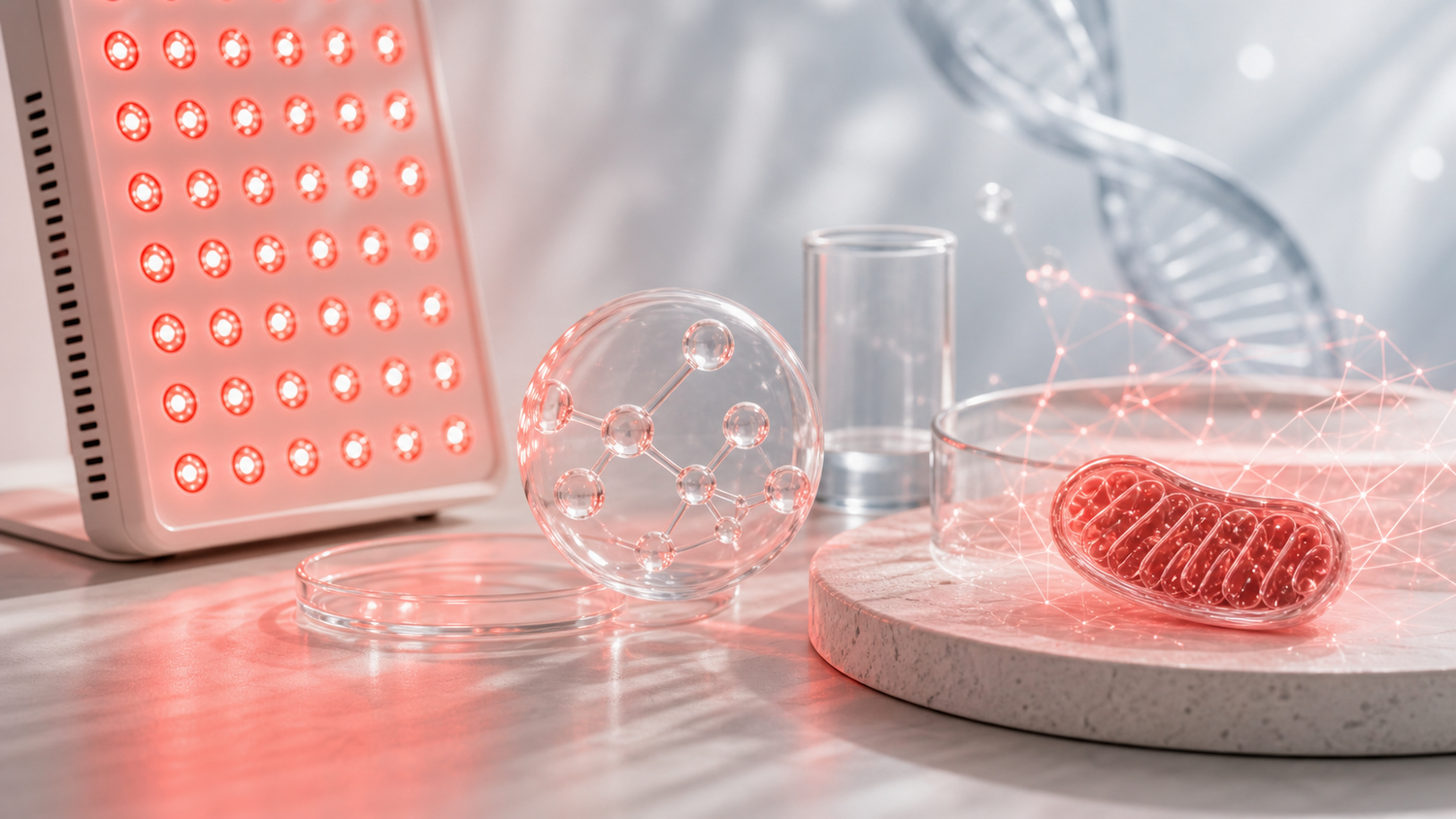
The technical name is photobiomodulation. The mechanism centers on absorption of these specific wavelengths by cytochrome c oxidase, an enzyme in mitochondria (the energy-producing structures of cells). This absorption may support ATP production, modulate cellular signaling, and influence inflammatory markers at the cellular level. The energy delivered is non-thermal at therapeutic doses — users feel mild warmth at most.
Why these specific wavelengths
Not every wavelength of light produces these cellular effects. Researchers have identified a "therapeutic window" — roughly 600 to 1000 nm — where light penetrates tissue meaningfully and is absorbed by cellular structures without producing heat damage.
- 660 nm (visible red): Penetrates a few millimeters into tissue, primarily skin and surface layers. The most studied wavelength for surface-skin applications.
- 850 nm (near-infrared): Penetrates several centimeters, reaching deeper into muscle, connective tissue, and joint areas.
Shorter wavelengths (blue, green) are absorbed by hemoglobin and melanin and don't penetrate far. Longer wavelengths (far infrared) are absorbed by water and converted to heat. The red and near-infrared window is where the cellular interaction happens.
How it works at the cellular level
When 660 nm or 850 nm light hits cells, it's absorbed by cytochrome c oxidase in mitochondria. Research suggests this absorption may:
- Support ATP (cellular energy) production
- Modulate cellular signaling pathways
- Influence inflammatory markers at the cellular level
- Affect microcirculation in tissue
These cellular effects are the basis for the various wellness applications people explore with red light panels.
Common areas of wellness interest
People incorporate red light wellness into broader routines for a range of general wellness goals. The research base varies in depth across application areas:
- Skin wellness routines — see our skin clarity guide
- Post-exercise recovery — see our muscle recovery guide
- Sleep and circadian routines — see our sleep guide
- General cellular wellness — see our photobiomodulation science guide
- Sensitive skin wellness — see our sensitive skin guide
- Joint comfort routines — see our joint comfort guide
For any specific medical condition, the right path is a qualified healthcare professional — not a wellness device.
The biphasic dose response
One of the more consistent findings in photobiomodulation research is the biphasic dose response: low doses produce stimulatory effects, medium doses produce optimal response, and high doses produce diminishing or no effect. The dose-response curve is bell-shaped.
This is counterintuitive compared to most pharmaceutical contexts. With red light wellness, "more is better" reasoning fails. Staying within recommended session parameters (typically 10–20 minutes at 6–12 inches) is essential.
A typical session framework
- Distance: 6–12 inches from skin (see our distance guide)
- Time: 10–15 minutes for face, 15–20 minutes for body areas
- Frequency: 3–5 sessions per week (see our frequency guide)
- Wavelengths: Quality panels deliver both 660 nm and 850 nm
- Eye protection: Every session
- Consistency: 8–12 weeks before evaluating results
When to consult a healthcare professional
Red light therapy panels are general wellness devices, not medical treatments. Consult a qualified healthcare professional before starting any new wellness practice including red light if you:
- Have any diagnosed medical condition
- Take photosensitizing medications
- Have a photosensitive medical condition
- Are pregnant or breastfeeding
- Have a recent history of skin cancer or are being monitored for skin concerns
- Have any concerns about how red light might interact with your specific situation
Frequently asked questions
Is red light wellness the same as a tanning bed?
No. Tanning beds use UV light, which causes skin damage. Red light wellness uses non-ionizing wavelengths in the visible red and near-infrared range, which do not produce UV exposure or skin damage at therapeutic doses.
How long before I might notice anything?
Cellular processes operate on slow timescales. Skin-related changes typically take 4–8 weeks of consistent sessions before they're observable. Recovery-related changes may be subjectively noticeable faster but are hard to attribute to any single variable.
Is red light wellness safe?
For most healthy adults using a quality panel at recommended distance and time, the safety profile is benign. The biggest practical caution is using eye protection. For specific medical situations, consult a healthcare professional first.
Can red light wellness replace skincare or medical care?
No. Red light is a general wellness practice that fits alongside the foundations (cleansing, sun protection, sleep, professional care). It does not replace any of those.
How does red light differ from LED face masks?
Different format with similar underlying wavelengths. Panels typically deliver higher irradiance at adjustable distance. Our panel vs mask comparison covers the full picture.
The bottom line
Red light wellness is a research-supported general wellness practice that uses specific narrow wavelengths of red and near-infrared light to interact with cellular processes. It's not a treatment for any specific condition, not a substitute for professional care, and not a guarantee of specific outcomes.
For users incorporating red light wellness alongside the foundations and professional care where indicated, the SOLRA Red Light Panel delivers 660 nm + 850 nm wavelengths through 40 dual-chip LEDs with verified specs and honest irradiance reporting. $159-229 depending on stand configuration, with free US shipping and a 60-day money-back guarantee.
Frequently asked questions
Is red light wellness the same as a tanning bed?
No. Tanning beds use UV light, which causes skin damage, while red light wellness uses non-ionizing wavelengths in the visible red and near-infrared range that do not produce UV exposure or skin damage at therapeutic doses.
Which wavelengths does red light wellness use and why those?
It typically uses around 660 nm visible red and 850 nm near-infrared because they fall in the therapeutic window of roughly 600 to 1000 nm, where light penetrates tissue meaningfully and is absorbed by cellular structures without producing heat damage.
How long before I might notice anything?
Cellular processes operate on slow timescales, so skin-related changes typically take 4 to 8 weeks of consistent sessions before they are observable, and the article suggests 8 to 12 weeks before evaluating results.
What does a typical session look like?
A typical framework is 6 to 12 inches from the skin, 10 to 15 minutes for the face or 15 to 20 minutes for body areas, 3 to 5 sessions per week, with eye protection every session.
Wellness Disclaimer: The information in this article is for general wellness and educational purposes only and is not intended to diagnose, treat, cure, or prevent any disease. SOLRA products are general wellness devices and have not been evaluated by the FDA. Individual results may vary. Consult a qualified healthcare professional before starting any new wellness practice, especially if you have a medical condition or are taking medications.
About this guide. Written and maintained by the SOLRA Team, who design and support the SOLRA Red Light Panel (660nm red + 850nm near-infrared light). Our guides focus on practical, comfort-first routines and use general wellness language rather than medical claims. Always follow your device instructions and consult a qualified professional about any medical condition. Editorial review: SOLRA Team · Updated June 2026.


Leave a comment
This site is protected by hCaptcha and the hCaptcha Privacy Policy and Terms of Service apply.