
Last Updated: May 25, 2026
Key takeaways
- The core rule is to do red light sessions on bare, freshly cleansed skin and apply all skincare products afterward, following cleanse & dry then session then routine.
- Vitamin C is suggested after the session, since it can oxidize faster under high-intensity light.
- Retinoids and AHA/BHA acids are suggested well-separated from sessions – different evenings or hours apart – so reactions stay easy to attribute.
- Niacinamide, peptides, hyaluronic acid and moisturizers are described as generally compatible in the standard after-session step.
- When new to both red light and an active, the article suggests introducing them weeks apart to isolate variables.
One of the most common questions from people incorporating red light wellness into existing skincare routines: how do these sessions fit with my actives? Retinoids, vitamin C, niacinamide, AHA/BHA acids — all have their own ideal timing, application rules, and sensitivities. Adding red light sessions to the mix raises real practical questions about sequencing and timing.
This guide walks through how to layer red light wellness with the most common active skincare ingredients, what to avoid combining, and the practical sequencing that keeps your routine working.
The core principle: sessions on bare clean skin
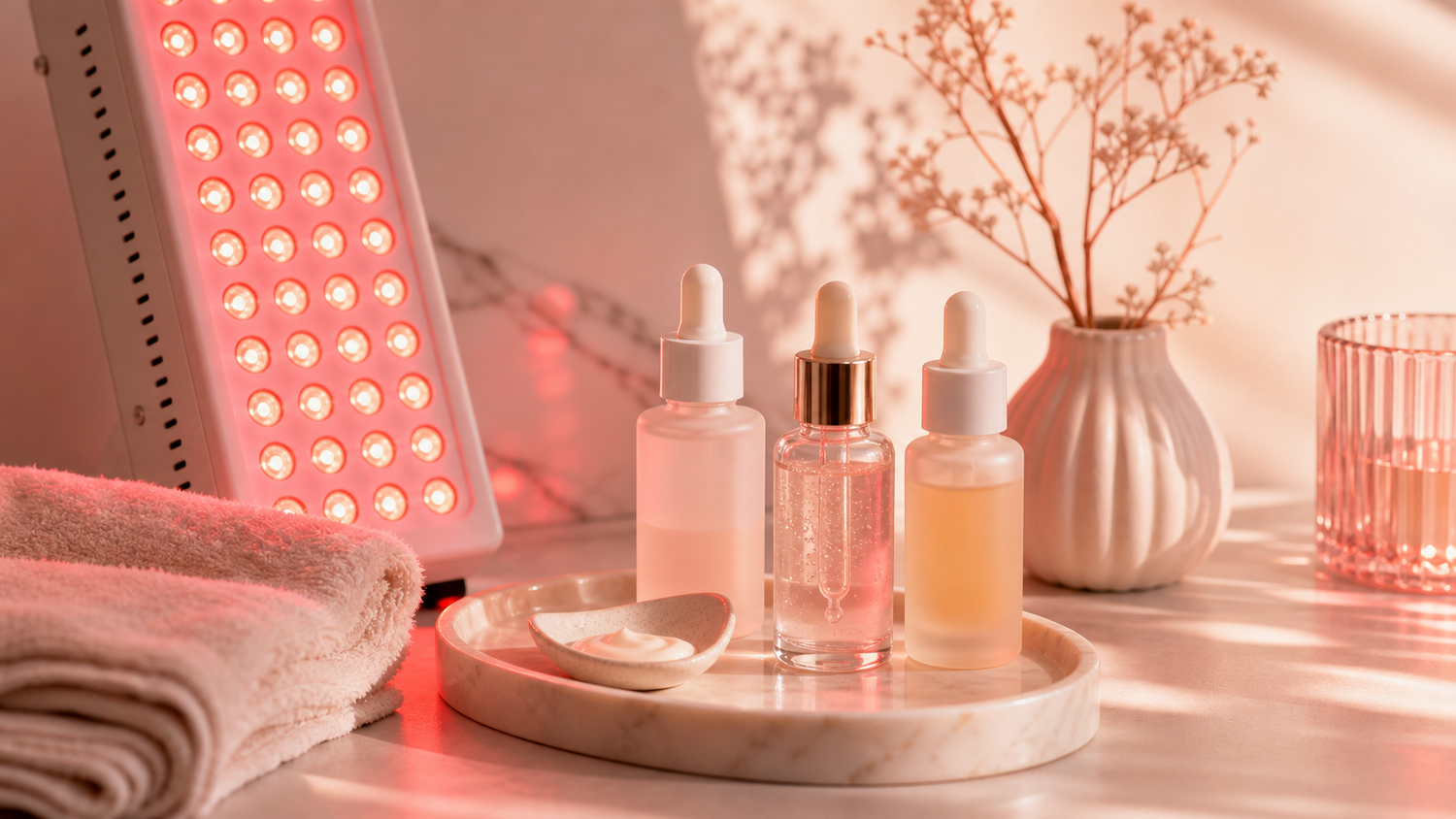
The single most important rule: red light sessions happen on bare, freshly cleansed skin. Skincare products applied to skin before a session can block light penetration, react unpredictably with light energy, or interact with the LEDs themselves in unhelpful ways. Apply everything after the session, not before.
This applies to:
- Cleansers (the residue should be rinsed off before sessions)
- Toners
- Serums (including vitamin C, niacinamide, peptides)
- Treatments (retinoids, AHA/BHA, prescription topicals)
- Moisturizers
- SPF (which you definitely don't want on during a session)
- Makeup of any kind
The standard sequence: cleanse → dry skin → red light session → apply your routine.
Layering with vitamin C
What it is
Vitamin C (L-ascorbic acid and its derivatives) is a popular antioxidant serum, typically used in the morning to support skin barrier and protect against environmental stressors.
Sequencing with red light
Apply vitamin C after your red light session, not before.
- Morning routine: Cleanse → red light session (10-15 min) → vitamin C serum → moisturizer → SPF
- Evening routine: Vitamin C is typically a morning ingredient; if you use it evening, same principle — after session
Why this order
Vitamin C is light-sensitive in storage; on skin, it can oxidize faster when exposed to high-intensity light. Applying after the session preserves the ingredient's intended effect and avoids any unpredictable interaction.
Layering with retinoids
What they are
Retinoids — including retinol (OTC), retinaldehyde, and prescription tretinoin/Retin-A — are vitamin A derivatives used for skin texture and surface concerns. They are evening-only for most users.
Sequencing with red light
Apply retinoids in the evening, well after any red light session — ideally on a separate evening or with several hours between.
- Option A (preferred): Red light in morning, retinoid in evening. Maximum separation.
- Option B: Red light in early evening (before dinner), retinoid at bedtime. At least 2-3 hours apart.
- Option C (alternate evenings): Mon/Wed/Fri red light evening sessions, Tue/Thu/Sat retinoid nights.
Why the separation
Retinoids increase skin's general sensitivity. Combining them too tightly with any new wellness practice (red light included) makes it hard to identify which variable your skin is responding to — if you have a reaction, you won't know what caused it. Spacing them out preserves cause-and-effect clarity.
If you're starting both at the same time
Don't. Introduce one, give it 2-4 weeks to settle, then introduce the other. Skin tolerance and reaction patterns vary widely; layering new variables makes diagnosis impossible.
Layering with niacinamide
What it is
Niacinamide (vitamin B3) is one of the most versatile skincare actives — supports barrier function, often well-tolerated, works in both morning and evening routines.
Sequencing with red light
Apply niacinamide after red light sessions. Generally one of the most compatible ingredients.
- Standard sequence: cleanse → red light → niacinamide serum → moisturizer
- Niacinamide is stable, well-tolerated, and doesn't have the light-sensitivity or skin-irritation profile of vitamin C or retinoids
This is usually the easiest active to integrate with red light wellness.
Layering with AHA/BHA acids
What they are
AHA (glycolic, lactic acid) and BHA (salicylic acid) are exfoliating acids that work on the skin surface. Often used 2-3 nights per week.
Sequencing with red light
Apply on separate evenings from red light sessions, especially when starting either.
- Standard: Acid nights and red light nights don't overlap initially
- If experienced: Once both are well-tolerated separately, same-evening combinations are possible — red light first on clean skin, then acid 30+ minutes after, then moisturizer
- Morning sessions: If you use acids only in evening, morning red light + evening acid is fully compatible
Why caution
Both red light wellness and acid exfoliation create change to surface skin in different ways. Stacking them initially can over-stress skin or make reaction patterns confusing.
Layering with peptides
What they are
Peptide serums (palmitoyl pentapeptide, copper peptides, others) are popular for barrier support and texture. Usually well-tolerated.
Sequencing with red light
Apply after red light sessions. Generally fully compatible.
- Standard sequence: cleanse → red light → peptide serum → moisturizer
- Peptides are not light-sensitive in the way vitamin C is, and don't increase skin sensitivity the way retinoids do
Layering with hyaluronic acid and moisturizers
Apply after sessions. Fully compatible.
Hyaluronic acid serums, moisturizers, and barrier-support products are the standard "after" step. Your post-session routine is the time to support skin with hydration and barrier ingredients.
Layering with SPF
Apply SPF after morning red light sessions, before going outside.
- Don't have SPF on skin during a session (blocks light penetration)
- Don't skip SPF because you used red light (red light doesn't replace sun protection — see our red light vs sunlight guide)
- Standard morning routine: cleanse → red light → serums → moisturizer → SPF
What about prescription topicals?
Prescription medications (tretinoin, hydroquinone, prescription corticosteroids, antibiotics like clindamycin, etc.) deserve specific consultation with your prescribing physician before incorporating red light wellness. They can:
- Increase photosensitivity
- Interact with cellular processes
- Have specific timing requirements
Your dermatologist can advise on whether and how red light fits with your specific prescription regimen.
A sample week schedule
One reasonable approach if you use multiple actives:
| Day | Morning | Evening |
|---|---|---|
| Monday | Cleanse → Red light (10 min) → Vit C → Moist → SPF | Cleanse → Retinoid → Moist |
| Tuesday | Cleanse → Red light (10 min) → Niacinamide → Moist → SPF | Cleanse → BHA → Moist |
| Wednesday | Cleanse → Red light (10 min) → Vit C → Moist → SPF | Cleanse → Hyaluronic → Moist |
| Thursday | Cleanse → Vit C → Moist → SPF | Cleanse → Retinoid → Moist |
| Friday | Cleanse → Red light (15 min) → Peptide → Moist → SPF | Cleanse → Hyaluronic → Moist |
| Saturday | Cleanse → Niacinamide → Moist → SPF | Cleanse → AHA → Moist |
| Sunday | Cleanse → Red light (15 min) → Peptide → Moist → SPF | Cleanse → Hyaluronic → Moist |
This is one possible schedule — your actual routine should match your skin's tolerance, your goals, and your dermatologist's input.
Starting both at once: the wrong approach
If you're new to red light AND new to a particular active, introduce them weeks apart. Here's why:
- Skin reactions are often unpredictable when multiple new variables are introduced simultaneously
- If you have a reaction, you won't know which variable caused it
- Each variable needs time (2-4 weeks) to show how skin responds
- Layering too fast often leads to abandoning both, when neither was actually problematic
Patience and isolation of variables serve you far better than aggressive multi-active routines.
When to consult a healthcare professional
Red light therapy panels are general wellness devices, not medical interventions. Consult a qualified healthcare professional before starting any new wellness practice including red light if you:
- Use prescription topical medications (consult your prescribing physician about timing)
- Take photosensitizing oral medications (some antibiotics, retinoids, certain antidepressants, some diuretics, herbal supplements like St. John's Wort)
- Have a diagnosed skin condition
- Have a photosensitive medical condition
- Have a recent history of skin cancer or are being monitored for skin concerns
- Are pregnant or breastfeeding
- Have any concerns about how red light might interact with your specific situation
Frequently asked questions
Can I do red light right after applying retinoid?
No. Apply red light on bare clean skin first, then retinoid afterward — or do them on separate evenings.
How long after a session before I apply skincare?
Immediately is fine. Skin doesn't need a "rest" between session and skincare application. The reason for sequence is product on skin during the session, not after.
What if I forget and have moisturizer on?
For occasional misses, not a problem — the light penetration is reduced but not blocked. For consistent practice, do sessions on cleansed skin.
Can I use facial oils after a session?
Yes — oils, serums, moisturizers, treatments all go on after the session.
What about exosome serums or growth factor products?
Same principle: after the session. These are typically marketed as post-treatment products anyway, so the timing aligns.
The bottom line
Red light wellness layers compatibly with most skincare actives — the key is doing sessions on bare clean skin, then applying products after. For sensitizing actives (retinoids, acids), introduce them weeks apart from starting red light so you can identify what your skin is responding to. For most other ingredients (niacinamide, hyaluronic acid, peptides, moisturizers, SPF), the standard "after session" sequence works fine.
If you're building a routine that includes red light wellness, the SOLRA Red Light Panel delivers verified 660 nm + 850 nm wavelengths through 40 dual-chip LEDs with a 60-day money-back guarantee so you can dial in the right session approach for your skincare routine. $159-229 depending on stand configuration, with free US shipping.
Frequently asked questions
Should I apply my skincare products before or after a red light session?
Apply everything after the session, not before, since products on skin during a session can block light penetration or react unpredictably; the standard sequence is cleanse, dry skin, red light session, then apply your routine.
Can I do a red light session right after applying a retinoid?
No. Apply red light on bare clean skin first, then apply the retinoid afterward, or do them on separate evenings.
Why is vitamin C applied after the session rather than before?
Vitamin C can oxidize faster when exposed to high-intensity light, so applying it after the session preserves the ingredient's intended effect and avoids unpredictable interaction.
Should I start red light and a new active at the same time?
No. Introduce one, give it 2 to 4 weeks to settle, then introduce the other, because layering multiple new variables makes it impossible to identify which one your skin is responding to if a reaction occurs.
Wellness Disclaimer: The information in this article is for general wellness and educational purposes only and is not intended to diagnose, treat, cure, or prevent any disease. SOLRA products are general wellness devices and have not been evaluated by the FDA. Individual results may vary. Consult a qualified healthcare professional before starting any new wellness practice, especially if you have a medical condition or are taking medications.
About this guide. Written and maintained by the SOLRA Team, who design and support the SOLRA Red Light Panel (660nm red + 850nm near-infrared light). Our guides focus on practical, comfort-first routines and use general wellness language rather than medical claims. Always follow your device instructions and consult a qualified professional about any medical condition. Editorial review: SOLRA Team · Updated June 2026.

Leave a comment
This site is protected by hCaptcha and the hCaptcha Privacy Policy and Terms of Service apply.