
Last Updated: May 13, 2026
Key takeaways
- Photobiomodulation uses specific red and near-infrared wavelengths to produce non-thermal effects on cellular function, mainly through mitochondrial chromophores.
- Therapeutic wavelengths cluster around red (600–700 nm) and near-infrared (760–900 nm), matching the absorption peaks of cytochrome c oxidase.
- Downstream effects discussed include increased ATP production, low-level reactive oxygen species acting as signals, and modulation of transcription factors.
- The biphasic (Arndt–Schulz) dose response means low doses stimulate, medium doses give maximum benefit, and high doses produce no or inhibitory effect.
- The article notes real limitations: unsettled mechanisms, individual variation, and limited long-term data.
When red light therapy is described in marketing materials, the explanation usually stops at "it boosts your cells." That phrase is technically not wrong, but it papers over an actual mechanism that is more interesting and more constrained than the loose language implies. Understanding what photobiomodulation actually does at the cellular level - and what it does not do - changes how the entire modality should be evaluated.
This article walks through the established science of photobiomodulation: which wavelengths matter and why, how those wavelengths interact with mitochondria, what downstream changes follow, and where the research is still working out the details. The goal is not to argue for or against red light therapy, but to provide the underlying biology that any honest evaluation of the modality has to start from.
What is photobiomodulation?
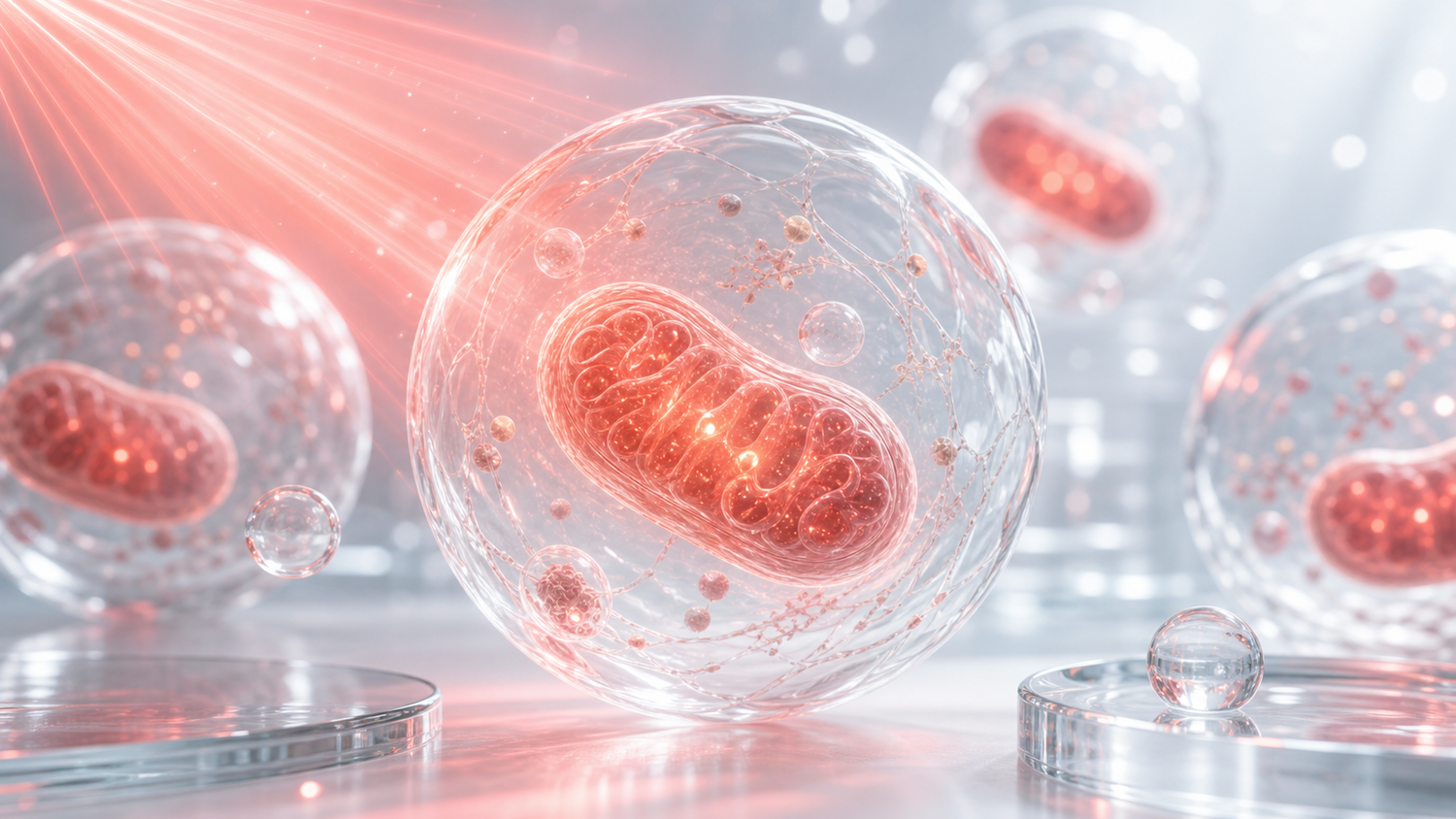
Photobiomodulation (PBM) is the use of specific wavelengths of visible red and near-infrared light to produce non-thermal effects on cellular function, primarily through interaction with mitochondrial chromophores.
The term replaced earlier names including "low-level laser therapy" (LLLT) and "cold laser therapy" as the field matured and recognized that the effects do not depend on laser-specific properties - LED-based devices produce similar effects when wavelength and dose are appropriate. The North American Association for Photobiomodulation Therapy and the World Association for Photobiomodulation Therapy adopted the current terminology to reflect this broader understanding.
What distinguishes PBM from other light-based interventions:
- Non-ionizing: Unlike UV light, the wavelengths used do not damage DNA
- Non-thermal at therapeutic doses: Unlike infrared heating or laser surgery, the goal is not to heat tissue
- Wavelength-specific: The effects depend on matching wavelengths to specific cellular absorbers, not on raw light intensity
- Dose-dependent in a biphasic way: More is not better past a certain point
Which wavelengths actually matter?
The therapeutic wavelengths in photobiomodulation cluster in two windows: red light around 600-700 nm and near-infrared around 760-900 nm, corresponding to the absorption peaks of cytochrome c oxidase.
These are not arbitrary numbers. Tissue optics research has mapped how different wavelengths penetrate and what they interact with:
- Wavelengths below 600 nm (blue, green, yellow) are absorbed strongly by hemoglobin and melanin, with limited tissue penetration
- Red wavelengths (around 660 nm) penetrate a few millimeters and are absorbed by cytochrome c oxidase
- Near-infrared wavelengths (around 810-850 nm) penetrate deeper - several centimeters - and are also absorbed by cytochrome c oxidase but at a different absorption peak
- Wavelengths above 1100 nm are absorbed strongly by water in tissue, converted to heat (this is the infrared sauna range, not the photobiomodulation range)
The combination of red and near-infrared wavelengths in many therapeutic devices reflects this dual targeting: red light for more superficial effects (skin, surface tissue), near-infrared for deeper tissue (muscle, joint, possibly bone).
What is cytochrome c oxidase and why does it matter?
Cytochrome c oxidase (CCO) is the fourth and final enzyme in the mitochondrial electron transport chain, and its absorption of red and near-infrared light is the most well-established initial step in the photobiomodulation cascade.
Mitochondria are the energy-producing organelles in cells. Inside the inner mitochondrial membrane, four enzyme complexes form the electron transport chain - the machinery that converts food energy into ATP, the cell's primary energy currency. Complex IV (cytochrome c oxidase) is the terminal enzyme that catalyzes the transfer of electrons to molecular oxygen, forming water as a byproduct.
CCO contains copper and heme centers that absorb light at specific wavelengths. The absorption spectrum of CCO shows peaks in roughly the same regions as the therapeutic photobiomodulation wavelengths - this overlap is what initially led researchers to identify CCO as the likely primary photoacceptor.
Several mechanisms have been proposed for how this absorption affects enzyme function:
- Nitric oxide displacement: Under conditions of cellular stress, nitric oxide (NO) can bind to CCO and inhibit its function. Light absorption is proposed to displace NO from its binding site, restoring CCO activity and downstream ATP production
- Redox state modulation: Light absorption may shift the redox state of copper and heme centers in CCO, altering electron flow efficiency
- Conformational changes: Some research suggests light absorption produces subtle structural changes in the CCO complex that affect its kinetics
The nitric oxide displacement model is the most widely cited, though the field continues to refine the mechanistic picture.
What happens after light absorption?
The downstream effects of CCO activation include increased ATP production, transient generation of reactive oxygen species (ROS) as signaling molecules, and modulation of multiple transcription factors that influence inflammation, cell survival, and tissue repair pathways.
This is where photobiomodulation moves from a single enzyme interaction to a cascade of cellular consequences:
ATP production
If CCO function is enhanced (or its inhibition is relieved), the electron transport chain runs more efficiently, producing more ATP. Studies measuring cellular ATP after photobiomodulation exposure have shown modest but consistent increases in many cell types. This additional energy availability is hypothesized to support cellular processes that require ATP - including tissue repair and synthesis of structural proteins.
Reactive oxygen species as signals
The term "reactive oxygen species" carries negative connotations in popular health writing, but ROS at low levels function as cellular signaling molecules - not as damage agents. Photobiomodulation appears to produce a brief, controlled ROS increase that triggers protective and adaptive responses. This is similar to the way moderate exercise produces beneficial ROS-mediated adaptations.
Transcription factor activation
The cellular response to photobiomodulation includes activation of transcription factors like NF-kB and AP-1, which regulate genes involved in inflammation, cell survival, and proliferation. The effect on inflammation is context-dependent: in chronically inflamed tissue, photobiomodulation tends to reduce pro-inflammatory signaling; in acutely injured tissue, the response may differ. This context-dependence is one reason simple statements like "red light reduces inflammation" are too crude to be accurate in all situations.
Cellular calcium dynamics
Some research has documented changes in intracellular calcium signaling following photobiomodulation exposure. Calcium is a critical second messenger in many cellular pathways, including those governing muscle function, neurotransmitter release, and gene expression.
Why is the dose response biphasic?
Photobiomodulation follows the Arndt-Schulz law, also called the biphasic dose response: low doses produce stimulatory effects, medium doses produce maximum benefit, and high doses produce inhibitory or no effect.
This is one of the most consistent and counterintuitive findings in the field. In most pharmaceutical contexts, more drug produces more effect up to a saturation point. Photobiomodulation behaves differently - the dose-response curve is bell-shaped.
Practical implications:
- Very short sessions or very low irradiance may not deliver sufficient energy to produce effects
- Optimal dosing typically falls between roughly 1 and 20 J/cm2 depending on tissue depth and target
- Excessive exposure - very long sessions or very high irradiance - can produce no effect or even adverse cellular responses
The biphasic response is why "more is better" reasoning fails with photobiomodulation. Clinical trials that use doses outside the therapeutic window often produce null results - not because the modality does not work, but because the parameters fell outside the active range. This is also why head-to-head comparisons of studies require careful attention to dosing details.
What does the research actually show at the cellular level?
The cellular biology of photobiomodulation has been investigated extensively in vitro (in cell cultures) and in vivo (in animal and human studies). Documented findings include:
- Fibroblast proliferation: Skin fibroblasts exposed to therapeutic doses show increased proliferation rates and collagen synthesis - relevant to skin and wound healing research
- Myoblast activity: Muscle precursor cells show enhanced proliferation and differentiation - relevant to muscle recovery research
- Chondrocyte activity: Cartilage cells show altered proliferation and matrix protein expression - relevant to joint research
- Neuronal effects: Neurons show increased ATP production and enhanced survival in models of cellular stress - relevant to neurological research applications
- Immune cell modulation: Various immune cell populations show altered cytokine profiles after exposure - relevant to inflammation research
These cellular findings provide the mechanistic foundation for the clinical research applications discussed in other articles. The translation from cell culture to whole organism is not always linear - tissue optics, dosing variability, and biological complexity all introduce factors that in vitro work cannot fully predict. But the cellular work provides the "why" behind clinical observations.
What the science does not yet explain
An honest summary of photobiomodulation science has to acknowledge where understanding is still incomplete:
The full mechanistic picture is not settled. While CCO is the most established initial photoacceptor, other candidates have been proposed - including light-sensitive ion channels, water clusters in tissue, and other chromophores. The relative contribution of these is still under investigation.
Pulsed versus continuous wave parameters. Some research suggests pulsed delivery at specific frequencies produces different effects than continuous-wave exposure, but the optimal pulsing parameters for various applications are not well characterized.
Inter-individual variation. Different people respond differently to identical doses, for reasons that likely involve skin pigmentation, tissue composition, baseline mitochondrial function, and other factors. Personalized dosing remains aspirational rather than established.
Long-term cellular changes. Most research focuses on acute and subacute responses. What happens to cellular function after months or years of regular photobiomodulation exposure is less studied.
Systemic versus local effects. When light is applied to one part of the body, some research suggests effects can occur in distant tissues - perhaps mediated by circulating factors or systemic signaling. The extent and clinical relevance of these systemic effects is an active research area.
The bottom line
Photobiomodulation is not magic, and it is not nothing. It is a documented biological phenomenon in which specific wavelengths of light interact with specific cellular structures - primarily cytochrome c oxidase in mitochondria - producing measurable changes in ATP production, signaling molecules, and gene expression patterns. These cellular effects have been linked to therapeutic outcomes in specific clinical contexts where dosing parameters fall within the established therapeutic window.
The honest framing: photobiomodulation has a real mechanism, documented at the cellular level across thousands of studies. It also has real limitations - dose dependency, condition specificity, individual variation, and unresolved mechanistic questions. Anyone evaluating the modality benefits from understanding both sides of this picture rather than the simplified versions on either end of the spectrum.
The cellular science is the foundation. Everything else - clinical applications, dosing recommendations, device design - builds on top of it.
Frequently asked questions
What is photobiomodulation?
Photobiomodulation is the use of specific wavelengths of visible red and near-infrared light to produce non-thermal effects on cellular function, primarily through interaction with mitochondrial chromophores.
Which wavelengths actually matter in photobiomodulation?
The therapeutic wavelengths cluster in two windows, red light around 600 to 700 nm and near-infrared around 760 to 900 nm, corresponding to the absorption peaks of cytochrome c oxidase.
Why is the dose response described as biphasic?
Photobiomodulation follows the Arndt-Schulz law, where low doses produce stimulatory effects, medium doses produce maximum benefit, and high doses produce inhibitory or no effect, with optimal dosing typically falling between roughly 1 and 20 J/cm2 depending on tissue depth and target.
What does the science of photobiomodulation not yet explain?
The article notes the full mechanistic picture is not settled, including the relative role of photoacceptors beyond cytochrome c oxidase, optimal pulsed versus continuous-wave parameters, inter-individual variation, long-term cellular changes, and the extent of systemic versus local effects.
Wellness Disclaimer: The information in this article is for general wellness and educational purposes only and is not intended to diagnose, treat, cure, or prevent any disease. SOLRA products are general wellness devices and have not been evaluated by the FDA. Individual results may vary. Consult a qualified healthcare professional before starting any new wellness practice, especially if you have a medical condition or are taking medications.
About this guide. Written and maintained by the SOLRA Team, who design and support the SOLRA Red Light Panel (660nm red + 850nm near-infrared light). Our guides focus on practical, comfort-first routines and use general wellness language rather than medical claims. Always follow your device instructions and consult a qualified professional about any medical condition. Editorial review: SOLRA Team · Updated June 2026.



Leave a comment
This site is protected by hCaptcha and the hCaptcha Privacy Policy and Terms of Service apply.