
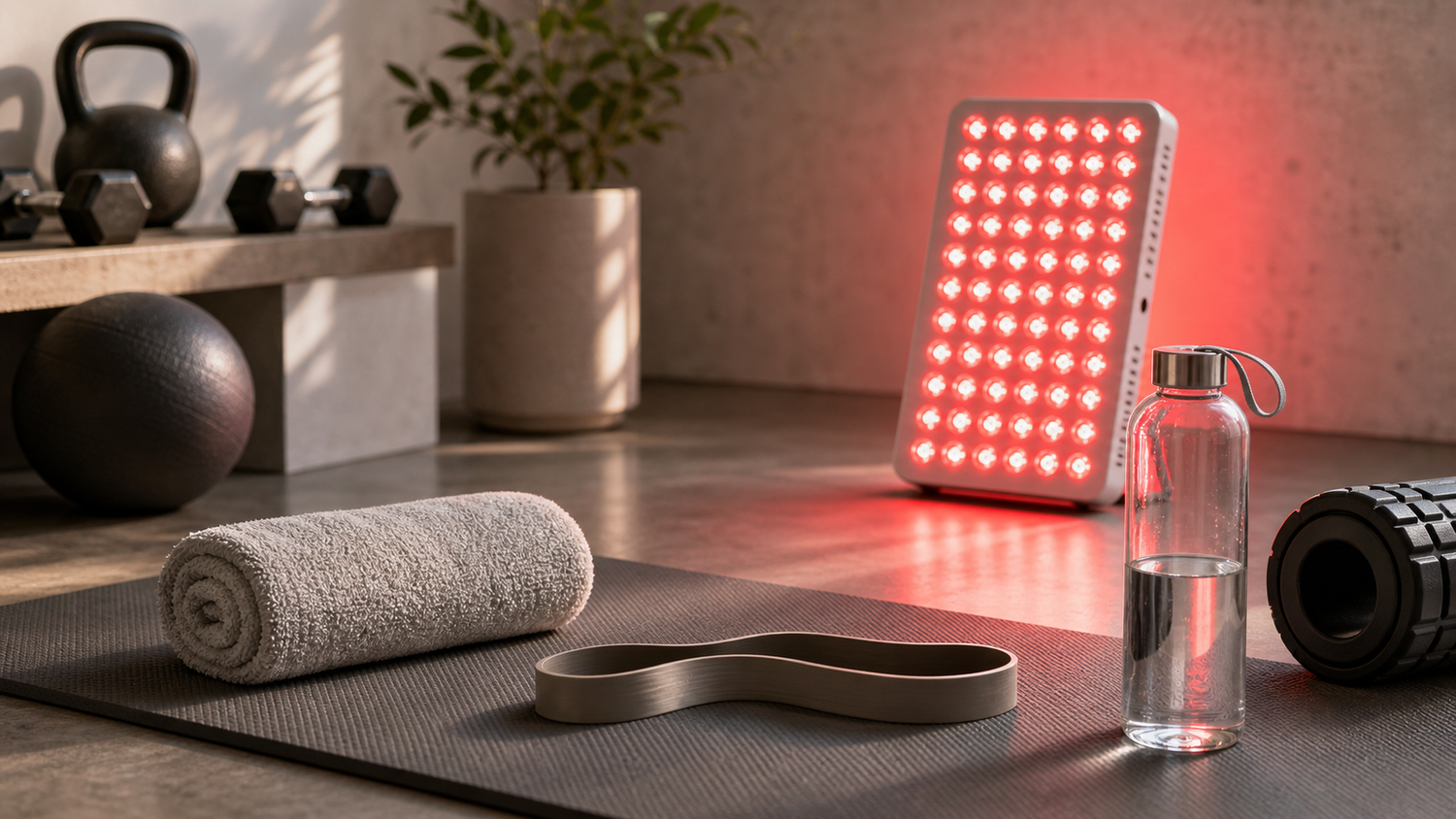
Professional athletes and fitness enthusiasts are increasingly turning to red light therapy — specifically near-infrared light at 850nm — as a recovery tool. Unlike ice baths or compression boots, photobiomodulation works at the cellular level, and the research backing it has moved well beyond preliminary stages. Here's what the science says and how to use it effectively.
Key takeaways
- Red light therapy, specifically near-infrared 850nm, is discussed as a cellular-level recovery tool that may support muscle repair after exercise.
- Research is associated with reduced delayed-onset muscle soreness, faster strength recovery within 24–48 hours, and lower post-exercise creatine kinase.
- Some studies suggest pre-exercise sessions may increase repetitions before exhaustion and reduce blood lactate during high-intensity exercise.
- Suggested protocol: 850nm (plus 660nm for surface tissue), 6–12 inches distance, 15–20 minutes per area, after training sessions.
- Use cold therapy first and red light afterward – never simultaneously – and pair sessions with consistency, good sleep, and hydration.
Why Does Red Light Therapy Help Muscle Recovery?
After intense exercise, your muscles go through a repair cycle. Muscle fibers sustain microscopic damage (this is normal — it's how muscles grow stronger), inflammatory responses activate to clean up damaged tissue, and satellite cells work to rebuild and strengthen the fibers. Each of these steps requires energy — specifically ATP, produced by mitochondria.
Near-infrared light at 850nm penetrates 30-40mm into tissue, reaching deep into muscle bellies, tendons, and connective tissue. When absorbed by mitochondria, it stimulates cytochrome c oxidase, supporting ATP production. More energy may support faster repair, modulate inflammation, and contribute to quicker return to full strength.
What Does the Research Say?
The evidence base for photobiomodulation in athletic recovery is substantial:
Reduced DOMS. A systematic review published in the Journal of Athletic Training analyzed multiple studies and concluded that photobiomodulation may reduce delayed-onset muscle soreness when applied before or after exercise. The effect sizes were meaningful — subjects reported less pain and showed faster recovery of muscle force production.
Faster strength recovery. Research in the European Journal of Applied Physiology found that participants who received near-infrared light treatment after eccentric exercise regained their baseline strength faster than control groups. The difference was measurable within 24-48 hours post-exercise.
Reduced creatine kinase. Creatine kinase (CK) is a blood marker of muscle damage. Multiple studies show that photobiomodulation treatment may reduce post-exercise CK levels, indicating less muscle damage or faster clearance of damaged tissue.
Improved performance when used pre-exercise. Interestingly, some studies show benefits when red light is applied before exercise — not just after. A study in Lasers in Medical Science found that pre-exercise photobiomodulation may increase the number of repetitions subjects can perform before exhaustion and may reduce blood lactate levels during high-intensity exercise.
Before or After Workout — When Should You Use It?
This is one of the most common questions, and the research supports both approaches:
Pre-workout (10-15 minutes before exercise): May prime your muscles with extra ATP. May support work capacity and delay fatigue. Think of it as "preloading" your cells with energy. Many users like this for high-intensity sessions where they want peak output.
Post-workout (within 30-60 minutes after exercise): Supports the recovery process when your muscles are actively repairing. May modulate inflammation and soreness. Many users like this for speeding recovery between training sessions.
Both: If you have time, doing a short pre-workout session (5-10 minutes) and a post-workout session (10-15 minutes) provides the most comprehensive support. This protocol is common among professional athletes with access to clinical-grade equipment — and now achievable at home.
The Muscle Recovery Protocol
Wavelength: 850nm (near-infrared). If your panel has combo mode with 660nm, use it — the 660nm supports surface tissue, while 850nm reaches deep muscle tissue.
Distance: 6-12 inches from the target muscle group. For larger areas (quads, back), position the panel to cover as much surface area as possible.
Duration: 15-20 minutes per session area. Deep muscle tissue benefits from more exposure time than skin — the light needs to penetrate further and deliver sufficient dose to the target tissue.
Target areas: Focus on the muscles you worked that day. Leg day = quads, hamstrings, calves. Upper body = chest, back, shoulders, arms. Full body = prioritize the largest muscle groups or the areas with the most soreness.
Frequency: After every training session for ongoing recovery support. On rest days, a maintenance session still supports ongoing repair processes.
Red Light Therapy vs. Other Recovery Tools
Ice baths / cold therapy: Cold may reduce inflammation through vasoconstriction. Red light may modulate inflammation through cellular mechanisms. Some research suggests combining both may provide additive support, but use cold first (it constricts blood vessels) and red light after (it improves circulation). Don't use simultaneously — the cold will reduce blood flow that red light relies on for its effects.
Compression boots: Mechanical compression supports lymphatic drainage and fluid movement. Red light works at the cellular level. Different mechanisms, potentially complementary.
Massage guns: Percussion provides mechanical stimulation to muscles. Red light provides photon stimulation to cells. Again, complementary rather than competing.
Foam rolling: Addresses myofascial adhesions and trigger points. Red light addresses cellular energy and inflammation modulation. Use both in your recovery stack.
Red light therapy's unique advantage: it's one of the few recovery tools that works at the mitochondrial level. Others address symptoms (perceived inflammation, fluid buildup, muscle tightness). Red light targets the root process (cellular energy production for repair).
What to Expect
First session: You won't feel dramatic changes immediately. The session area may feel slightly warmer due to increased blood flow. Some users report a sense of relaxation.
First week (3-5 sessions): You may notice reduced soreness after workouts. Recovery between sessions may start to feel slightly faster. This is subtle — track your perceived recovery rate to notice the difference.
Week 2-4: The recovery support may become more consistent. You may find you can train the same muscle group more frequently without excessive soreness. Sleep quality often improves as well, which compounds recovery support.
Month 2+: Red light therapy becomes a seamless part of your recovery routine. The cumulative effect of faster recovery may translate to more quality training sessions over time.
Practical Tips for Athletes
1. Timing matters. Post-workout within 60 minutes is the recovery sweet spot. Don't wait until the next day — the inflammatory response peaks within hours of exercise.
2. Consistency over intensity. A 10-minute session every training day beats a 30-minute session once a week. The cumulative effect of regular sessions is what drives results.
3. Pair with good sleep. Most muscle repair happens during sleep. Red light therapy supports the repair process, but sleep provides the time window for repair to occur. Optimize both.
4. Stay hydrated. Cellular processes require water. Dehydrated cells produce less ATP regardless of light exposure.
Get Started
The SOLRA Red Light Panel delivers 850nm near-infrared light alongside 660nm red light through 40 dual-chip LEDs. Wired design for consistent full-power sessions. Silent operation so it doesn't disrupt your post-workout routine. Starting at $159 with free US shipping and a 60-day guarantee.
Frequently asked questions
How deep does 850nm near-infrared light penetrate into muscle tissue?
Near-infrared light at 850nm penetrates 30-40mm into tissue, reaching deep into muscle bellies, tendons, and connective tissue. When absorbed by mitochondria it stimulates cytochrome c oxidase, supporting ATP production.
Should I use red light before or after a workout?
Research supports both. A pre-workout session 10-15 minutes before exercise may prime muscles with extra ATP and support work capacity, while a post-workout session within 30-60 minutes supports the recovery process; doing a short session both before and after provides the most comprehensive support.
What distance and duration does the muscle recovery protocol recommend?
Position the panel 6-12 inches from the target muscle group and run 15-20 minutes per session area, since deep muscle tissue benefits from more exposure time so the light can penetrate further and deliver a sufficient dose.
Can I combine red light with cold therapy like ice baths?
Some research suggests combining both may provide additive support, but use cold first since it constricts blood vessels and red light after since it improves circulation. Do not use them simultaneously, because the cold will reduce the blood flow red light relies on for its effects.
Wellness Disclaimer: The information in this article is for general wellness and educational purposes only and is not intended to diagnose, treat, cure, or prevent any disease. SOLRA products are general wellness devices and have not been evaluated by the FDA. Individual results may vary. Consult a qualified healthcare professional before starting any new wellness practice, especially if you have a medical condition or are taking medications.
About this guide. Written and maintained by the SOLRA Team, who design and support the SOLRA Red Light Panel (660nm red + 850nm near-infrared light). Our guides focus on practical, comfort-first routines and use general wellness language rather than medical claims. Always follow your device instructions and consult a qualified professional about any medical condition. Editorial review: SOLRA Team · Updated June 2026.

Leave a comment
This site is protected by hCaptcha and the hCaptcha Privacy Policy and Terms of Service apply.