
Last Updated: May 25, 2026
Key takeaways
- For most trips under 2 weeks, skipping sessions is the most realistic option since red light benefits come from consistency over weeks, not single sessions.
- Most quality home panels are not travel-friendly; portable handheld devices, mini panels, or LED face masks are realistic for face sessions only, with lower output.
- If bringing a portable device, use a protective case, check destination voltage, pack the right adapter, and don't skip eye protection.
- Don't increase intensity or length to make up for missed sessions – the biphasic dose response means cramming doesn't help.
- Cumulative benefit takes roughly 1–3 weeks to rebuild after a gap, and foundations like sleep, hydration, and sun protection matter far more than a brief pause.
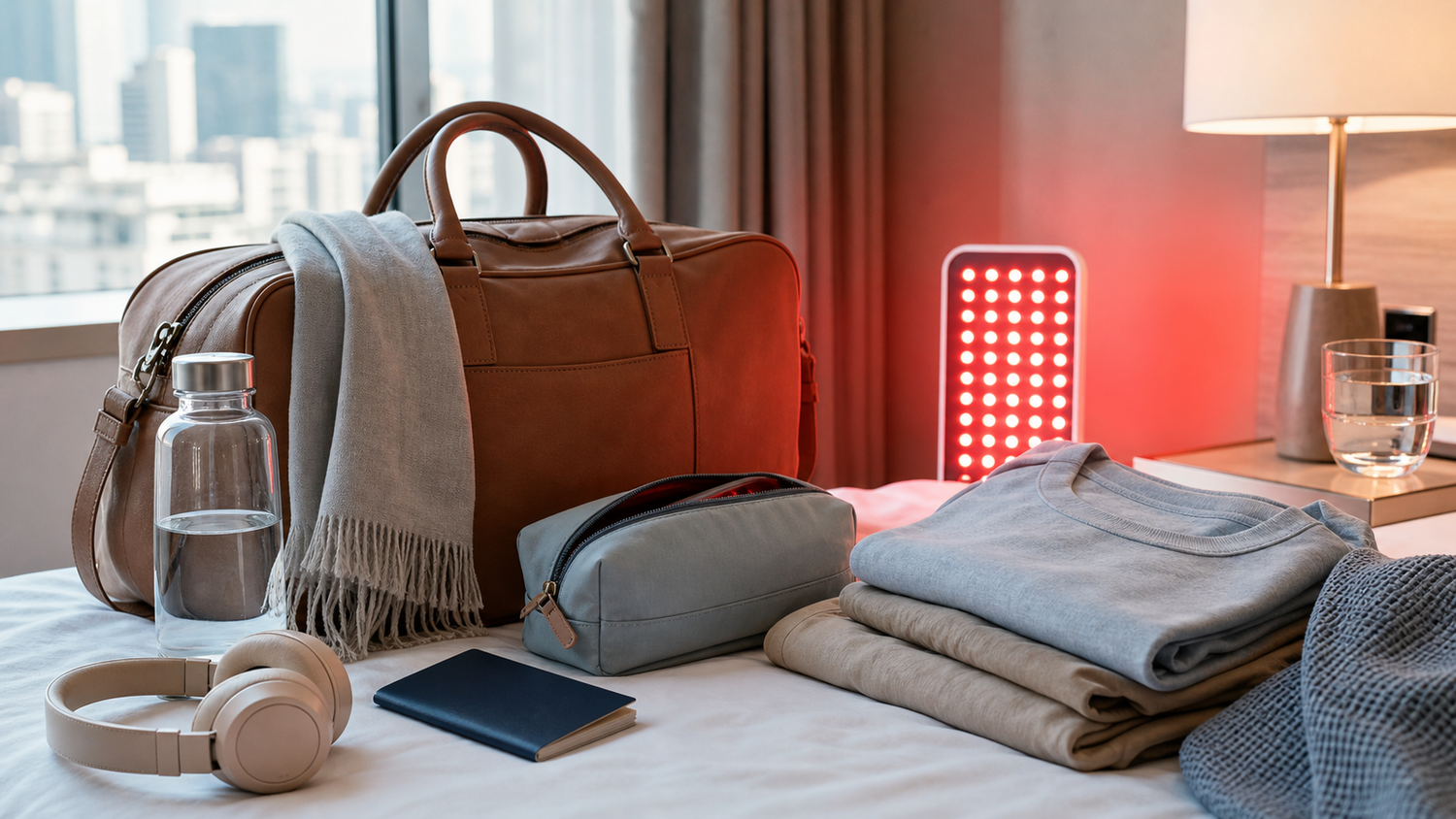
One of the most common questions from users who've built a consistent red light wellness routine: what happens when you travel? Business trips, vacations, weekends away — these gaps in routine are exactly when consistency breaks down. And the foundation of red light wellness benefits is consistency over weeks, not intensity in single sessions.
This guide walks through how to maintain your red light wellness practice while traveling, what's realistic to bring, when to skip sessions entirely, and how to handle the gaps without losing the cumulative benefit you've built.
The honest starting point
Most quality red light wellness panels are not travel-friendly. They're designed for home use — substantial size, weight, glass panels, and 110V power requirements. Asking a panel to fit airline carry-on or international travel is asking it to be something it isn't.
That doesn't mean travel = giving up. It means realistic options:
- Skip sessions for the trip duration — fully fine for trips under 2 weeks
- Bring a portable panel — for trips longer than 2 weeks or when consistency matters most
- Use hotel/destination amenities — some wellness hotels have red light setups
Option 1: Skipping sessions while traveling
This is the most realistic option for the majority of trips. The honest truth:
- 1-week trip: No meaningful impact on cumulative benefit. Resume normal sessions when home.
- 2-week trip: Slight dip in cumulative effect, but easily recovered in 1-2 weeks of resumed sessions.
- 3+ week trip: You'll partially "reset" — not back to zero, but a longer ramp back to peak routine effect.
For most trips, accepting the pause is more practical than trying to maintain sessions. The accumulated benefit you've built doesn't disappear in a week off.
What helps during travel pauses
While you're not doing red light sessions, prioritize the foundations:
- Sleep (despite jet lag, time zones)
- Hydration (flying is dehydrating)
- Sun protection (different climates, often more sun than usual)
- Continued skincare routine (mini sizes of your essentials)
- Movement (despite time-zone disruption, walking helps)
These foundations matter more than any wellness practice. Travel often disrupts all of them — which is why a one-week pause in red light is rarely the variable that matters.
Option 2: Bringing a portable red light setup
What's actually portable?
Some genuinely travel-friendly options exist:
- Small handheld red light devices (USB-powered, about the size of a phone) — lower output, narrow coverage, but truly portable. Realistic for very small areas (small face zones, single joints).
- Mini panels (~6x6 inches, 100-200g) — fit in luggage, can plug into hotel outlets, modest output. Realistic for face sessions only.
- LED face masks with travel cases — some are designed for portability. Output and wavelength accuracy vary widely. Our panel vs mask comparison covers the trade-offs.
What's NOT portable: full-size home panels (18+ inches), anything requiring 220V conversion for international travel, anything heavy enough to push luggage over weight limits.
If you bring something portable
- Use the included travel case (or a protective sleeve) — panels and masks have glass or LED arrays that don't tolerate luggage abuse
- Check power requirements for your destination (US 110V vs Europe/Asia 220V — some panels are dual-voltage, some aren't)
- Bring the right plug adapter for your destination
- Pack eye protection (don't skip this even for travel)
- Expect shorter sessions — portable devices have lower output, sessions may need to be slightly longer than home equivalent
Option 3: Using destination amenities
Some wellness-focused hotels, retreats, and spas have red light setups available for guests. If you're planning a wellness-themed trip:
- Check the property's amenities list for "red light therapy," "photobiomodulation," or "LED light therapy"
- Ask front desk about availability and booking
- These setups range from clinic-grade panels to consumer-quality units — quality varies
- Eye protection should be provided; if not, ask for it or skip
This is a niche option — most general hotels won't have anything — but worth checking for retreat-style trips.
Travel session adjustments
If using a portable device
- Distance: Similar to home (6-12 inches) but adjust for the specific device's recommended distance
- Session length: Possibly slightly longer (12-18 min) to compensate for lower output
- Frequency: 3-5 sessions per week if practical; 2-3 if travel schedule is hectic
- Focus area: Face only (don't try to cover body with a portable device — not enough output)
Realistic environment considerations
- Hotel rooms: Power outlets near beds/desks usually work fine
- Time: Jet lag and packed schedules often mean evening sessions are most realistic
- Privacy: Eye protection + bare skin sessions assume you have a private moment — not always easy on shared trips
Returning home: how to resume
After a travel pause:
- First week back: Don't try to "make up" missed sessions with longer or more frequent sessions — stay within recommended parameters
- Frequency: Resume your normal schedule (3-5x/week)
- Session length: Back to your usual time and distance
- Expectations: Cumulative benefit takes 1-3 weeks to rebuild to where you left off, depending on how long the gap was
The biphasic dose response still applies — cramming sessions doesn't help, and may produce less benefit than the gradual rebuild.
Travel scenarios: what to do
| Scenario | Recommended approach |
|---|---|
| 3-day business trip | Skip sessions, resume on return |
| 1-week vacation | Skip sessions, resume on return |
| 2-week trip | Skip or bring portable device for face sessions only |
| 3+ week trip | Bring portable device if maintaining matters; otherwise plan 2-3 weeks to ramp back at home |
| Frequent traveler (twice/month) | Build routine around home days only, don't expect travel-day consistency |
| Move / relocation | Pause until settled in new location, then resume |
| Wellness retreat | Use property amenities if available; otherwise pause |
What not to do
- Don't pack a full-size home panel — the glass cracks, the case bulks out luggage, the weight pushes you over airline limits
- Don't use random hotel-room "red light" gadgets from vending machines or amenity stations without checking what they are
- Don't increase intensity or session length to "make up" for missed sessions — dose response is bell-shaped
- Don't skip eye protection just because you're traveling
- Don't expect a portable device to replace your home setup — it's a hold-the-line tool, not a full substitute
When to consult a healthcare professional
Red light therapy panels are general wellness devices, not medical interventions. Consult a qualified healthcare professional before starting any new wellness practice including red light if you have any diagnosed medical condition, take photosensitizing medications, are pregnant or breastfeeding, or have any concerns about how red light might interact with your specific situation.
Frequently asked questions
Will a 2-week travel gap undo my progress?
No. Cumulative benefits don't disappear in 2 weeks. You'll resume from approximately where you paused, with a brief ramp period.
Can I bring my SOLRA panel on a plane?
It can be checked luggage with proper protective packaging, but for most trips we'd recommend leaving it home. The panel is designed for stable home use.
Are there any "travel-size" SOLRA options?
Currently, SOLRA focuses on the home wellness panel category. For travel, small handheld devices from other brands are an option, though output and wavelength quality vary significantly.
What if I'm staying somewhere long-term (1+ month)?
For extended stays, consider whether you can ship or buy a panel for the destination. A month is long enough that resuming a routine matters more than a single trip's portability.
Does jet lag affect red light wellness?
Not in any specific way — red light sessions don't strongly affect circadian rhythm (red wavelengths don't suppress melatonin the way blue light does). So you can do sessions any time when traveling without disrupting sleep adaptation.
Should I tell my dermatologist if I'm traveling and skipping sessions?
Generally not necessary unless you're under specific medical care that involves coordinating wellness practices — in which case yes, mention it.
The bottom line
For most trips under 2 weeks, skipping red light sessions is the most realistic option — the cumulative benefit doesn't disappear in a week or two. For longer trips or frequent travelers, portable devices exist but are limited in output and coverage. The foundations — sleep, hydration, sun protection, nutrition — matter far more than a brief gap in any single wellness practice.
If you're building a home red light wellness practice that you'll be away from periodically, the SOLRA Red Light Panel is designed for consistent home use with verified specs and durable build. $159-229 depending on stand configuration, with free US shipping, 2-year warranty, and a 60-day money-back guarantee.
Frequently asked questions
Will a one or two week travel gap undo my red light progress?
No, the cumulative benefit does not disappear in a week or two; a 1-week trip has no meaningful impact and a 2-week trip causes only a slight dip easily recovered in 1-2 weeks of resumed sessions. You resume from approximately where you paused, with a brief ramp period.
Can I bring my SOLRA panel on a plane?
It can go in checked luggage with proper protective packaging, but for most trips it is better left home since the panel is designed for stable home use. Full-size home panels are not travel-friendly due to size, weight, glass, and power requirements.
What kind of red light device is actually portable for travel?
Genuinely portable options include small handheld USB-powered devices about the size of a phone, mini panels around 6x6 inches, and some LED face masks with travel cases, though these have lower output and are realistic for face sessions only. Output and wavelength accuracy vary widely between devices.
Does jet lag affect red light wellness sessions?
Not in any specific way, because red light sessions do not strongly affect circadian rhythm since red wavelengths do not suppress melatonin the way blue light does. You can do sessions any time when traveling without disrupting sleep adaptation.
Wellness Disclaimer: The information in this article is for general wellness and educational purposes only and is not intended to diagnose, treat, cure, or prevent any disease. SOLRA products are general wellness devices and have not been evaluated by the FDA. Individual results may vary. Consult a qualified healthcare professional before starting any new wellness practice, especially if you have a medical condition or are taking medications.
About this guide. Written and maintained by the SOLRA Team, who design and support the SOLRA Red Light Panel (660nm red + 850nm near-infrared light). Our guides focus on practical, comfort-first routines and use general wellness language rather than medical claims. Always follow your device instructions and consult a qualified professional about any medical condition. Editorial review: SOLRA Team · Updated June 2026.

Leave a comment
This site is protected by hCaptcha and the hCaptcha Privacy Policy and Terms of Service apply.