
Last Updated: May 21, 2026
Key takeaways
- Red light wellness panels emit narrow 660 nm and 850 nm wavelengths that exist in sunlight, but they are not sunlight and do not replace it.
- Panels emit zero UV, so they do not produce vitamin D, do not cause tanning, and do not cause sunburn.
- Red light wellness does not replace sunscreen or sun protection, and has no UV-blocking properties.
- Both share two wavelengths absorbed by cytochrome c oxidase, but panels deliver them at higher concentrated intensity without the UV sunlight packages alongside.
- Nothing about red light wellness stops you going outdoors – the two are separate practices that fit alongside each other.
One of the most common questions new red light wellness users ask is whether red light has anything to do with sun exposure. The marketing language in this category often conflates the two — phrases like "natural light" and "sunlight-like wavelengths" appear in product descriptions — even though the underlying biology is quite different.
This guide walks through what red light wellness actually shares with sunlight, where the two are fundamentally different, and the practical considerations for using red light alongside your existing sun-related routines (whether that's outdoor time, sunscreen, or sun-care concerns).
The short answer
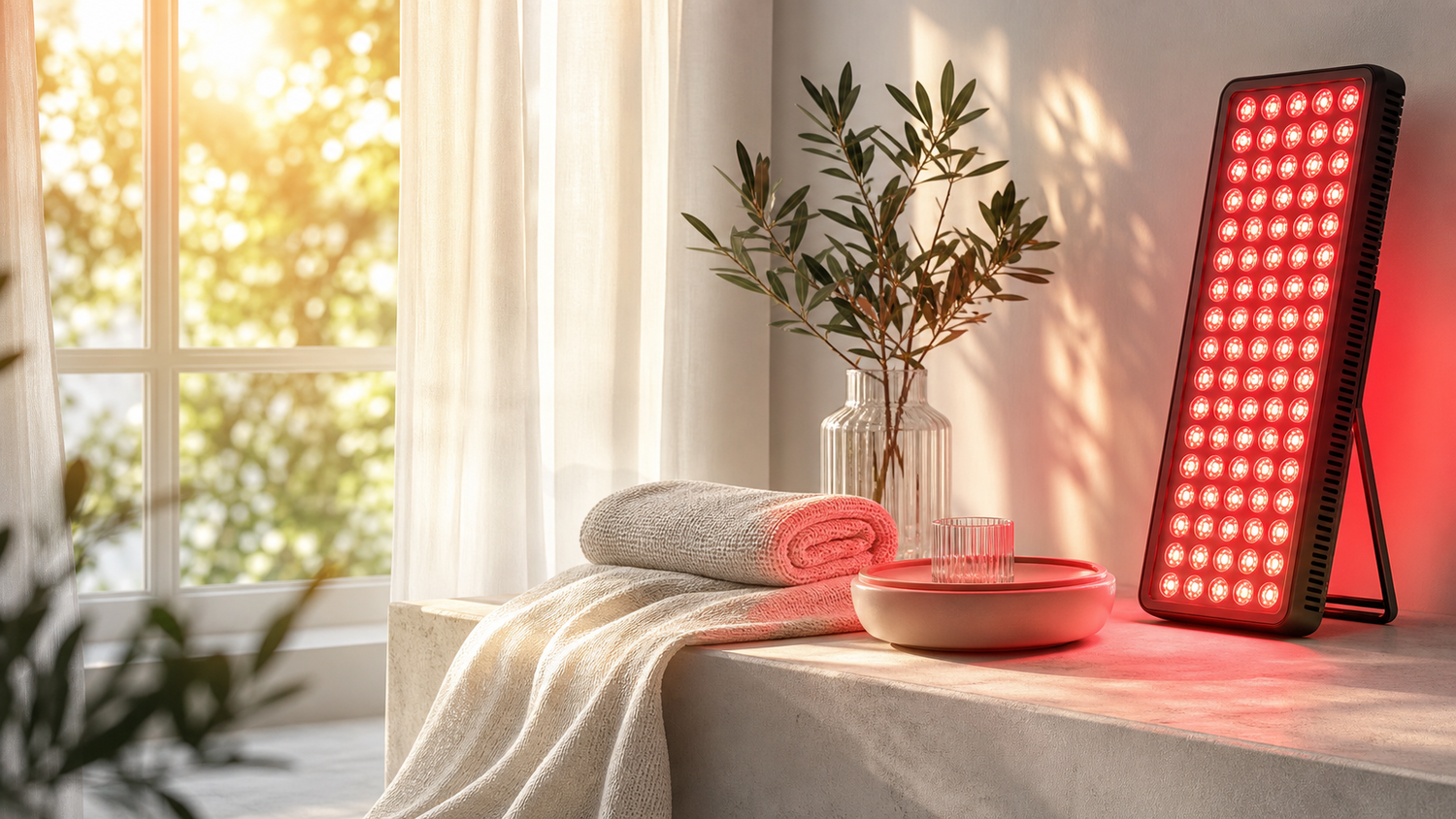
Red light wellness panels emit specific narrow wavelengths of red and near-infrared light (around 660 nm and 850 nm). Sunlight contains a much broader spectrum that includes UV, visible light, and infrared. Red light wellness panels do NOT emit UV. Using red light wellness does not provide the benefits of sun exposure (like vitamin D) and does not replace sun protection.
What sunlight actually contains
Sunlight at the Earth's surface is a continuous spectrum spanning roughly 280 to 2500 nanometers, with notable bands including:
- UV-B (280-315 nm): Short wavelengths that drive vitamin D synthesis in skin but also damage DNA in surface skin cells. Primary driver of sunburn.
- UV-A (315-400 nm): Longer wavelengths that penetrate deeper into skin. Major contributor to long-term skin changes and skin aging.
- Visible light (400-700 nm): The full rainbow your eyes can see, from violet through blue, green, yellow, orange, to red.
- Near-infrared (700-1400 nm): Felt as warmth on skin; penetrates tissue.
- Far-infrared (1400+ nm): Primary heat band; absorbed at skin surface.
Sunlight is roughly 7% UV, 39% visible, and 54% infrared by intensity at the surface.
What red light wellness panels actually emit
Quality red light wellness panels emit two specific narrow wavelength bands:
- 660 nm (visible red): Falls within the deep-red end of visible light. You can see it as a red glow.
- 850 nm (near-infrared): Falls within the near-infrared band. Mostly invisible to the eye except for a faint red glow at the source.
Both wavelengths sit within sunlight's spectrum — but at extremely narrow, concentrated bands rather than the continuous distribution sunlight provides. And critically, red light wellness panels emit zero UV-A and zero UV-B.
Where red light and sunlight overlap
Both red light wellness and sunlight deliver wavelengths that can be absorbed by cytochrome c oxidase in mitochondria — the cellular mechanism of photobiomodulation. When you're outside on a sunny day, your skin is receiving some of the same wavelengths that a red light wellness panel emits, alongside UV and many other wavelengths.
This is the kernel of truth in marketing language that compares red light wellness to "natural sunlight" — the 660 nm and 850 nm wavelengths are present in sunlight. But sunlight delivers them at much lower intensity per square centimeter, mixed with UV and other wavelengths that produce entirely different effects on skin. The full mechanistic picture is in our photobiomodulation guide.
Where they're fundamentally different
UV exposure
Sunlight produces UV exposure that drives vitamin D synthesis but also DNA damage in skin cells, sunburn, and long-term skin changes. Red light wellness panels emit zero UV. They will not give you vitamin D, will not produce a tan, and will not cause sunburn.
Intensity at therapeutic wavelengths
A red light wellness panel delivers 660 nm and 850 nm at irradiance levels (50-100+ mW/cm² at 6 inches in quality panels) that are far higher than what sunlight delivers at those specific wavelengths in the same time window. This is what allows a 10-20 minute panel session to deliver a cellular dose that would take much longer in sunlight — and which sunlight always packages alongside UV exposure you can't separately control.
Heat
Sunlight produces significant skin warmth and heat at the surface through its full infrared spectrum. Red light wellness panels produce mild warmth at most, primarily from the LEDs themselves rather than from light absorption.
Skin pigmentation effects
UV exposure stimulates melanin production (tanning). Red light wellness does not. There is no tanning effect from red light wellness.
Common misunderstandings to clear up
"Red light wellness gives me vitamin D"
No. Vitamin D synthesis requires UV-B exposure, which red light wellness panels do not emit. For vitamin D, you need direct sunlight (with appropriate sun protection), dietary sources, or supplementation — your healthcare provider can guide what's right for you.
"Red light wellness replaces my morning sun exposure for circadian rhythm"
Mostly no. Morning sunlight's effect on circadian rhythm comes primarily from bright blue-spectrum light hitting the retina, which suppresses melatonin and signals "daytime" to the brain. Red wavelengths produce minimal melatonin suppression — which is why they're compatible with evening use — but for the same reason, they don't reproduce the morning sunlight circadian effect. Our sleep guide covers this in more depth.
"Red light wellness will tan my skin"
No. Tanning requires UV exposure. Red light wellness panels emit no UV and produce no pigment response.
"Red light wellness can replace sunscreen"
No. Sunscreen protects against UV exposure. Red light wellness has no UV-blocking properties and cannot protect skin from sun damage.
"I shouldn't go outside if I use red light wellness"
Nothing in red light wellness contraindicates spending time outdoors. The two are entirely separate; you can do both. Use appropriate sun protection for outdoor time, and use red light wellness as an indoor practice on its own schedule.
Practical guidance: using red light wellness alongside sun-related routines
If you spend significant time outdoors
Continue your sun protection routine — sunscreen, protective clothing, hats, sunglasses. Red light wellness does not affect any of these decisions. Schedule sessions for indoor time, often morning or evening.
If you have a history of sun damage or skin cancer monitoring
Consult your dermatologist before starting red light wellness. Their guidance is the relevant input here. Red light wellness panels are general wellness devices, not medical treatments, and any specific concern around skin health warrants professional input.
If you're using topical skincare with sun sensitivity considerations
Retinoids, AHA/BHA acids, vitamin C, and some other actives increase skin's sun sensitivity. These products are still compatible with red light wellness (no UV), but check with your dermatologist about sequence and timing in your routine. Apply skincare after sessions, not before.
If you take photosensitizing medications
Consult a healthcare professional before starting red light wellness. Some photosensitizing medications interact with light exposure broadly (including non-UV wavelengths), and individual situations vary. This includes some antibiotics like doxycycline and tetracycline, retinoids like Accutane, certain antidepressants, some chemotherapy agents, some diuretics, and certain herbal supplements like St. John's Wort.
If you've had recent sun exposure or sunburn
The conservative approach is to wait for any sunburn or active irritation to fully resolve before doing red light sessions on that area. Acutely inflamed or damaged skin is a signal to pause, not a context for adding new variables.
The question of "natural light" framing
Marketing language that frames red light wellness as "natural light" or "sunlight-like" is technically referencing the fact that 660 nm and 850 nm wavelengths exist in sunlight. The framing is technically not wrong, but it can imply benefits that don't carry over.
Red light wellness uses sunlight-spectrum wavelengths delivered without UV at higher concentrated intensity than sunlight provides at those specific bands. That's a fair, accurate description — and it's neither sunlight nor a replacement for it.
The bottom line on red light vs sunlight
| Feature | Sunlight | Red light wellness panel |
|---|---|---|
| UV exposure | Yes (UV-A + UV-B) | No |
| Vitamin D synthesis | Yes | No |
| Tanning / pigmentation | Yes | No |
| Sunburn risk | Yes | No |
| 660 nm + 850 nm | Yes (low concentration) | Yes (high concentration) |
| Heat / warmth | Significant | Mild |
| Circadian rhythm anchoring | Yes (via blue light) | Minimal effect |
| Skin damage from prolonged exposure | Yes (UV-driven) | No (non-UV) |
When to consult a healthcare professional
Red light therapy panels are general wellness devices, not medical treatments. Consult a qualified healthcare professional before starting any new wellness practice including red light if you have any diagnosed medical condition, a history of skin cancer or sun-related skin concerns, take photosensitizing medications, have a photosensitive medical condition, are pregnant or breastfeeding, or have any concerns about how red light might interact with your specific situation.
The bottom line
Red light wellness and sun exposure share two specific wavelengths but are otherwise fundamentally different. Red light wellness panels do not emit UV, do not produce vitamin D, do not cause tanning, and do not replace sun protection or sun exposure. They are a separate practice that fits alongside whatever sun-related routine you have, not a substitute for any of it.
The SOLRA Red Light Panel delivers verified 660 nm + 850 nm wavelengths through 40 dual-chip LEDs with no UV emission, honest irradiance reporting, and a 60-day money-back guarantee. $159-229 depending on stand configuration, with free US shipping.
Quick comparison
| Red light panel | Sunlight | |
|---|---|---|
| UV emitted | None | Yes |
| Produces vitamin D | No | Yes |
| Tanning / sunburn | No | Possible |
| Wavelengths | Concentrated 660nm & 850nm | Full spectrum incl. UV |
| Replaces sun protection? | No | — |
Frequently asked questions
Does red light wellness give you vitamin D like sunlight does?
No. Vitamin D synthesis requires UV-B exposure, which red light wellness panels do not emit, so they will not provide vitamin D; for that you need direct sunlight, dietary sources, or supplementation as your healthcare provider advises.
What wavelengths do red light panels emit, and do they include UV?
Quality panels emit two narrow bands, 660 nm visible red and 850 nm near-infrared, and they emit zero UV-A and zero UV-B.
Can red light wellness replace sunscreen or sun protection?
No. Sunscreen protects against UV exposure, and red light wellness has no UV-blocking properties and cannot protect skin from sun damage, so continue your usual sun protection routine.
Why does a short panel session deliver more of these wavelengths than time in the sun?
A panel delivers 660 nm and 850 nm at irradiance levels of 50-100+ mW per cm2 at 6 inches, far higher than sunlight provides at those specific wavelengths, which is what lets a 10-20 minute session deliver a cellular dose that would take much longer outdoors.
Wellness Disclaimer: The information in this article is for general wellness and educational purposes only and is not intended to diagnose, treat, cure, or prevent any disease. SOLRA products are general wellness devices and have not been evaluated by the FDA. Individual results may vary. Consult a qualified healthcare professional before starting any new wellness practice, especially if you have a medical condition or are taking medications.
About this guide. Written and maintained by the SOLRA Team, who design and support the SOLRA Red Light Panel (660nm red + 850nm near-infrared light). Our guides focus on practical, comfort-first routines and use general wellness language rather than medical claims. Always follow your device instructions and consult a qualified professional about any medical condition. Editorial review: SOLRA Team · Updated June 2026.

Leave a comment
This site is protected by hCaptcha and the hCaptcha Privacy Policy and Terms of Service apply.