
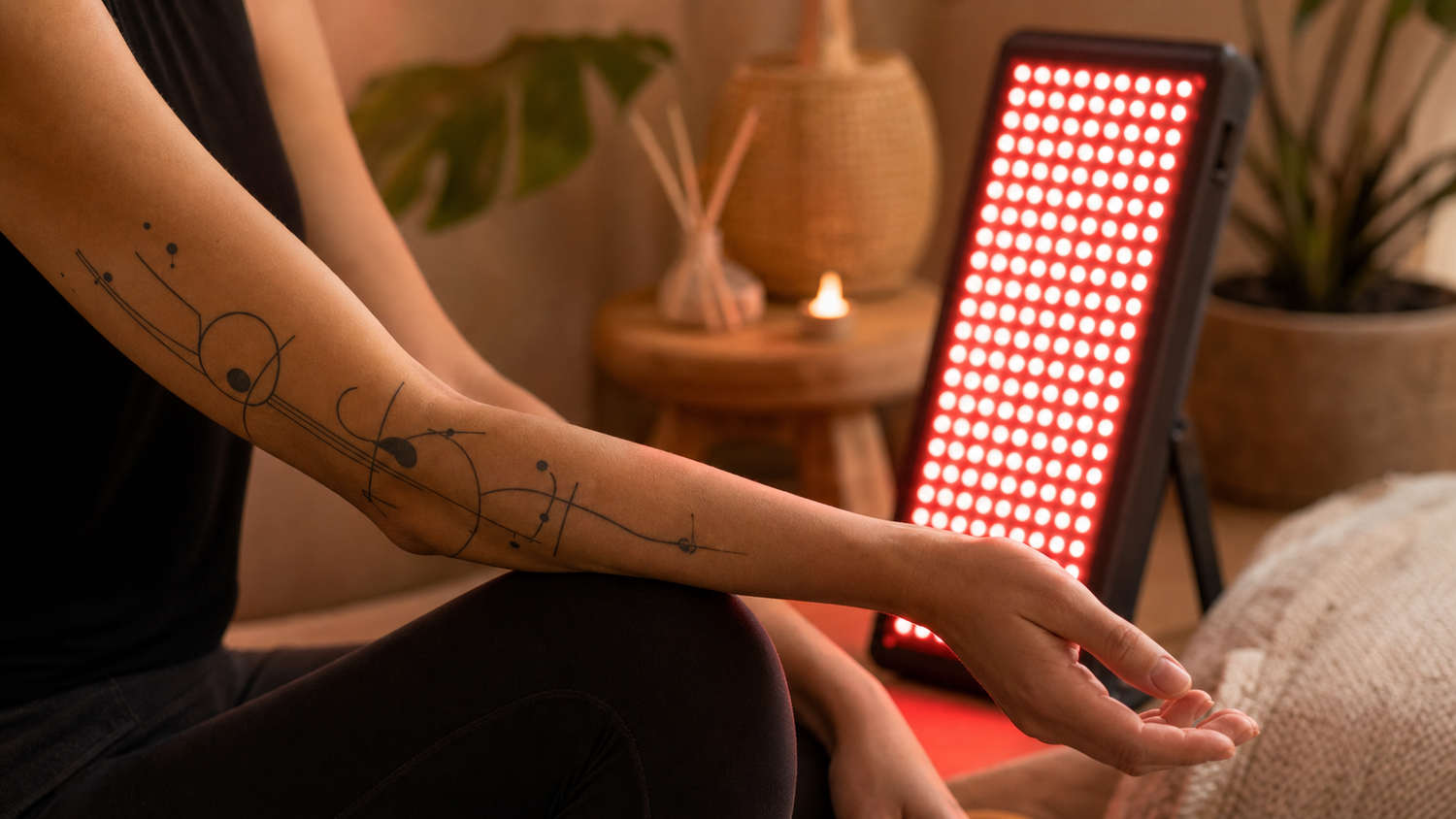
If you have tattoos, it is reasonable to wonder how they fit with a red light routine — both for a fresh, healing tattoo and for older, settled ink. This is a comfort-first, cautious topic, and the honest answer for anything involving healing skin is to check with the right professional. Here is a practical framing of what to consider.
Key takeaways
- For a new or healing tattoo, consider the area to be recovering skin: follow your tattoo artist’s or a qualified professional’s aftercare guidance rather than adding a red light session over it.
- For older, fully settled tattoos, the main everyday consideration is comfort — dark ink can absorb more light and may feel warmer, so distance and comfort matter.
- This is a "when in doubt, ask" topic: if you are unsure how a session interacts with a tattoo, a qualified professional is the right person to ask.
- General comfort-first habits still apply: recommended distance, sensible session length, and easing off if anything feels too warm.
Fresh tattoos are healing skin — defer to aftercare
A new tattoo is essentially a healing wound, and healing skin has its own care routine set by your tattoo artist or a qualified professional. The sensible approach is to let that aftercare guidance lead and not to introduce a red light session over a fresh tattoo on your own assumptions. If you are curious about timing, that question belongs to the person overseeing your aftercare, not to a general routine. This aligns with our broader wellness safety principle: when skin is compromised or healing, professional guidance comes first.
Older, settled tattoos: comfort is the main factor
Once a tattoo is fully healed and settled, the everyday consideration shifts to comfort. Darker inks absorb more light, and areas of dense, dark tattooing may feel warmer during a session than surrounding skin. That is a comfort signal worth respecting.
- Keep the recommended distance rather than moving the panel closer over a tattooed area.
- If a tattooed area feels noticeably warm, increase distance or shorten the session.
- Comfort during the session is your guide, just as it is for any skin.
Will red light affect how a tattoo looks?
People often ask whether a routine will fade or change their ink. We are not going to make claims either way — the honest position is that this is not something to guess about. If protecting the appearance of a tattoo matters to you, raise it with your tattoo artist or a qualified professional who can speak to your specific situation. A cautious approach — reasonable distance, comfortable sessions, and professional input where it counts — is the sensible default.
The bottom line
Tattoos and red light is a "check first" topic rather than a "just go ahead" one. For fresh tattoos, follow aftercare and professional guidance. For settled tattoos, let comfort lead and keep your usual distance and session habits. And whenever you are unsure, take that uncertainty as a cue to ask a qualified professional rather than to experiment.
Frequently asked questions
Can you use red light therapy over a new tattoo?
A new tattoo is healing skin, so the sensible approach is to follow your tattoo artist’s or a qualified professional’s aftercare guidance rather than adding a red light session over it on your own; questions about timing belong to whoever is overseeing your aftercare.
Is red light therapy okay over an older, healed tattoo?
For fully settled tattoos the main everyday consideration is comfort: darker ink can absorb more light and may feel warmer, so keep the recommended distance, and if a tattooed area feels noticeably warm, increase distance or shorten the session.
Does red light therapy fade tattoos?
This is not something to guess about; if protecting a tattoo’s appearance matters to you, raise it with your tattoo artist or a qualified professional who can speak to your specific situation, and take a cautious approach with reasonable distance and comfortable sessions.
What is the safest approach to red light with tattoos?
Approach it as a check-first topic: follow aftercare and professional guidance for fresh tattoos, let comfort lead for settled ones with your usual distance and session length, and take any uncertainty as a cue to ask a qualified professional rather than to experiment.
Where SOLRA fits
Choose the configuration that matches your space: a tabletop setup for compact, seated routines, or a floor stand for larger areas and full-body sessions. The SOLRA Red Light Panel is built around 660nm red light and 850nm near-infrared light, with setup options for panel-only use, tabletop placement, or a complete floor-stand kit.
Quick safety notes
Red light wellness routines should feel comfortable. Avoid staring directly into bright LEDs, follow your device instructions, and consult a qualified professional if you are pregnant, photosensitive, using light-sensitive medication, or managing a medical condition.
About this guide. Written and maintained by the SOLRA Team, who design and support the SOLRA Red Light Panel (660nm red + 850nm near-infrared light). Our guides focus on practical, comfort-first routines and use general wellness language rather than medical claims. Always follow your device instructions and consult a qualified professional about any medical condition. Editorial review: SOLRA Team · Updated July 2026.

Leave a comment
This site is protected by hCaptcha and the hCaptcha Privacy Policy and Terms of Service apply.