
Last Updated: May 20, 2026
Key takeaways
- Red light wellness is discussed as at most one supportive practice for general back-area wellness, not a treatment for back pain or any specific condition.
- Back pain that persists, worsens, follows injury, or comes with numbness, weakness or systemic symptoms is framed as a signal for professional evaluation, not a wellness device.
- It uses 660 nm and 850 nm wavelengths, with 850 nm emphasized for deeper tissue penetration in body-area sessions.
- Suggested back sessions are 6–12 inches for 15–20 minutes, 3–5 times weekly, paired with movement, sleep and ergonomics.
- Cellular processes are slow, so the article suggests 4–8 weeks of consistent sessions before evaluating, and foundations do most of the work.
The back — from the lower lumbar region up through the mid-back and into the shoulders — takes the cumulative load of how we move, sit, sleep, train, and carry stress throughout the day. For many people, it's also the area where they first notice the value of structured recovery practices.
Red light wellness has emerged as one practice some users incorporate into their back-area recovery routines. This guide walks through what cellular research suggests about photobiomodulation, how it fits alongside the foundations of back-area wellness, and — most importantly — where professional care is the right path instead of a wellness device.
The most important framing first
Back pain that persists, worsens, follows injury, or affects your daily life requires professional evaluation — not self-management with a wellness device.
Red light therapy panels are general wellness devices. They are not medical interventions. The back is a structurally complex area with many possible sources of pain or discomfort — muscular, skeletal, neurological, and otherwise. Sorting through what's happening requires a qualified healthcare professional (primary care physician, physical therapist, orthopedist, chiropractor, or specialist depending on the situation), not a wellness panel.
Signals that warrant professional evaluation rather than wellness device use:
- Pain that has persisted for more than a few weeks without clear cause
- Pain that significantly affects daily activities, sleep, or work
- Pain following injury or trauma
- Pain accompanied by numbness, tingling, weakness, or shooting sensations into legs or arms
- Pain accompanied by loss of bladder or bowel control (immediate emergency — seek care now)
- Pain accompanied by fever, unexplained weight loss, or other systemic symptoms
- Pain that wakes you from sleep or is significantly worse at certain times
- Any back concern that worries you
This list is not exhaustive. The general principle: if you're uncertain, see a professional rather than self-managing.
What red light wellness is, at the cellular level
Red light wellness uses specific narrow wavelengths of visible red light (around 660 nm) and near-infrared light (around 850 nm) to interact with cellular structures — primarily cytochrome c oxidase in mitochondria — without producing significant heat.
For back-area sessions specifically, the near-infrared wavelength (850 nm) is more commonly emphasized because of its deeper tissue penetration. The 850 nm wavelength reaches several centimeters into tissue, while 660 nm primarily addresses surface layers. Quality dual-wavelength panels deliver both.
The full mechanistic picture is in our photobiomodulation guide.
What research has explored for back-area applications
The research base for red light wellness in back-area contexts spans cellular studies, muscle-recovery research, and small clinical trials — with the strongest evidence in general muscle recovery contexts rather than specific back conditions.
What research has explored:
- Cellular mechanisms of muscle recovery after exercise
- Microcirculation effects in muscle tissue
- Inflammatory marker modulation at the cellular level
- Small clinical trials in various musculoskeletal contexts
What the research does not establish: red light as a treatment for any specific back condition. The clinical research is variable, and the back is anatomically complex enough that general findings do not translate predictably to specific situations.
The honest framing: for general back-area muscle wellness in users without diagnosed conditions, photobiomodulation is one supportive practice with plausible mechanisms. For diagnosed back conditions, professional care is the appropriate path.
The foundations of back wellness
Before any discussion of supportive practices, the foundations that the evidence base supports for general back wellness:
- Movement: Regular movement, including resistance training and mobility work, supports musculoskeletal health
- Posture and ergonomics: How you sit, sleep, and work affects how your back feels day to day
- Sleep: Quality sleep allows recovery processes to operate
- Stress regulation: Chronic stress can manifest in muscular tension patterns
- Hydration: Connective tissue function depends on adequate hydration
- Professional care when indicated: Physical therapy, chiropractic, massage therapy, or medical care for specific concerns
Red light wellness sits at most as one supportive layer alongside these foundations. It is not a replacement for any of them.
If you've decided to incorporate red light for general back-area wellness
For users without diagnosed back conditions, exploring red light as part of a broader wellness routine:
Distance and time
For back-area sessions, position the panel 6-12 inches from the target area, with sessions of 15-20 minutes. The back is a larger area, so you may need to reposition during a session to cover the full target area at adequate dose. Our distance guide covers how distance affects intensity.
Frequency
3-5 sessions per week is the general framework. Consistency over weeks matters far more than any single session. Our frequency guide covers session timing.
Wavelength
850 nm near-infrared is more commonly emphasized for body-area sessions because of its deeper tissue penetration. Quality dual-wavelength panels delivering both 660 nm and 850 nm offer flexibility.
Position
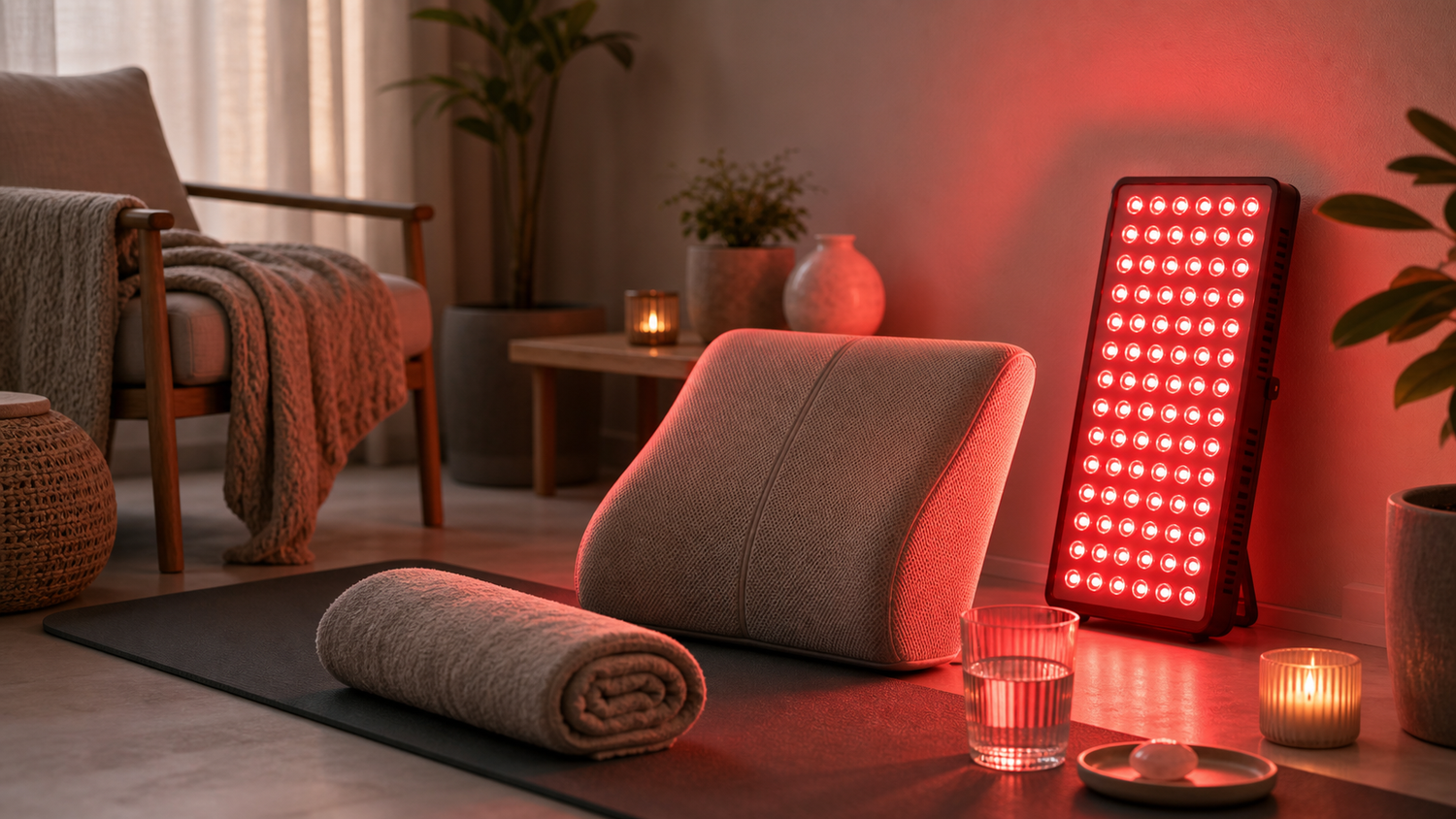
For lower back sessions, lying face-down with the panel positioned above on a stand works well. For mid-back or upper back, seated or standing positions with the panel mounted appropriately can work. Whatever position you choose, the key is being able to maintain a consistent distance for the full session.
Pair with movement and recovery foundations
Red light sessions work best as part of a broader recovery practice that includes appropriate movement, sleep, and other foundations. They are not a substitute for any of those.
The biphasic dose response
More is not better past the optimal dose range. 15-20 minutes per session area is sufficient; extending to 30 or 45 minutes does not produce proportionally more benefit and may reduce response.
Pair with the muscle recovery framework
Red light wellness for back-area recovery shares many of the same mechanics as broader muscle recovery applications. The cellular biology is similar, and the session approach is similar. Our muscle recovery guide covers what the research has explored in athletic and active-adult contexts.
When to consult a healthcare professional
The signals listed at the top of this article are the most important. Beyond those, also consult a healthcare professional before starting any new wellness practice, including red light, if you:
- Take photosensitizing medications
- Have a photosensitive medical condition
- Are pregnant or breastfeeding
- Have implanted medical devices in the session area
- Have a recent history of skin cancer in the session area
- Are recovering from surgery in the back area
- Have any concerns about how red light might interact with your specific situation
Frequently asked questions
Can red light wellness treat back pain?
No. Red light therapy panels are general wellness devices, not treatments for any specific condition. For back pain, professional evaluation and care is the appropriate path — not a wellness device.
What might red light wellness support for the back area?
For users without diagnosed conditions, red light wellness is one supportive practice that may sit alongside the foundations (movement, sleep, ergonomics) of general back-area wellness. Individual responses vary, and red light is supportive at best, not primary.
How long before I might notice anything?
Cellular processes operate on slow timescales. Plan for 4-8 weeks of consistent sessions before evaluating any observed changes. Subjective changes are hard to attribute to any single variable.
Can I use red light alongside physical therapy or chiropractic care?
That's a question for your healthcare provider. Many practitioners are comfortable with general wellness practices alongside their care; the right answer depends on your specific situation. Always be transparent with your providers about everything you're doing.
Should I use heat, cold, or red light?
Different mechanisms with different uses. Heat increases circulation and may reduce muscle tension. Cold reduces inflammation through vasoconstriction. Red light works at the cellular level. They can be combined (apply cold first, then red light later, since cold reduces blood flow that red light effects rely on). Your healthcare provider can guide what's appropriate for your situation.
Is red light wellness safe for the back area?
For most healthy adults using a quality panel at recommended distance and time, the safety profile is benign. For specific medical situations (implants, recent injuries, diagnosed conditions, surgery recovery), consult a healthcare professional first.
The bottom line
Back wellness is an area where the foundations — movement, sleep, ergonomics, stress regulation, professional care — do most of the work. Red light wellness is at most one supportive practice that fits alongside those foundations for users without diagnosed conditions.
The most important framing: any back concern that persists, worsens, significantly affects daily life, follows injury, or causes worry is a signal for professional evaluation — not for self-management with a wellness device. The right path is a qualified healthcare professional who can assess your specific situation.
For users incorporating red light wellness alongside the foundations and professional care where indicated, the SOLRA Red Light Panel delivers 660 nm + 850 nm wavelengths through 40 dual-chip LEDs with verified specs and honest irradiance reporting. $159-229 depending on stand configuration, with free US shipping and a 60-day money-back guarantee.
Frequently asked questions
Can red light wellness treat back pain?
No. Red light therapy panels are general wellness devices, not treatments for any specific condition, and for back pain professional evaluation and care is the appropriate path.
What distance, time, and frequency are suggested for back-area sessions?
Position the panel 6 to 12 inches from the target area for 15 to 20 minutes, 3 to 5 sessions per week, repositioning as needed to cover the larger back area at an adequate dose.
Which wavelength is emphasized for back-area sessions and why?
The 850 nm near-infrared wavelength is more commonly emphasized for body-area sessions because of its deeper tissue penetration, reaching several centimeters into tissue, while 660 nm primarily addresses surface layers.
When should back pain be evaluated by a professional instead of using a wellness device?
Seek professional evaluation for pain that persists more than a few weeks, significantly affects daily life or sleep, follows injury, or comes with numbness, tingling, weakness, or shooting sensations; loss of bladder or bowel control is an immediate emergency requiring care now.
Wellness Disclaimer: The information in this article is for general wellness and educational purposes only and is not intended to diagnose, treat, cure, or prevent any disease. SOLRA products are general wellness devices and have not been evaluated by the FDA. Individual results may vary. Consult a qualified healthcare professional before starting any new wellness practice, especially if you have a medical condition or are taking medications.
About this guide. Written and maintained by the SOLRA Team, who design and support the SOLRA Red Light Panel (660nm red + 850nm near-infrared light). Our guides focus on practical, comfort-first routines and use general wellness language rather than medical claims. Always follow your device instructions and consult a qualified professional about any medical condition. Editorial review: SOLRA Team · Updated June 2026.

Leave a comment
This site is protected by hCaptcha and the hCaptcha Privacy Policy and Terms of Service apply.