
Last Updated: May 20, 2026
Key takeaways
- Modern photobiomodulation traces to NASA's 1960s–70s plant biology research using red LEDs, though saying NASA developed red light therapy is too strong a claim.
- The hypothesis was that wavelengths supporting photosynthesis might interact with animal cells through mitochondrial chromophores like cytochrome c oxidase.
- Two ranges emerged as most studied: red light around 660nm for surface tissue and near-infrared around 850nm for deeper tissue.
- The research base has plausible cellular mechanisms and small-to-medium clinical studies – enough for general wellness use, not a treatment for specific conditions.
- Suggested framework: 6–12 inches, 10–15 minutes face or 15–20 minutes body, 3–5 sessions weekly with eye protection, evaluated over 8–12 weeks.
Most wellness modalities have unremarkable origin stories. Red light wellness is an exception. The line of research that became modern photobiomodulation started not in a dermatology clinic or a wellness lab but in NASA's plant biology experiments in the 1960s and 70s. What followed is one of the more interesting science stories in the broader category of light-based wellness practices.
This guide walks through the history — from early space-program plant research, to the discovery of cellular effects on tissue, to the modern cellular research that defines the field today.
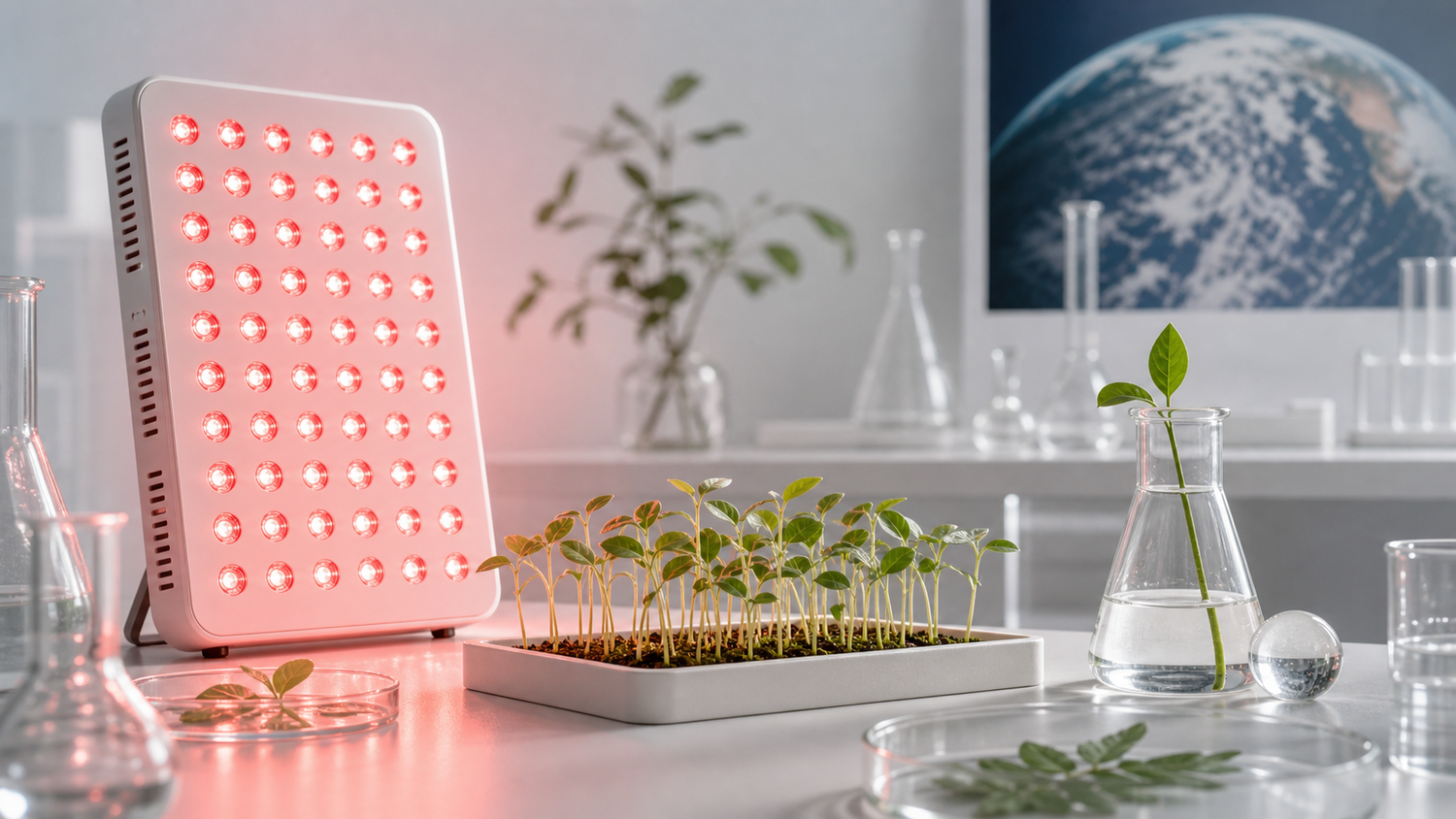
NASA, plants, and red LEDs
In the late 1980s and early 1990s, NASA researchers were exploring whether red LEDs could be used to grow plants in space — with implications for future long-duration missions where crews might need to produce their own food.
The plant biology was straightforward: photosynthesis uses specific wavelengths of light, with red light being especially important. LEDs were efficient, durable, and lightweight — attractive qualities for any payload going into orbit. The question was whether they could deliver enough useful light to keep plants growing.
What researchers observed was that plants grew well under red LED exposure. The more interesting observation came as a side note: the human researchers working with the experiments reported that minor surface concerns on their hands seemed to behave differently. This was an anecdotal observation, not a research finding — but it prompted a question worth following.
From plant biology to cellular research
The hypothesis that emerged was that the same wavelengths that supported photosynthesis in plants might interact with cellular processes in animals — specifically through mitochondrial chromophores.
This was not as speculative as it might sound. Plants and animals share considerable cellular biology. The electron transport chain, ATP production, and the chromophores that absorb specific wavelengths all have evolutionary parallels. The hypothesis was that what worked in plants might have analogues in animal cells.
Research that followed in the 1990s and 2000s explored:
- Whether specific wavelengths affected cellular ATP production
- Which mitochondrial structures absorbed which wavelengths
- How light absorption affected downstream cellular signaling
- Whether observed in-vitro effects translated to whole-organism contexts
By the early 2000s, a reasonably consistent picture had emerged: specific wavelengths of red and near-infrared light are absorbed by cytochrome c oxidase in mitochondria, which may support ATP production and modulate cellular signaling. The full mechanistic picture is in our photobiomodulation science guide.
The wavelengths that matter
Two specific wavelength ranges emerged as the most commonly studied in photobiomodulation research: red light around 660 nm and near-infrared light around 850 nm.
These wavelengths are not arbitrary. They correspond to absorption peaks of cytochrome c oxidase, the enzyme at the end of the mitochondrial electron transport chain. Shorter wavelengths (blue, green) are absorbed by hemoglobin and melanin and don't penetrate far into tissue. Longer wavelengths (far infrared) are absorbed by water and converted to heat. The 600-1000 nm window is the "therapeutic window" where light can interact with cellular structures at meaningful depth without producing heat damage.
For surface tissue, 660 nm is more commonly emphasized. For deeper tissue, 850 nm. Quality home wellness panels deliver both.
From research to wellness practice
The translation from cellular research to consumer wellness products happened gradually, with LED panels becoming widely available in the 2010s as the underlying components became cheaper and more reliable.
The original devices in this category were clinical — used by physical therapists, dermatologists, and other specialists in specific clinical contexts. The home wellness category emerged as the underlying technology became affordable and as consumer interest in cellular-level wellness practices grew.
What the consumer market did well: making the wavelengths accessible to people who wanted to incorporate them into broader wellness routines.
What the consumer market often does poorly: overpromising on outcomes, marketing claims that run ahead of the evidence, and failing to distinguish general wellness use from specific clinical applications.
What the research base actually supports
The honest framing of the current research base: photobiomodulation has plausible cellular mechanisms, decades of research at the cellular and tissue level, and a range of small-to-medium clinical studies across various applications — enough to support general wellness use, not enough to position it as a treatment for any specific medical condition.
Areas with more established research:
- Skin and fibroblast cellular processes
- Muscle recovery and athletic context (see our muscle recovery guide)
- General cellular ATP production and mitochondrial function
- Microcirculation effects
Areas where research is more preliminary:
- Specific clinical conditions
- Long-term outcome data
- Optimal protocols for different individual responses
- Combination effects with other modalities
The biphasic dose response
One of the more consistent findings across the research base is the biphasic dose response: low doses produce stimulatory effects, medium doses produce optimal response, and high doses produce diminishing or no effect. This is counterintuitive — most pharmaceutical contexts follow "more = more" up to saturation. Photobiomodulation behaves differently, with a bell-shaped dose-response curve.
The practical implication: stay within recommended session parameters. Extending sessions to 30 or 45 minutes does not produce proportionally more benefit — and may produce less.
If you've decided to incorporate red light wellness
For users incorporating red light as part of a broader wellness routine, the practical framework that comes up most often:
- Distance: 6-12 inches from skin
- Time: 10-15 minutes for face, 15-20 minutes for body
- Frequency: 3-5 sessions per week
- Wavelengths: Both 660 nm and 850 nm for flexibility
- Eye protection: Every session
- Consistency: 8-12 weeks before evaluating
Our distance guide and frequency guide cover the parameters in more depth.
When to consult a healthcare professional
Red light therapy panels are general wellness devices, not medical interventions. Consult a qualified healthcare professional before starting any new wellness practice, including red light, if you:
- Have a diagnosed medical condition
- Take photosensitizing medications
- Have a photosensitive medical condition
- Are pregnant or breastfeeding
- Have any concerns about how red light might interact with your specific situation
For specific concerns — surface skin issues, persistent comfort issues, anything affecting daily life — a qualified healthcare professional is the right path, not a wellness device.
Frequently asked questions
Did NASA actually develop red light therapy?
NASA's role was in early plant biology research that used red LEDs. The cellular biology research that followed in the broader scientific community is what became modern photobiomodulation research. "NASA developed red light therapy" is too strong a claim — NASA's research was part of the origin story, not the full development.
How long has photobiomodulation been studied?
The field has roots going back to the 1960s with early laser-based research, with the LED-based work taking off in the 1990s and the cellular biology becoming reasonably well characterized by the 2010s. There are now thousands of published studies in the broader field.
Are home panels the same as what's used in research?
Quality home panels deliver wavelengths and irradiances in the range used in many research protocols. Lower-quality home panels often have less wavelength accuracy and less honest irradiance reporting, which makes their performance harder to evaluate. Our cheap panels guide covers the tradeoffs.
What's still unclear in the research?
Optimal protocols for different individuals, long-term outcomes, specific clinical applications, and how red light wellness combines with other modalities are all active research areas. The honest framing is that the cellular mechanisms are reasonably well established and the clinical applications are still being characterized.
The bottom line
Red light wellness has an unusual research history — from space-program plant biology, through decades of cellular research, into the consumer wellness category that exists today. The cellular biology is reasonably well established. The marketing in the consumer category often runs ahead of the evidence. Both can be true at the same time.
For users incorporating red light as part of a broader wellness routine, alongside the foundations and professional care where indicated, it is one supportive practice among many.
If you decide it fits into your routine, the SOLRA Red Light Panel delivers 660 nm + 850 nm wavelengths through 40 dual-chip LEDs with verified specs and honest irradiance reporting. $159-229 depending on stand configuration, with free US shipping and a 60-day money-back guarantee.
Frequently asked questions
Did NASA actually develop red light therapy?
That is too strong a claim. NASA's role was in early plant biology research that used red LEDs, and the cellular biology research that followed in the broader scientific community is what became modern photobiomodulation; NASA's work was part of the origin story, not the full development.
Why are 660 nm and 850 nm the wavelengths that matter?
These wavelengths correspond to absorption peaks of cytochrome c oxidase in mitochondria. Shorter blue and green wavelengths are absorbed by hemoglobin and melanin and do not penetrate far, while longer far-infrared wavelengths are absorbed by water and turn to heat, leaving the roughly 600-1000 nm therapeutic window where light interacts with cells at depth without heat damage.
How long has photobiomodulation been studied?
The field has roots going back to the 1960s with early laser-based research, with LED-based work taking off in the 1990s and the cellular biology becoming reasonably well characterized by the 2010s. There are now thousands of published studies in the broader field.
Are home panels the same as what is used in research?
Quality home panels deliver wavelengths and irradiances in the range used in many research protocols. Lower-quality panels often have less wavelength accuracy and less honest irradiance reporting, which makes their performance harder to evaluate.
Wellness Disclaimer: The information in this article is for general wellness and educational purposes only and is not intended to diagnose, treat, cure, or prevent any disease. SOLRA products are general wellness devices and have not been evaluated by the FDA. Individual results may vary. Consult a qualified healthcare professional before starting any new wellness practice, especially if you have a medical condition or are taking medications.
About this guide. Written and maintained by the SOLRA Team, who design and support the SOLRA Red Light Panel (660nm red + 850nm near-infrared light). Our guides focus on practical, comfort-first routines and use general wellness language rather than medical claims. Always follow your device instructions and consult a qualified professional about any medical condition. Editorial review: SOLRA Team · Updated June 2026.

Leave a comment
This site is protected by hCaptcha and the hCaptcha Privacy Policy and Terms of Service apply.