
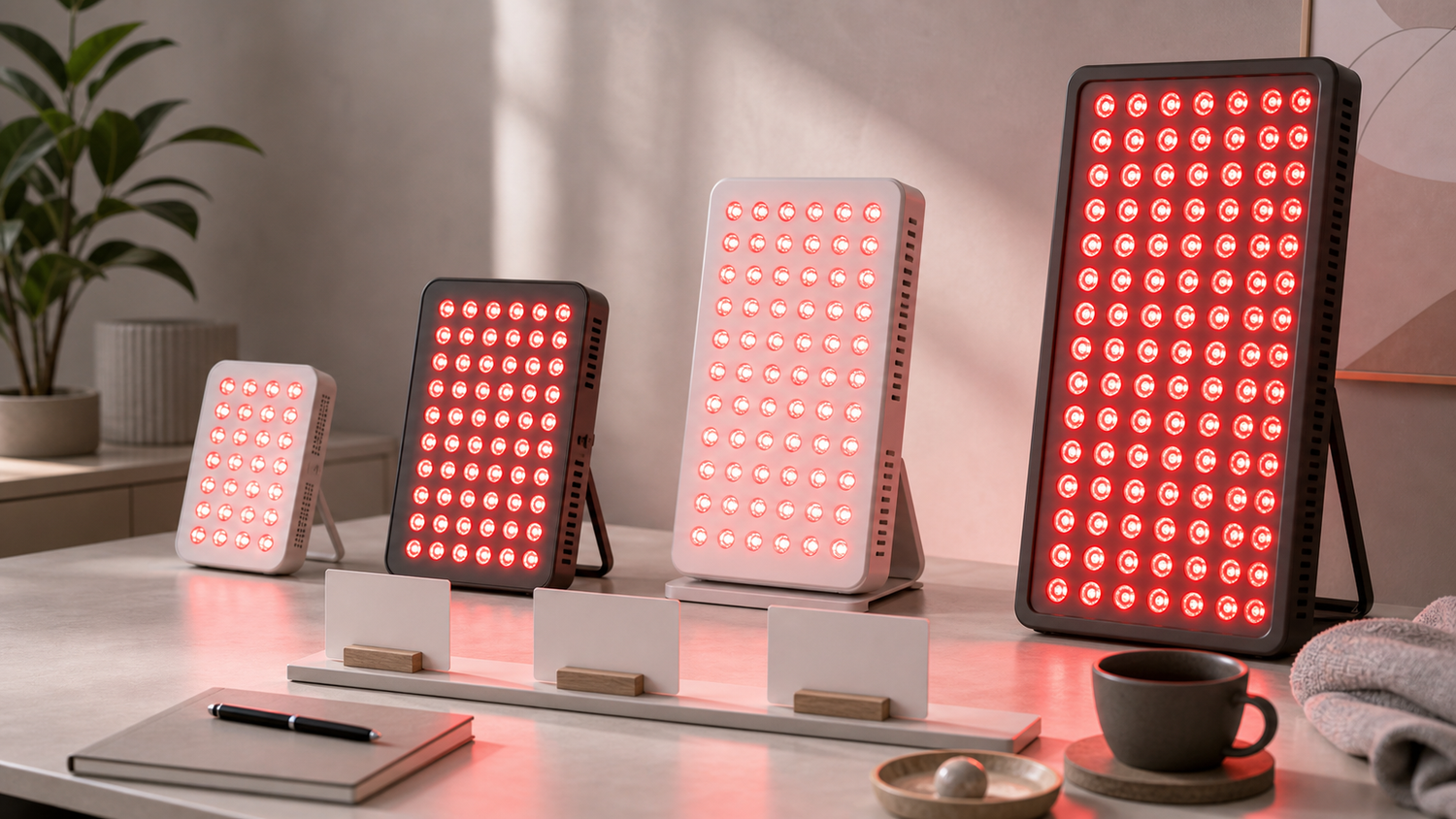
Search Amazon for "red light therapy panel" and you'll find devices starting at $39. Search the premium end of the market and you'll find panels priced at $1,200, $1,800, even $3,000. That's a 75x price spread for what looks, on the surface, like the same category of product.
Key takeaways
- The article concludes the value sweet spot for most home users is $150–300, below which the gap between listing specs and delivered performance widens sharply.
- Cheap panels often have wavelength drift away from 660nm and 850nm, plus irradiance figures measured at zero distance that can be 30–60% higher than real use.
- Inexpensive LEDs may degrade faster, delivering 60–70% of month-one irradiance by month twelve.
- Premium $1,000–3,000 panels deliver real performance but past the point of diminishing returns for typical home use.
- Quality markers discussed include honest irradiance at 6 inches, dual wavelength, solid build, and a real warranty and support contact.
Most buyers want to know two things: are the cheap panels actually working, and is the premium tier worth the markup? The honest answer is more useful than either marketing pitch on either end of the market. This guide walks through what you actually get at each price tier, what's worth paying for, and where the value sweet spot lives.
Quick Answer
Panels under $100 generally underdeliver on wavelength accuracy, real irradiance, and longevity — you can use them, but the dose you're actually getting may be a fraction of what the listing claims. Panels over $1,000 typically deliver real performance but include a substantial brand and feature premium past the point of diminishing returns. The value sweet spot for most home users sits at $150–300, where you get verified wavelengths, honest irradiance, durable build quality, and full-body capability without paying for marketing or features you won't use.
What $50–$100 Panels Don't Tell You
Cheap panels aren't fraudulent in a strict sense — they produce red light. But the gap between what they claim and what they deliver is often substantial. Four specific issues recur in this tier:
1. Wavelength accuracy
Quality red light therapy depends on hitting specific wavelengths — typically 660nm and 850nm — because the absorption curve of cytochrome c oxidase peaks at those wavelengths. LEDs that emit at 640nm or 670nm are not equivalent. Many budget panels use lower-bin LEDs that emit broader, less-targeted wavelengths. The listing says "660nm." The actual output is centered closer to 645nm or 675nm, with a wider distribution. Some of the therapeutic effect still happens. A significant amount is lost.
The full picture on why specific wavelengths matter is in our 660nm vs 850nm guide.
2. Irradiance honesty
Irradiance — the power delivered per square centimeter of skin — is the spec that determines how much dose you receive per minute. Budget panels routinely cite irradiance figures measured at zero distance (touching the device), with the panel running cool, with new LEDs. The number you'd actually achieve at a realistic 6–12 inch treatment distance, with the panel in normal operating temperature, is often 30–60% lower than the headline figure.
This matters because the research that establishes red light therapy's clinical effects uses specific dose ranges. If you're getting half the dose the spec suggests, your sessions need to be twice as long — or you're under-dosing without knowing it. The dose math is in our distance guide.
3. LED quality and degradation
Inexpensive LEDs degrade faster. A panel that delivers reasonable irradiance at month one may be delivering 60–70% of that at month twelve. Premium-bin LEDs from established manufacturers (Osram, Cree, Lumileds) maintain output far longer. Many budget panels use generic LEDs with no quality binning, which is invisible to the buyer but very real over a year of use.
4. Build quality and safety
EMF emissions, thermal management, and electrical safety vary substantially at the low end. Some cheap panels run hot enough to be uncomfortable at clinical distances, which is both a safety concern and a use-case constraint — hot panels are particularly problematic for sensitive skin and any condition with heat sensitivity. Build quality also affects how long the device survives normal home use.
What $1,000–$3,000 Panels Are Actually Selling You
The premium tier delivers real performance — but the math gets harder to defend as price climbs.
- Higher irradiance: Real, measurable, and useful. But the marginal benefit from 150 mW/cm² to 200 mW/cm² is small once you're already above the 50 mW/cm² threshold needed to reach research-protocol doses in reasonable session times.
- Larger coverage area: Premium full-body panels (4–6 feet tall) eliminate repositioning. This matters for people running daily full-body protocols, but is mostly unnecessary for face, joint, and targeted use cases.
- More features: Pulsing modes, app control, multi-wavelength variants, integrated timers. Mostly nice-to-have, occasionally useful, rarely essential.
- Brand premium: A significant portion of price at the very top of the market is brand and marketing spend, not engineering differential.
For a professional setting, a serious athlete running daily full-body recovery protocols, or someone with disposable income who values having the highest-spec device, the premium tier makes sense. For typical home use focused on face, skin, recovery, joints, and the use cases we cover throughout our red light therapy guides, the premium tier delivers diminishing returns on a much larger spend.
The Quality Markers Actually Worth Paying For
Independent of brand, these are the specs and qualities that determine whether a panel will deliver the results research describes:
- Verified wavelengths: True 660nm ± 5nm and 850nm ± 10nm. Specs should be specific, not vague ("red light spectrum" is a red flag).
- Honest irradiance at realistic distance: Quality manufacturers report irradiance at 6 inches, not at zero distance. A panel honestly rated at 50–100 mW/cm² at 6 inches outperforms one claiming 200 mW/cm² at the surface.
- Dual-wavelength configuration: 660nm + 850nm in one device. Single-wavelength panels limit use cases meaningfully.
- LED count and density: Higher LED density at quality binning produces more uniform coverage.
- Build quality: Metal housing, proper thermal management (the panel shouldn't be hot to touch during sessions), and electrical safety certifications.
- Real return and warranty terms: 30+ day returns and 2+ year warranty signal the manufacturer's confidence in the device.
- Customer support that exists: The category has a lot of Amazon-only dropshipped brands with no support channel beyond the listing. A real brand with a real support email is worth the small premium.
The Cost-Benefit Sweet Spot
Looking at the panel market without brand allegiance, the value zone for typical home users sits in the $150–300 range. In that zone you can reasonably find:
- Verified dual-wavelength panels (660nm + 850nm)
- Honest irradiance specs in the 50–100 mW/cm² at 6-inch range
- LED density appropriate to the panel size
- Solid build quality and thermal management
- Coverage sufficient for face, joints, and most body areas with repositioning
- Real warranty and support
Below $150, you typically lose one or more of those. Above $300, you're paying for incremental specs that don't materially change your at-home results until you reach professional or athlete-level daily full-body protocols.
This is also the zone where adding stand options keeps total spend reasonable: a floor stand for hands-free full-body work or a tabletop stand for face-focused use adds $40–70 to a $150–250 panel, keeping the total system under most premium single-device prices. Our panel size guide covers how to think about coverage tradeoffs in this tier.
What to Watch Out For at Any Price
Independent of tier, these are buyer red flags:
- Irradiance claims without specifying measurement distance
- "Red light spectrum" or vague wavelength language instead of specific nm values
- No warranty or warranty terms shorter than 1 year
- No clear return policy
- No company support contact, only an Amazon product page
- Marketing language emphasizing benefits without any specs
- Reviews that are uniformly recent and uniformly five-star (suggests review manipulation)
Bottom Line
Cheap panels are tempting, and not all of them are scams — but the gap between listing specs and delivered performance widens dramatically below $150. Premium panels deliver real performance but well past the point of diminishing returns for typical home use. The math favors the middle tier.
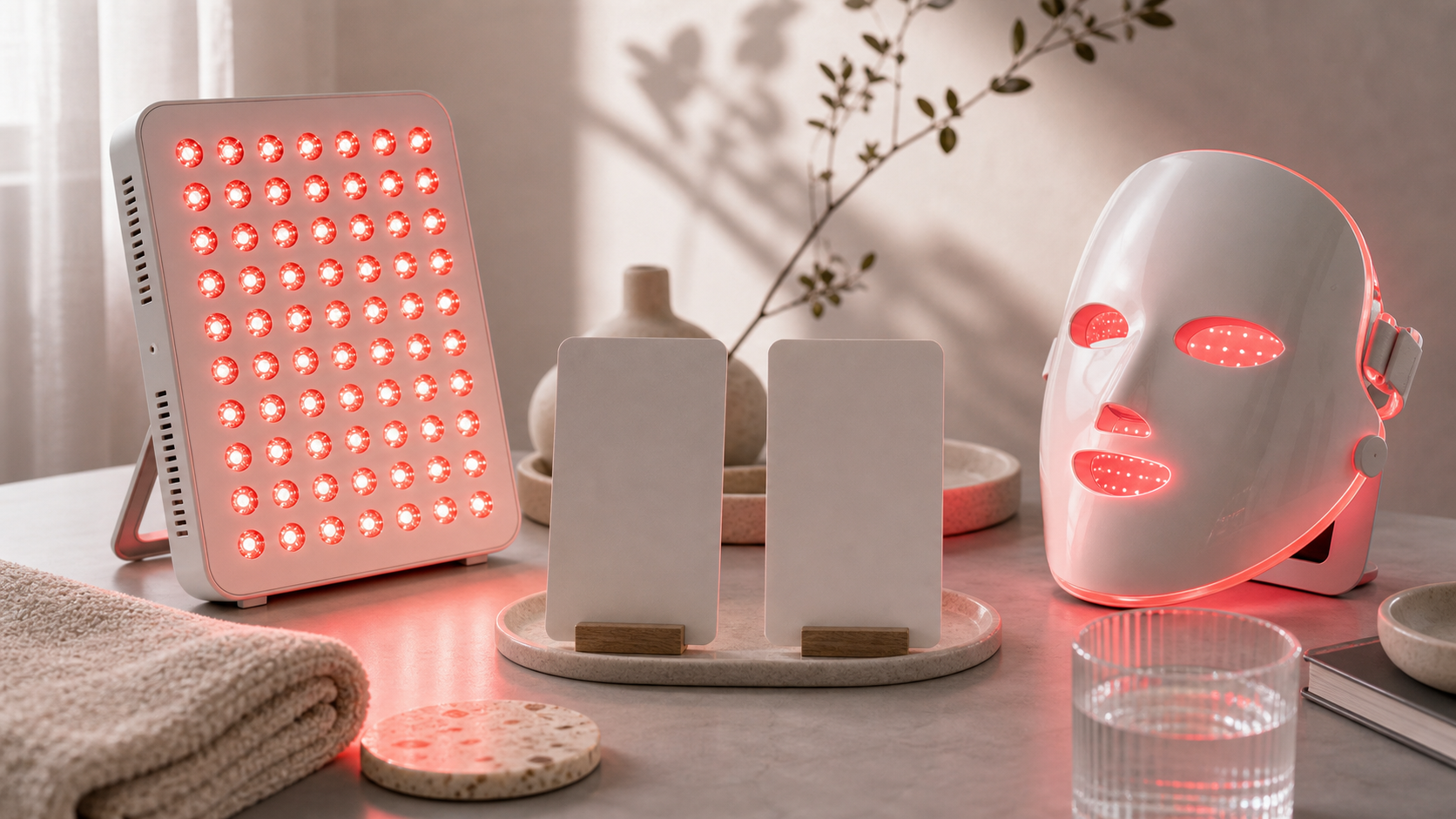
If you're buying your first panel, the practical answer is: don't optimize for the lowest price, and don't pay for the brand premium at the top of the market. Find a panel in the $150–300 zone with verified dual wavelengths, honest specs, real build quality, and a manufacturer that stands behind it. The SOLRA Red Light Panel sits in that zone deliberately — 660nm + 850nm, honest irradiance, durable build, real warranty, and pricing that reflects engineering rather than marketing.
Frequently asked questions
Are cheap red light therapy panels under 100 dollars worth buying?
Panels under 100 dollars generally underdeliver on wavelength accuracy, real irradiance, and longevity, so the dose you are actually getting may be a fraction of what the listing claims. They produce red light but the gap between what they claim and what they deliver is often substantial.
What is the value sweet spot for most home users?
The value sweet spot sits at 150 to 300 dollars, where you can find verified dual-wavelength panels with honest irradiance specs in the 50 to 100 mW per square centimeter at 6 inch range, solid build quality, and a real warranty and support. Below 150 you typically lose one or more of those qualities.
Are premium panels over 1,000 dollars worth the markup?
Premium panels deliver real, measurable performance, but the marginal benefit is small once you are already above the threshold needed to reach research-protocol doses in reasonable session times. A significant portion of price at the very top of the market is brand and marketing spend, not engineering differential.
How can I tell if an irradiance claim is honest?
Quality manufacturers report irradiance at 6 inches, not at zero distance, and a panel honestly rated at 50 to 100 mW per square centimeter at 6 inches outperforms one claiming 200 at the surface. Irradiance claims without a specified measurement distance are a buyer red flag.
Wellness Disclaimer: The information in this article is for general wellness and educational purposes only and is not intended to diagnose, treat, cure, or prevent any disease. SOLRA products are general wellness devices and have not been evaluated by the FDA. Individual results may vary. Consult a qualified healthcare professional before starting any new wellness practice, especially if you have a medical condition or are taking medications.
About this guide. Written and maintained by the SOLRA Team, who design and support the SOLRA Red Light Panel (660nm red + 850nm near-infrared light). Our guides focus on practical, comfort-first routines and use general wellness language rather than medical claims. Always follow your device instructions and consult a qualified professional about any medical condition. Editorial review: SOLRA Team · Updated June 2026.

Leave a comment
This site is protected by hCaptcha and the hCaptcha Privacy Policy and Terms of Service apply.