
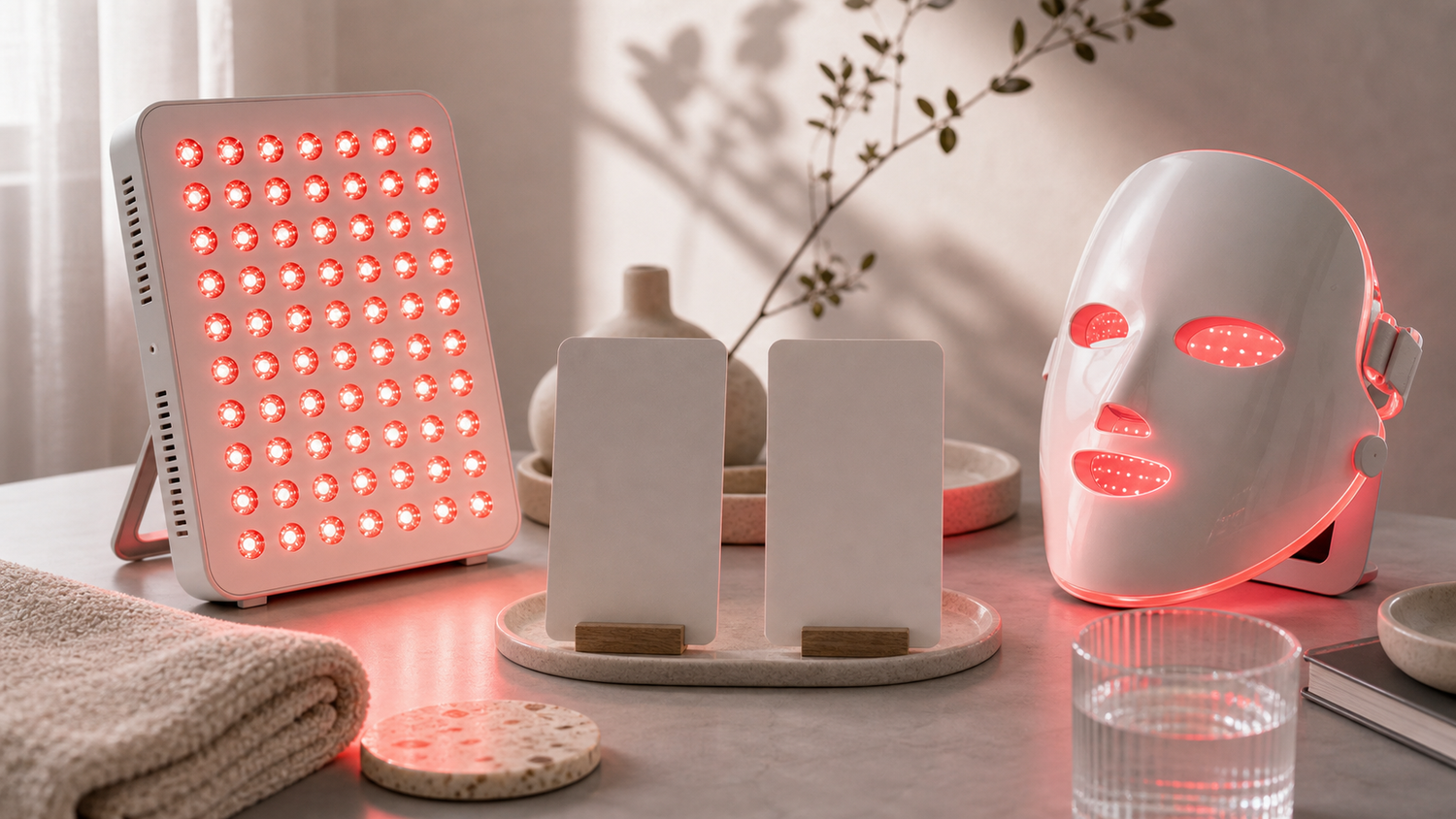
If you've spent any time researching red light therapy for skin, you've run into the same fork in the road: an LED face mask, or a red light therapy panel. Both promise similar benefits. Both use red and near-infrared wavelengths. The price ranges overlap. The marketing overlaps. The actual right answer for most people doesn't.
Key takeaways
- The article concludes a panel is the better long-term buy for nearly everyone, while a mask suits people who only ever want hands-free facial use.
- Both use similar wavelengths (around 630–660nm red, often with 830–850nm near-infrared), but panels deliver higher irradiance – 30–100+ mW/cm² at 6 inches versus 4–20 mW/cm² for masks.
- A panel covers the face plus body, joints, and scalp, and offers distance flexibility from 6 to 24 inches.
- On cost, quality dual-wavelength panels run $150–250 for face plus full-body use, often below premium face masks at $300–500.
- Hands-free use is achievable with a panel on a tabletop or floor stand, weakening the mask's main advantage.
This guide cuts through the marketing parity and walks you through how these two device categories actually differ — in coverage, power, versatility, and cost-per-outcome — so you can pick the one that fits how you'll actually use it.
Quick Answer
An LED face mask makes sense if you exclusively want a hands-free, low-effort facial treatment and you'll never use red light therapy for anything beyond your face. A red light therapy panel makes sense for nearly everyone else — it covers the face equally well (with the right stand), delivers higher irradiance, and treats the rest of your body, joints, scalp, and any other area you might want to address later. For most buyers, the panel is the better long-term purchase.
The Core Difference: Coverage and Power
Both devices use the same general wavelengths (typically 630–660nm red, sometimes paired with 830–850nm near-infrared). The mechanism at the cellular level is the same. The differences are in three engineering decisions:
- Coverage area: Masks cover your face. Panels cover your face plus everything else.
- Irradiance (power delivered to skin): Most LED masks operate at 4–20 mW/cm² at skin contact. Quality panels operate at 30–100+ mW/cm² at 6 inches. This is a real, measurable gap.
- Distance flexibility: A mask sits on your face at one distance. A panel can move from 6 inches (intensive) to 24 inches (gentle), letting you adjust dose without buying a new device.
The irradiance gap matters more than most masks let on. The research that demonstrates collagen support, anti-inflammatory effects, and other documented outcomes is typically run at irradiance levels in the panel range. Lower-irradiance devices reach the same dose only by extending session time — sometimes substantially. The math is covered in our distance guide.
Where the Face Mask Wins
Honest analysis: there are genuine situations where a face mask is the right choice.
- Pure hands-free convenience. A mask sits on your face while you do something else. No positioning required.
- Travel. Most masks are flexible and pack easily. Panels do not travel well.
- Multi-tasking during sessions. Reading, working, scrolling — a mask doesn't require you to face a device.
- Limited goals. If you're only addressing facial concerns and you won't expand the use case, a mask covers exactly that use case.
If those four points describe your actual situation — and you're confident the use case won't expand — a mask is a reasonable buy. The Solawave, CurrentBody, and Omnilux lines are not bad products within their narrow scope.
Where the Panel Wins
For almost everyone else, a panel is the more useful device. The reasons compound:
- Higher irradiance. Quality panels deliver research-protocol-equivalent dose in shorter sessions. Sessions of 10–15 minutes at 6–12 inches are achievable with a panel; the same dose with a mask takes 20–30+ minutes.
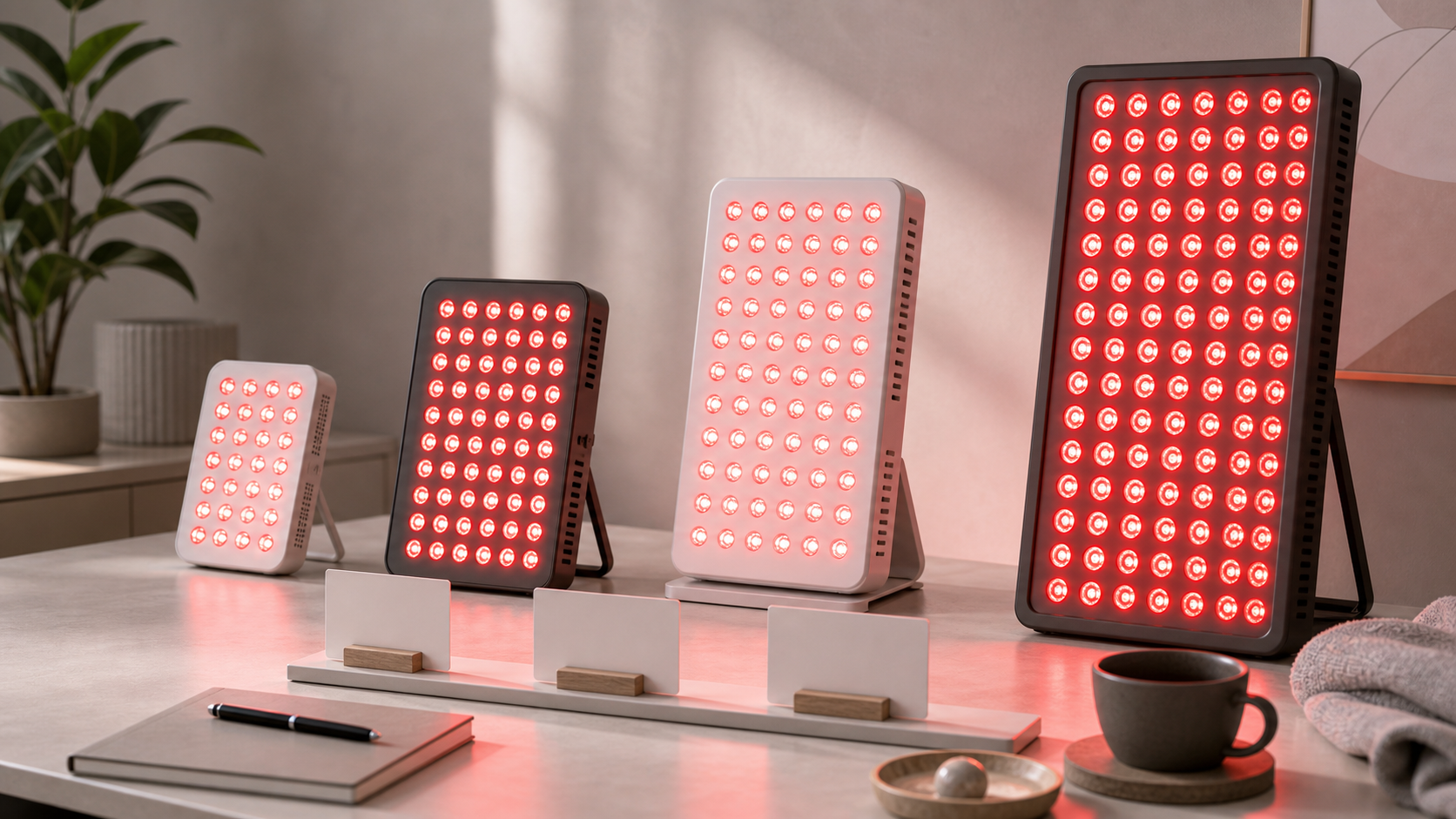
- Full face coverage at distance. A panel covers your whole face plus neck, décolleté, scalp — areas masks rarely treat well. The panel size guide covers what each size handles.
- Versatility. Once you have a panel, you can use it on skin, scalp, joints, muscles, the back, and anywhere else without buying additional devices.
- Distance flexibility. Same device can run intensive (6 inches) or gentle (24 inches) protocols. Useful for sensitive skin or graduated dosing.
- Both wavelengths in one device. Most masks emphasize 630–660nm. Most quality panels deliver 660nm + 850nm together. The deeper-penetrating 850nm reaches deeper tissue, while 660nm targets surface layers.
- Hands-free is achievable. The argument that masks are uniquely hands-free is weaker than it sounds. A panel on a tabletop stand or floor stand is fully hands-free during sessions.
The Cost Math
This is where the comparison gets sharp.
- Premium LED face masks: $300–500 for face-only coverage
- Mid-tier LED face masks: $150–300, often with lower irradiance and limited wavelengths
- Quality dual-wavelength home panel: $150–250 for face plus full-body capability
The market structure is counterintuitive. A face-only device often costs more than a full-body capable device, because the mask category has been pushed into beauty-premium pricing while panels are sold closer to functional equipment pricing. For more on overall RLT pricing, see our cost guide.
Cost-per-use math
If you only use a $400 mask for facial sessions, your cost-per-use across one year of 4x-weekly sessions is roughly $1.92 per session. If you use a $200 panel for face plus body (say, three different use cases at 4x weekly), your cost-per-use across the same period is roughly $0.32 per session. The panel pays itself back many times over once you expand beyond the face.
The Decision Framework
Three questions decide the right device for you:
- Are you using it on anything beyond your face? Joints, muscles, scalp, body skin, recovery, sleep support — if yes to any of these, panel.
- Do you want research-protocol-equivalent dosing in shorter sessions? If yes, panel (higher irradiance).
- Is your only constraint pure hands-free convenience while moving around the house? If yes and only yes, mask.
For most red light therapy buyers, the honest answer is that the use case expands over time. Someone who starts with skin interest discovers they also have a sore shoulder, or post-workout recovery, or seasonal sleep disruption — all addressable with a panel, none addressable with a mask without buying additional devices.
What About Combining Both?
Some people buy both. This is a defensible strategy only in a specific situation: you have an established face-mask routine you genuinely enjoy and won't break, and you want to add body capability separately. The panel becomes the body device, the mask stays the face device. Total spend is higher but each device gets used.
For first-time buyers, this is almost always the wrong move. Buy the panel, use it for face initially (it works just as well there with proper distance), and skip the mask entirely unless you discover, after months of use, that the convenience gap actually matters for you.
Bottom Line
LED face masks are functional devices within a narrow use case. Red light therapy panels are general-purpose devices that handle the face just as well plus everything else, at higher delivered dose, with more flexibility, and typically at lower or comparable cost.
For nearly every first-time red light therapy buyer, a panel is the better purchase — not because masks are useless, but because the panel doesn't lock you into one use case and doesn't underdeliver on power. The SOLRA Red Light Panel delivers 660nm + 850nm at research-protocol-equivalent irradiance, pairs with a tabletop stand for face-focused use or a floor stand for full-body work, and comes in at panel-category pricing that's often below the premium mask category.
Buy the device that won't limit you. Spend the savings on consistency.
Quick comparison
| Red light panel | LED face mask | |
|---|---|---|
| Irradiance at 6 in | ~30–100+ mW/cm² | ~4–20 mW/cm² |
| Coverage | Face plus body, joints, scalp | Face only |
| Distance flexibility | 6–24 inches | Fixed to face |
| Typical cost | $150–250 (face + full body) | $300–500 (premium) |
| Hands-free | Yes, on a tabletop or floor stand | Yes |
Frequently asked questions
Should I buy an LED face mask or a red light therapy panel?
An LED face mask makes sense if you exclusively want a hands-free, low-effort facial treatment and will never use red light therapy beyond your face. A panel makes sense for nearly everyone else because it covers the face equally well with the right stand, delivers higher irradiance, and treats the rest of the body.
How do the irradiance levels of masks and panels compare?
Most LED masks operate at 4 to 20 mW per square centimeter at skin contact, while quality panels operate at 30 to 100 or more mW per square centimeter at 6 inches. Lower-irradiance devices reach the same dose only by extending session time, sometimes substantially.
Which device tends to cost less?
Premium LED face masks run 300 to 500 dollars for face-only coverage and mid-tier masks 150 to 300 dollars, while a quality dual-wavelength home panel runs 150 to 250 dollars for face plus full-body capability. A face-only device often costs more than a full-body capable device because masks have been pushed into beauty-premium pricing.
Can a panel be used hands-free like a mask?
Yes, the argument that masks are uniquely hands-free is weaker than it sounds, because a panel on a tabletop stand or floor stand is fully hands-free during sessions. Sessions of 10 to 15 minutes at 6 to 12 inches are achievable with a panel.
Wellness Disclaimer: The information in this article is for general wellness and educational purposes only and is not intended to diagnose, treat, cure, or prevent any disease. SOLRA products are general wellness devices and have not been evaluated by the FDA. Individual results may vary. Consult a qualified healthcare professional before starting any new wellness practice, especially if you have a medical condition or are taking medications.
About this guide. Written and maintained by the SOLRA Team, who design and support the SOLRA Red Light Panel (660nm red + 850nm near-infrared light). Our guides focus on practical, comfort-first routines and use general wellness language rather than medical claims. Always follow your device instructions and consult a qualified professional about any medical condition. Editorial review: SOLRA Team · Updated June 2026.

Leave a comment
This site is protected by hCaptcha and the hCaptcha Privacy Policy and Terms of Service apply.