
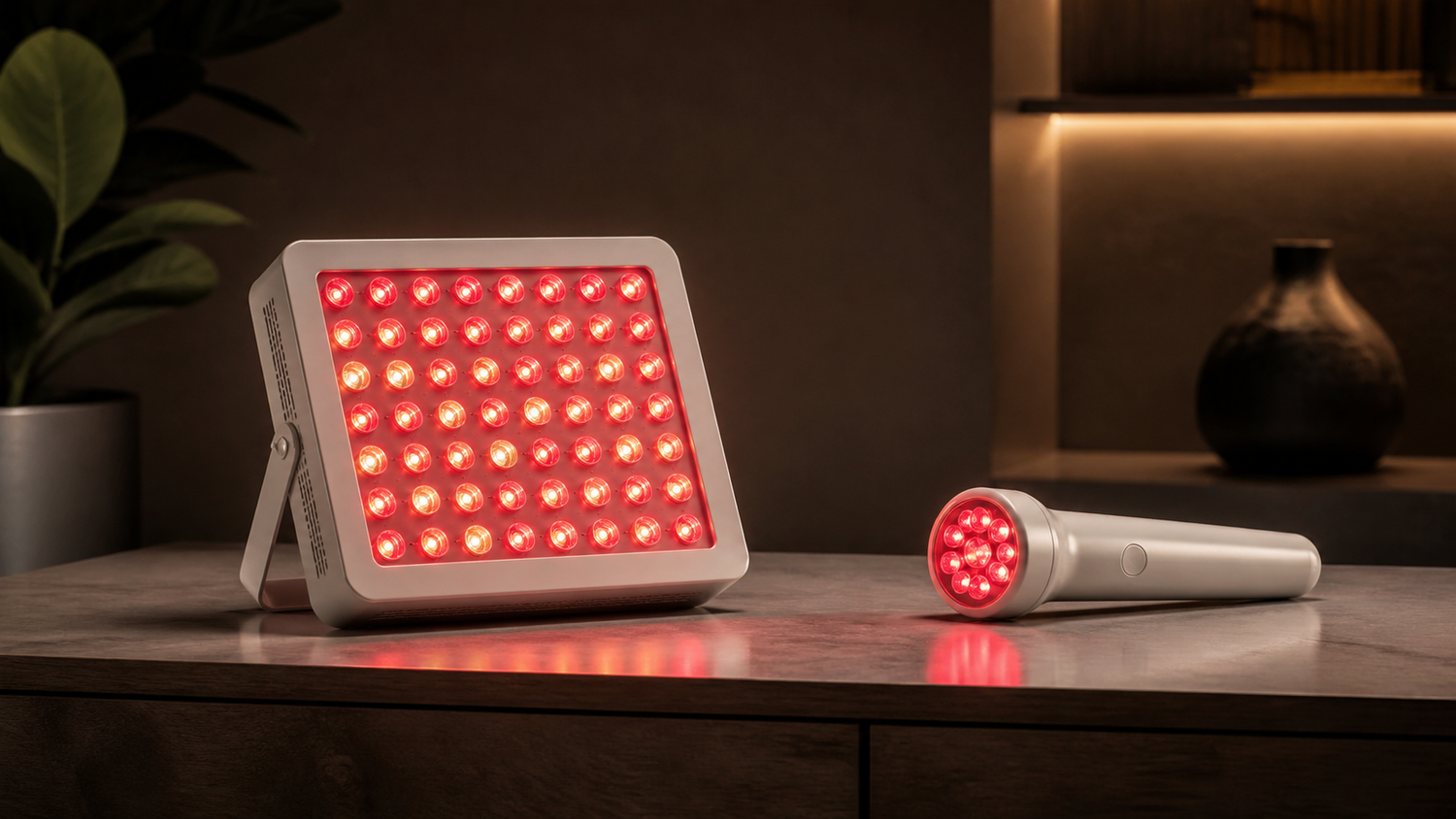
Alongside panels, the market is full of handheld red light devices — wands, torches, and small spot treatments. They look convenient and often cost less, which raises a fair question: do you need a panel at all, or will a handheld do? The honest answer is that they suit different jobs. Here is how to tell which fits your routine.
Key takeaways
- A panel covers a large area at once, making it suited to full-body or multi-area routines; a handheld wand or torch covers a small spot and is built for pinpoint use.
- Handhelds are portable and often cheaper, but you hold them and cover one small area at a time, which adds up for larger routines.
- A panel is hands-free on a stand and covers more per session; a handheld trades coverage for portability and targeted convenience.
- Choose by routine: broad or whole-body use favors a panel, occasional small-spot use favors a handheld — and some people use both.
The core difference: coverage vs pinpoint
The essential split is how much they light up at once. A panel is a large array of LEDs designed to cover a sizable area — your face and chest, your back, or much of the body depending on size and distance. A handheld wand or torch concentrates a small amount of light on a small spot, meant to be moved around by hand. That single difference drives everything else about how they fit a routine, and it connects to coverage area more broadly.
Convenience cuts both ways
Handhelds win on portability and price, and for a quick, single-spot routine that is genuinely handy. But "handheld" also means you are holding it and treating one small area at a time. For anything broad — a full-body routine, or several areas in a sitting — that becomes slow and tiring compared to sitting in front of a hands-free panel. A panel on a stand runs while you relax; a wand runs while you work.
Panel vs handheld at a glance
| Factor | Red light panel | Handheld wand / torch |
|---|---|---|
| Coverage per session | Large area at once | Small spot at a time |
| Hands-free? | Yes, on a stand | No — you hold it |
| Best for | Full-body & multi-area routines | Occasional pinpoint use |
| Portability | Less portable (though travel options exist) | Very portable |
| Typical cost | Higher | Often lower |
Which one fits your routine?
Let your actual use decide. If you want to cover the face and body, do multi-area sessions, or build a repeatable at-home routine, a panel's coverage and hands-free setup make it the practical choice. If you only want the occasional small-spot session and value pocket-sized portability, a handheld may be enough. Some people even keep both — a panel for the main routine, a handheld for travel or quick touch-ups. Our panel vs face mask comparison covers a related "coverage vs form-factor" decision.
Do not judge by size alone
A final caution: a small device is not automatically a bargain, and a big one is not automatically better. Whatever the form factor, the fundamentals still matter — sensible wavelengths, honest irradiance reporting at a stated distance, and a design you will actually use. A handheld with vague specs is not a smarter buy than a well-specified panel just because it costs less. Our guide to what cheap panels actually get you applies to handhelds too.
Frequently asked questions
Is a red light panel better than a handheld wand?
Neither is universally better; they suit different jobs. A panel covers a large area hands-free and fits full-body or multi-area routines, while a handheld wand or torch covers a small spot at a time and suits occasional pinpoint use and portability.
Are handheld red light devices worth it?
For quick, single-spot routines and travel, a handheld can be genuinely handy and often costs less; the trade-off is that you hold it and cover one small area at a time, which becomes slow and tiring for broad or whole-body routines.
Can a handheld replace a full panel?
For broad or whole-body routines, not really — you would be treating one small spot at a time by hand. If your routine is mostly occasional small-spot use, a handheld may be enough, and some people keep both a panel and a handheld.
Does a smaller red light device mean worse results?
Size alone does not decide quality. Whatever the form factor, the fundamentals matter — sensible wavelengths, honest irradiance reporting at a stated distance, and a design you will actually use; a handheld with vague specs is not a smarter buy just because it costs less.
Where SOLRA fits
Choose the configuration that matches your space: a tabletop setup for compact, seated routines, or a floor stand for larger areas and full-body sessions. The SOLRA Red Light Panel is built around 660nm red light and 850nm near-infrared light, with setup options for panel-only use, tabletop placement, or a complete floor-stand kit.
Quick safety notes
Red light wellness routines should feel comfortable. Avoid staring directly into bright LEDs, follow your device instructions, and consult a qualified professional if you are pregnant, photosensitive, using light-sensitive medication, or managing a medical condition.
Wellness disclaimer: SOLRA products are general wellness devices and have not been evaluated by the FDA. This article is for educational purposes only and is not intended to diagnose, treat, cure, or prevent any disease. Consult a qualified healthcare professional before beginning a new wellness practice, especially if you have a medical condition or take medication.
About this guide. Written and maintained by the SOLRA Team, who design and support the SOLRA Red Light Panel (660nm red + 850nm near-infrared light). Our guides focus on practical, comfort-first routines and use general wellness language rather than medical claims. Always follow your device instructions and consult a qualified professional about any medical condition. Editorial review: SOLRA Team · Updated July 2026.

Leave a comment
This site is protected by hCaptcha and the hCaptcha Privacy Policy and Terms of Service apply.