
Last Updated: May 9, 2026
Key takeaways
- The article says both morning and night work: morning sessions tend to support energy, mood & circadian rhythm, while evening sessions support recovery, skin, and sleep.
- Red and near-infrared light do not suppress melatonin the way blue and white light do, which is discussed as making them suitable for evening use.
- Consistency is presented as mattering far more than timing, with daily sessions at any time beating occasional perfectly-timed ones.
- Standard sessions are 10–20 minutes per area, with facial use around 5–10 minutes and the response saturating near 15 minutes for the face.
- The best time is framed as the one you can sustain daily for at least 90 days, chosen by your primary goal and schedule.
You bought the panel. You've worked out where it'll live. Now the practical question: when do you actually use it? Morning routine, between Zoom calls, after the gym, before bed? Does it matter?
The short answer: yes, timing matters - but maybe not in the way you think. There's no single "best" time that works for everyone. The right time depends on what you're trying to achieve, when you can be consistent, and whether late-night sessions affect your sleep.
This guide breaks down exactly when to use red light therapy based on your goals, the circadian rhythm science behind it, and how to build a sustainable routine that actually works.
Is morning or night better for red light therapy?
Both work - but morning sessions tend to support energy, mood, and circadian rhythm, while evening sessions support recovery, skin repair, and sleep quality. The "best" time depends on your primary goal and your schedule consistency.
Here's the honest truth most articles dance around: the timing difference is real but smaller than people make it out to be. Consistency matters far more than timing. Daily morning sessions beat occasional perfectly-timed evening sessions every time.
How does red light therapy interact with circadian rhythm?
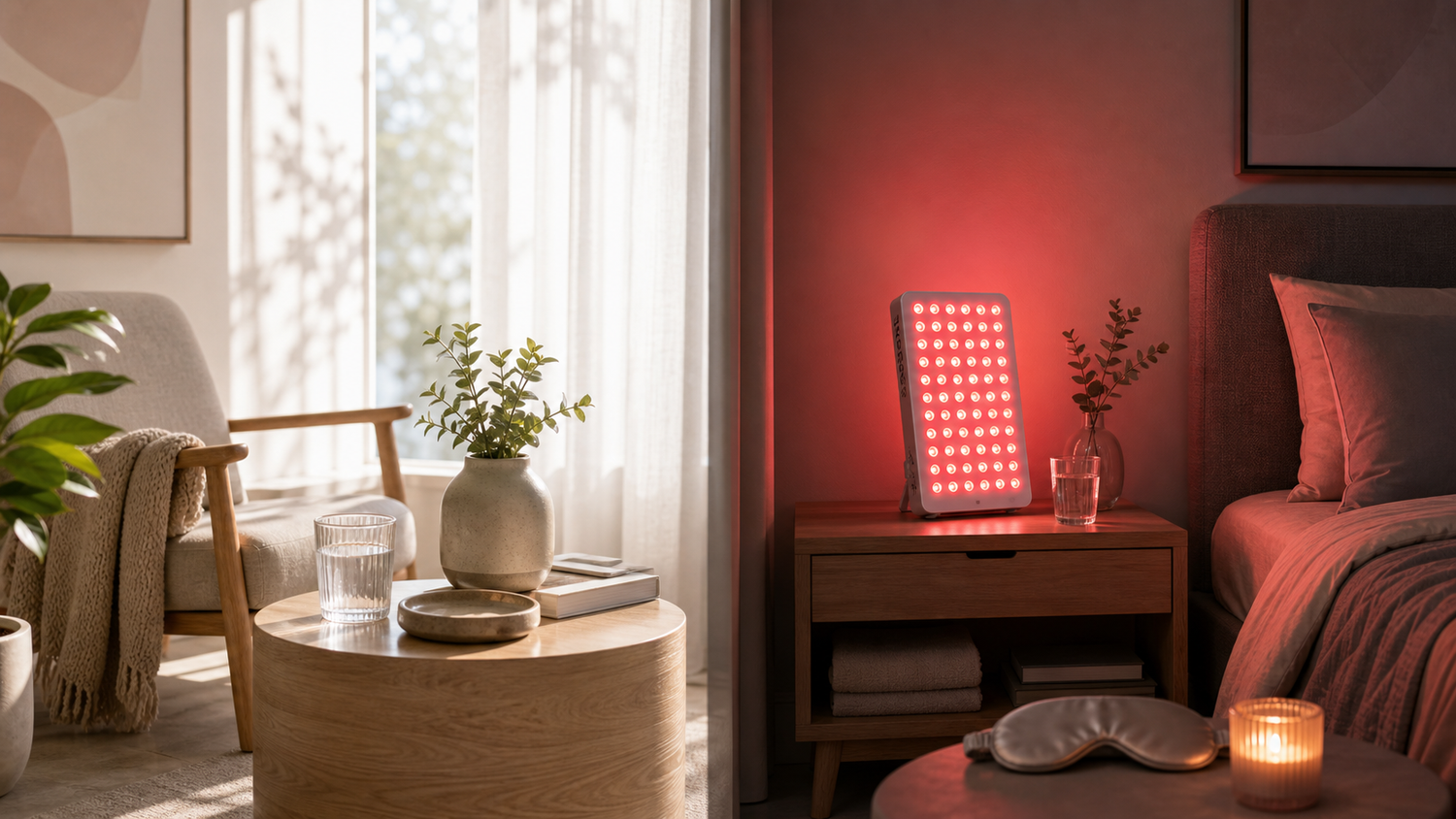
Red and near-infrared light don't suppress melatonin the way blue and white light do, which makes them safe for evening use - but bright morning red light exposure can still help anchor a healthy circadian rhythm.
Your circadian rhythm is the 24-hour internal clock that regulates sleep, hormones, body temperature, and alertness. It's primarily set by light exposure - bright light in the morning signals "wake up," low light in the evening signals "wind down."
The key wavelength facts:
- Blue light (450-490nm): Strongly suppresses melatonin. This is why screens before bed disrupt sleep.
- Green light (495-570nm): Mildly suppresses melatonin.
- Red light (620-700nm): Does NOT suppress melatonin. Some research suggests it may even support melatonin production.
- Near-infrared (700-1100nm): No effect on melatonin. Penetrates skin, doesn't interact with eye photoreceptors that govern circadian timing.
This is why a 7 PM red light session won't wreck your sleep the way 30 minutes of phone scrolling will. The wavelengths are biologically distinct.
That said: the LED brightness itself can be stimulating if you're staring directly at panels late at night. Wear your eye protection and don't use red light therapy as your last activity before lights-out.
Benefits of morning red light therapy
Morning red light therapy supports circadian rhythm, energy levels, mood, and provides full-day "head start" on cellular processes that compound throughout the day.
The case for morning sessions:
1. Reinforces healthy cortisol rhythm
Cortisol naturally peaks 30-45 minutes after waking - this is the "cortisol awakening response" that gives you energy. Bright light exposure within the first hour of waking supports this peak. Red light, while not as bright as outdoor sun, contributes to the morning light signal.
2. Supports daytime alertness
Mitochondrial activation in the morning supports cellular energy throughout the day. Some users report feeling more "switched on" in the hours after a morning session.
3. Mood and seasonal affective support
Morning bright-light exposure is the gold-standard treatment for seasonal affective disorder. Red light isn't a direct substitute for full-spectrum SAD lamps, but it adds to the morning light dose, especially in winter or for people with limited natural light access.
4. Easier to maintain consistency
Morning routines tend to be more consistent than evening ones - you're less likely to skip due to social plans, fatigue, or unpredictable evenings.
5. Pairs well with skin routine
Cleanse, red light session, then apply morning skincare (serums, moisturizer, sunscreen). The sequence makes natural sense.
6. Pre-workout warmup support
If you train in the morning, a brief red light session before exercise may support circulation and joint comfort.
Benefits of evening red light therapy
Evening red light therapy supports overnight cellular repair, recovery from the day's physical activity, may improve sleep quality, and aligns with the body's natural nighttime regeneration processes.
The case for evening sessions:
1. Supports overnight recovery
Most cellular repair happens during sleep. An evening session "primes" cells with the energy boost that supports overnight regeneration.
2. May improve sleep quality
Some studies suggest red light exposure in the evening (without bright LED interference) may support deeper sleep.
3. Calms post-exercise inflammation
If you train in the evening, post-workout red light therapy supports recovery while you sleep.
4. Skin overnight repair
Skin enters its primary repair phase during sleep. Evening sessions support this natural cycle.
5. Wind-down ritual
10-15 minutes in front of a calm red light panel, away from phones, can serve as an effective transition from the work day to evening relaxation.
6. Better skin product penetration
Evening red light followed by serums and night cream may support better absorption.
How to choose between morning and night for your routine
Pick the time that you can sustain daily for at least 90 days. Use this decision framework:
Choose morning if:
- You want energy and mood support
- Your evenings are unpredictable (social, family, work)
- You wake up early and have a consistent morning window
- You have seasonal affective tendencies or limited daylight access
- You exercise in the morning
- You prefer not to think about wellness routines after work
Choose evening if:
- Your priority is skin/hair recovery and overnight regeneration
- You exercise in the evening and want post-workout sessions
- You have a consistent evening wind-down routine
- You want a transition activity from work-mode to rest-mode
- Your mornings are too rushed for 10-20 minutes
- You want to combine with night skincare or PM retinoid routines
How long should each session be?
Standard sessions are 10-20 minutes per body area, regardless of time of day. Shorter sessions (5-10 min) work for facial use; longer sessions (15-20 min) work for body or scalp.
Time-of-day specific tips:
- Morning: Shorter sessions (10-15 min) fit better into busy mornings
- Evening: Longer sessions (15-20 min) work as wind-down rituals
- Multiple short sessions: If you split AM/PM, 5-10 min each is fine
The cellular response saturates around 15 minutes for facial use - going to 30 minutes doesn't double the effect. Stick to recommended durations.
The bottom line
The best time for red light therapy is the time you'll actually do it every day. The minor differences between morning and evening matter less than 90 days of consistent use at any time of day.
If you want a simple recommendation: morning sessions for most general wellness goals (consistency tends to be higher, circadian benefits add up), evening sessions if you're recovery-focused or want a wind-down ritual.
The SOLRA Red Light Panel is built for daily use - quick to position, fast to warm up, with a wired design that delivers consistent power session after session whether you use it at 7 AM or 9 PM.
Shop the SOLRA Red Light Panel - From $159 with Free US Shipping ->
Frequently asked questions
Is morning or night better for red light therapy?
Both work; morning sessions tend to support energy, mood, and circadian rhythm, while evening sessions support recovery, skin repair, and sleep quality, so the best time depends on your goal and what you can do consistently.
Will an evening red light session disrupt my sleep?
Red and near-infrared light do not suppress melatonin the way blue and white light do, so a 7 PM session should not wreck sleep, though the LED brightness can be stimulating if you stare directly at panels late at night.
How long should each session be regardless of time of day?
Standard sessions are 10 to 20 minutes per body area, with shorter 5 to 10 minute sessions for facial use and longer 15 to 20 minute sessions for body or scalp.
Does timing matter more than consistency?
No. The article states consistency matters far more, noting daily morning sessions beat occasional perfectly-timed evening sessions and recommending you pick a time you can sustain daily for at least 90 days.
Wellness Disclaimer: The information in this article is for general wellness and educational purposes only and is not intended to diagnose, treat, cure, or prevent any disease. SOLRA products are general wellness devices and have not been evaluated by the FDA. Individual results may vary. Consult a qualified healthcare professional before starting any new wellness practice, especially if you have a medical condition or are taking medications.
About this guide. Written and maintained by the SOLRA Team, who design and support the SOLRA Red Light Panel (660nm red + 850nm near-infrared light). Our guides focus on practical, comfort-first routines and use general wellness language rather than medical claims. Always follow your device instructions and consult a qualified professional about any medical condition. Editorial review: SOLRA Team · Updated June 2026.

Leave a comment
This site is protected by hCaptcha and the hCaptcha Privacy Policy and Terms of Service apply.