
Last Updated: May 20, 2026
Key takeaways
- For midlife wellness, red light is one possible supportive layer alongside the foundations – not a treatment for any specific midlife concern, hormonal change, or symptom.
- The cellular research spans skin collagen and microcirculation, sleep and circadian rhythm, recovery, and joint comfort, with effects accumulating gradually.
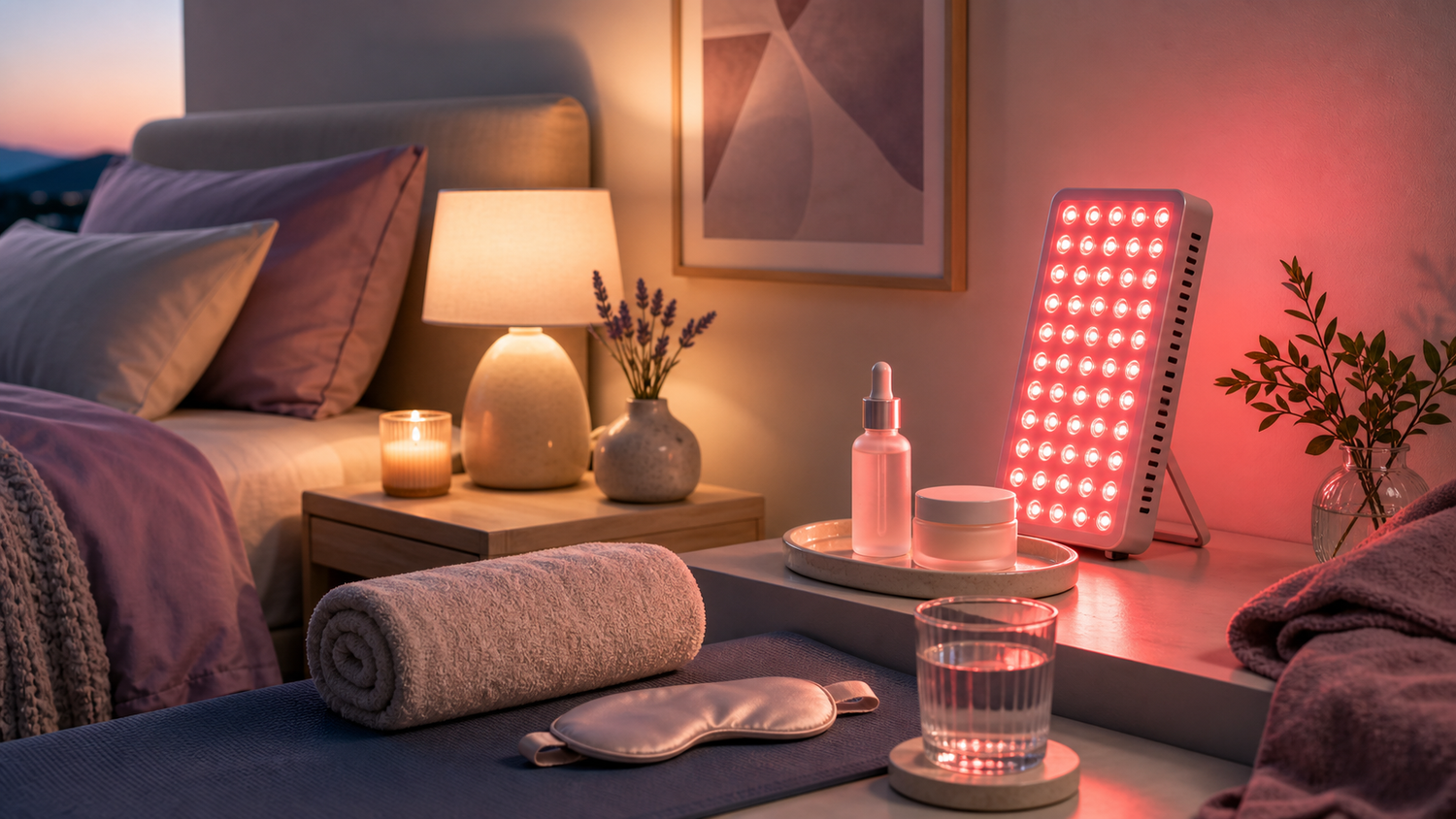
- Red and near-infrared wavelengths produce minimal melatonin suppression, so evening sessions may be more sleep-compatible than bright blue-rich light.
- Suggested approach: 660nm & 850nm at 6–12 inches, 10–15 minutes face or 15–20 minutes body, 3–5 sessions weekly, evaluated over 8–12 weeks.
- Hormonal changes and persistent symptoms warrant a qualified healthcare professional, as red light is not a hormonal modality.
Midlife is when wellness routines tend to benefit from more intentionality. The body responds differently to stress, recovery, sleep, and skincare in your 40s and 50s than it did in your 20s and 30s. Many people in these years find themselves layering additional supportive practices into their routine — not because anything is wrong, but because the foundations that quietly worked before now benefit from being more actively maintained.
Red light wellness has become one of those layers for some people. The cellular research base spans several areas relevant to midlife wellness goals — skin processes, sleep and circadian rhythm, and recovery. This guide walks through what the research suggests, where red light wellness may fit into broader midlife routines, and where professional care is the right path instead.
What red light wellness is, at the cellular level
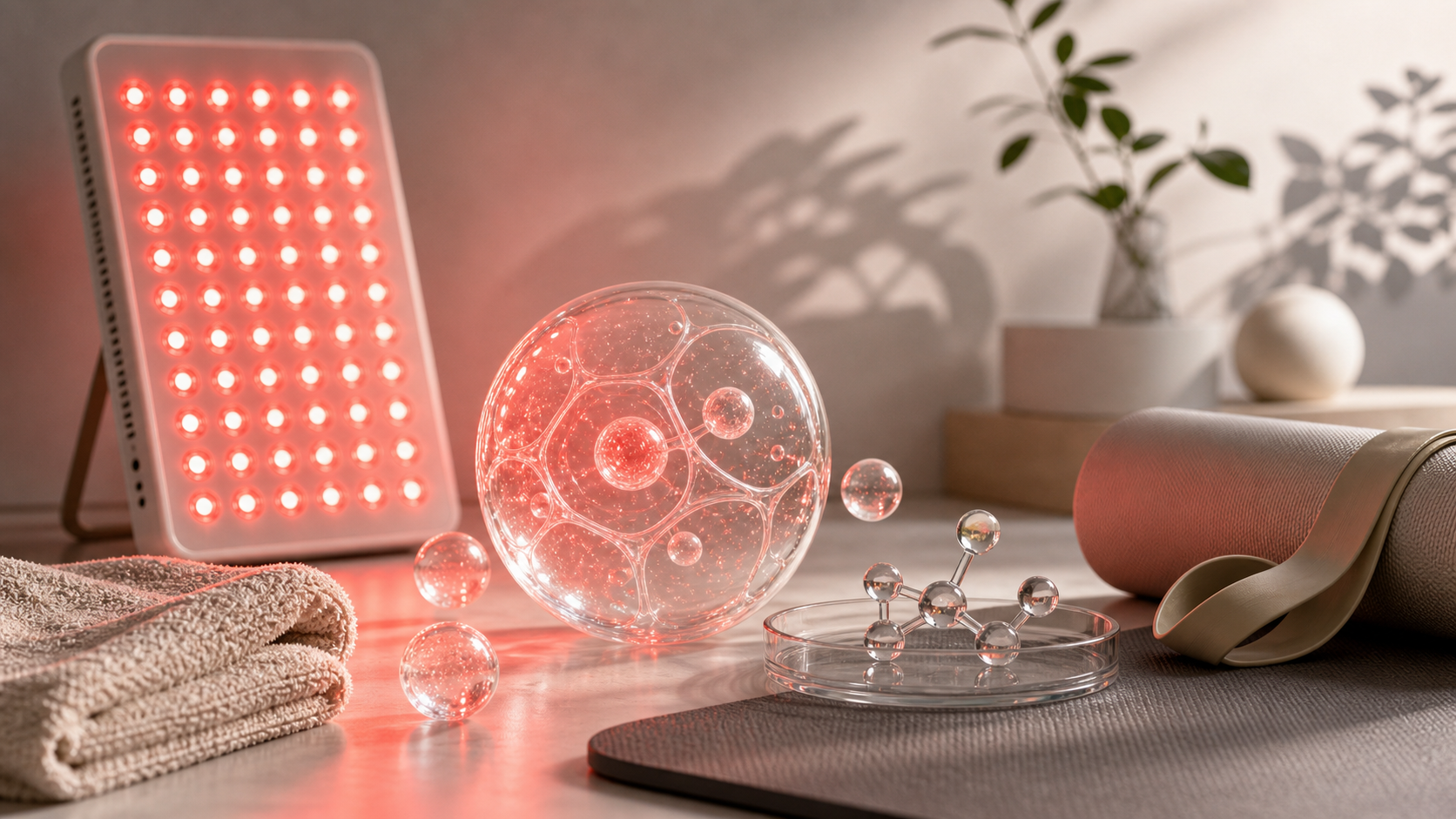
Red light wellness uses specific narrow wavelengths of visible red light (around 660 nm) and near-infrared light (around 850 nm) to interact with cellular structures — primarily cytochrome c oxidase in mitochondria — without producing significant heat.
The mechanism, technically called photobiomodulation, is the same regardless of the application. Light absorption may support mitochondrial function, modulate cellular signaling, and influence inflammatory markers at the cellular level. The downstream effects vary by tissue, dose, and individual response. The full science is covered in our photobiomodulation guide.
Skin: collagen processes and microcirculation
One of the more studied areas of photobiomodulation research is its effect on skin fibroblasts — the cells responsible for producing collagen and other structural proteins.
Skin processes shift with age. Collagen synthesis slows. Microcirculation patterns change. The structural and surface qualities of skin reflect these underlying cellular changes over time.
What research has explored:
- Fibroblast responses to specific wavelength exposure in cell-culture settings
- Microcirculation changes in skin capillaries after red light sessions
- Skin texture and tone outcomes in small clinical trials
What this means practically: for midlife skin wellness, red light is one approach that may sit alongside a broader skincare routine — cleansing, hydration, sun protection, professional treatments where appropriate. It is not a replacement for any of those, and the changes observed in research generally accumulate slowly over weeks of consistent use rather than appearing acutely.
Sleep and circadian rhythm
Sleep quality often changes during midlife years, and research has explored how light wavelengths interact with the circadian system.
The key wavelength facts for sleep:
- Bright blue-rich light suppresses melatonin and promotes wakefulness — useful in the morning, disruptive at night
- Red and near-infrared wavelengths produce minimal melatonin suppression compared to blue light
- Bright light exposure in the morning helps anchor circadian rhythm; evening light should be lower and warmer-toned
Red light wellness sessions in the evening may be more compatible with sleep than other forms of indoor lighting because of the wavelength characteristics. Whether they actively support sleep is a separate question — the research base for red light specifically as a sleep wellness practice is preliminary, with some small studies suggesting effects on sleep quality measures and others showing little change. Our sleep and circadian guide covers what research has explored.
Recovery, energy, and daily wellness
Cellular research suggests photobiomodulation may support general recovery processes that matter at any age but may benefit from more active support in midlife.
What the research has explored:
- Muscle recovery markers after exercise sessions in athletes and active adults
- Cellular ATP production and mitochondrial function in various tissue types
- Microcirculation effects relevant to recovery
For midlife users, this matters in the context of broader routines — movement that's harder to recover from than it once was, longer days where the cumulative effects of stress are more noticeable, and the value of practices that support cellular function. Our muscle recovery guide covers the research in more depth.
Joints and connective tissue comfort
Some research has explored photobiomodulation effects on joint comfort and connective tissue, with the deeper-penetrating 850 nm wavelength being the more commonly studied for this area.
Joint comfort tends to be more variable in midlife. There are many factors involved — cumulative wear, activity patterns, hormonal changes, hydration, and general inflammatory status. Red light wellness may be one supportive practice some users incorporate, used over specific joint areas at moderate distance for 15-20 minute sessions.
What it is not: a treatment for diagnosed joint conditions. If joint pain persists, worsens, affects daily activities, or causes you concern, that's a signal for professional evaluation by a healthcare provider — not a wellness device.
Session approaches for midlife wellness
If you've decided red light wellness fits into your routine, a few practical considerations:
Distance and time
For face sessions: 6-12 inches, 10-15 minutes. For body areas: 6-12 inches, 15-20 minutes. Our distance guide covers how distance affects intensity.
Frequency
3-5 sessions per week is the general framework. Consistency over weeks matters more than maximizing any individual session. Our frequency guide walks through specific schedules.
Time of day
Morning sessions pair well with skincare routines and may support daytime energy. Evening sessions integrate with wind-down rituals and don't disrupt sleep the way bright blue light does. Both can work — the right time is the one you'll actually stay consistent with. Our morning vs night guide covers the differences.
The biphasic dose response
More is not better past the optimal dose range. Stay within 10-20 minute sessions at recommended distances. Extending sessions does not produce proportionally more benefit, and may reduce response.
When to consult a healthcare professional
Red light therapy panels are general wellness devices. They are not medical interventions, and they are not substitutes for professional care. The transitions and changes that happen during midlife often warrant professional evaluation rather than self-managing with wellness devices:
- Persistent sleep disruption affecting daily functioning
- Joint pain that interferes with daily activities
- Significant or persistent skin changes
- Mood changes affecting quality of life
- Hormonal changes you want guidance on
- Any new symptom that concerns you
A qualified healthcare professional (primary care, gynecologist, dermatologist, or specialist depending on the concern) can assess your individual circumstances and provide guidance no general wellness article can substitute for. Red light wellness may sit alongside professional care in some routines, but it does not replace it.
Also consult a healthcare professional before starting any new wellness practice, including red light, if you:
- Take photosensitizing medications (some antibiotics, retinoids, certain antidepressants, some diuretics, some herbal supplements like St. John's Wort)
- Have a photosensitive medical condition
- Have a recent history of skin cancer or are being monitored for skin concerns
- Are pregnant or breastfeeding
- Have any concerns about how red light might interact with your specific situation
Frequently asked questions
How long before I might notice anything?
Different processes operate on different timescales. Skin processes typically take 6-12 weeks of consistent sessions before any observable changes. Subjective changes in recovery or energy can be hard to attribute to any single variable. Plan for 8-12 weeks of consistent use before evaluating whether red light wellness is something you want to keep in your routine.
Should I expect specific outcomes from red light?
No — individual responses vary widely, and red light wellness is supportive rather than primary. If you're looking for specific outcomes from any wellness practice, the foundations (sleep, movement, nutrition, professional care where indicated) are what move the needle.
Can I combine red light wellness with other practices?
Generally yes. The cellular mechanism is distinct from heat-based practices (sauna), pressure-based practices (massage), or movement-based practices (yoga). Red light wellness can layer onto a broader routine without obvious conflicts. For specific medical situations, consult a healthcare provider.
What about hormonal changes during midlife?
Hormonal changes during midlife years are a topic for a qualified healthcare professional — ideally a gynecologist, endocrinologist, or primary care provider with specific expertise. Red light is a general wellness device and is not a hormonal modality. Anyone navigating hormonal changes benefits from professional guidance, not wellness device-based self-management.
Is red light safe to use on the face for someone in midlife?
For most healthy adults, red light wellness has a benign safety profile when used as directed — with eye protection, at recommended distance and time. For individual medical situations, consult a healthcare professional first.
How does this differ from infrared sauna use?
Different mechanism. Infrared sauna uses far-infrared wavelengths that heat the body, producing cardiovascular and sweating responses. Red light wellness uses non-thermal wavelengths absorbed at the cellular level. They serve different purposes and are not interchangeable. Our comparison guide covers the full picture.
The bottom line
Midlife wellness is a topic where the foundations — sleep, movement, nutrition, stress regulation, professional care — do the heavy lifting. Red light wellness is one possible supportive layer that fits alongside those foundations for users who are already managing them.
The honest framing: red light wellness is not a treatment for any specific midlife concern, hormonal change, or symptom. It is a general wellness practice that some people incorporate alongside their broader routine. For anything beyond general wellness — persistent symptoms, significant changes, anything that concerns you — professional care is the right path, not a wellness device.
If you decide red light wellness fits into your routine, the SOLRA Red Light Panel delivers 660 nm + 850 nm wavelengths through 40 dual-chip LEDs with verified specs and honest irradiance reporting. $159-229 depending on stand configuration, with free US shipping and a 60-day money-back guarantee.
Frequently asked questions
How do red and near-infrared wavelengths relate to evening use and sleep?
Red and near-infrared wavelengths produce minimal melatonin suppression compared to blue light, so evening red light sessions may be more compatible with sleep than other indoor lighting. Whether they actively support sleep is a separate question, since the research for red light specifically as a sleep practice is preliminary.
What distance and session times does the article suggest for midlife routines?
For face sessions, 6-12 inches for 10-15 minutes, and for body areas, 6-12 inches for 15-20 minutes, with 3-5 sessions per week as the general framework. Staying within roughly 10-20 minute sessions reflects the biphasic dose response, where more is not better past the optimal range.
Can red light help with hormonal changes during midlife?
Hormonal changes during midlife are a topic for a qualified healthcare professional such as a gynecologist, endocrinologist, or primary care provider. Red light is a general wellness device, is not a hormonal modality, and is not a substitute for professional guidance.
How long before I might notice anything, especially for skin?
Skin processes typically take 6-12 weeks of consistent sessions before any observable changes, and subjective changes in recovery or energy are hard to attribute to a single variable. The article suggests planning for 8-12 weeks of consistent use before evaluating whether to keep red light in your routine.
Wellness Disclaimer: The information in this article is for general wellness and educational purposes only and is not intended to diagnose, treat, cure, or prevent any disease. SOLRA products are general wellness devices and have not been evaluated by the FDA. Individual results may vary. Consult a qualified healthcare professional before starting any new wellness practice, especially if you have a medical condition or are taking medications.
About this guide. Written and maintained by the SOLRA Team, who design and support the SOLRA Red Light Panel (660nm red + 850nm near-infrared light). Our guides focus on practical, comfort-first routines and use general wellness language rather than medical claims. Always follow your device instructions and consult a qualified professional about any medical condition. Editorial review: SOLRA Team · Updated June 2026.

Leave a comment
This site is protected by hCaptcha and the hCaptcha Privacy Policy and Terms of Service apply.